


Charles Rotblut leads a class in AAII's new Essential Investing Video Course. Go to https://www.aaii.com/ves for more information and to subscribe.
The standard deduction was claimed on 91% of tax returns filed in 2023, a significant jump from 68% in 2017. This increase is largely attributable to the near doubling of the deduction mandated by the Tax Cuts and Jobs Act (TCJA) of 2017. Unless Congress passes new legislation, the deduction will revert to pre-TCJA levels after December 31, 2025.
To illustrate how much the standard deduction has grown during the TCJA era, let’s revisit its historical changes.
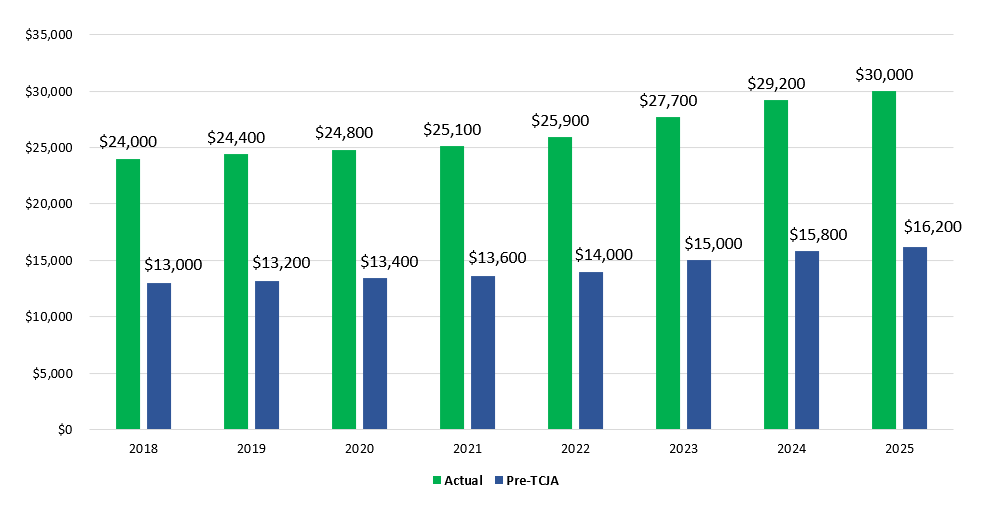
In 2017, the standard deduction for married couples filing jointly was $12,700 and was set to increase to $13,000 in 2018. However, the TCJA raised the standard deduction to $24,000 instead. Since then, it has steadily risen, reaching $29,200 this year and $30,000 next year.
Notably, while the higher standard deduction is slated to sunset, one key change from the TCJA will not: the adoption of the chained consumer price index (CPI) for inflation adjustments. Unlike the traditional CPI, the chained CPI accounts for shifts in consumer behavior when relative prices change, resulting in slower calculated inflation rates.
This permanent change allows us to project what the standard deduction would have been without the TCJA significantly increasing it. Applying inflation data since 2018 to the pre-TCJA deduction, we find a notable difference: In 2018, the TCJA increased the deduction for joint filers by $11,000, and by next year, it will be $13,800 higher than it would have been otherwise.
The future of the standard deduction depends on congressional decisions. Given its widespread use, there is likely to be pressure to maintain it at higher levels. However, your effective tax rate—the percentage of your total income paid out in taxes—depends on many factors, not just the standard deduction.
Figure 1. Actual vs. Pre-TCJA Standard Deduction (2018–2025)
The green bars represent the actual standard deduction, whereas the blue bars assume the deduction if the Tax Cuts and Jobs Act (TCJA) of 2017 was not in place.
Source: Internal Revenue Service (IRS) and AAII.

Discussion
FREE REPORT

Get your free copy of our special
report analyzing the tech stocks
most likely to outperform the
market.
BARRY J from TX posted almost 2 years ago:
RANDALL L from CA posted almost 2 years ago:
STERLING C from NY posted almost 2 years ago:
JOE D from CA posted over 1 year ago:
You need to log in as a registered AAII user before commenting.
Log InCreate an account