Cognitive Decline Worsens Investors’ Returns

Cognitive decline and behavioral biases reduce the investment performance of older mutual fund investors, with middle-aged investors achieving the highest returns while older groups experience lower returns.

Cognitive decline and behavioral biases reduce the investment performance of older mutual fund investors, with middle-aged investors achieving the highest returns while older groups experience lower returns.

A detailed analysis of over 206,000 mutual fund accounts in China examined how aging impacts investment performance. The research used transaction and demographic data from 2006 to 2011, including age, gender and portfolio size. Patterns in trading behavior, timing ability and the impact of prior stock market experience were also evaluated.
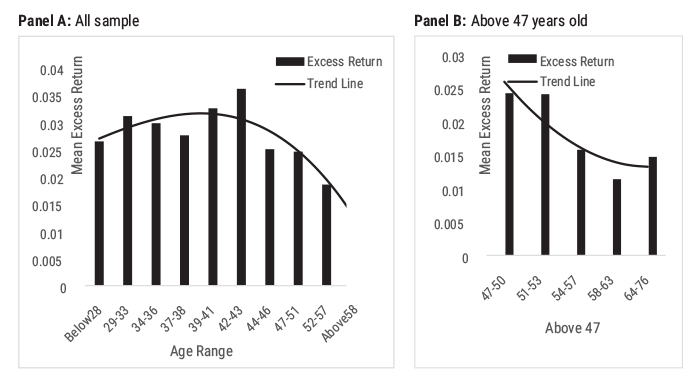
The research found that investment performance follows an inverted U-shaped pattern, with middle-aged investors achieving the highest returns. Panel A in the chart below shows that middle-aged investors, especially those ages 42 to 43, earn the highest returns. After this peak, performance drops as age increases. Panel B, which focuses on investors over age 47, highlights this decline. Retirees (ages 64 to 76) see a small improvement in returns, likely because they have more time to focus on managing their portfolios. However, they still earn less than middle-aged investors.

Part of this may be due to overconfidence. Experienced investors may be more likely to attribute their success in the market to personal skill. To the extent they exhibit this bias, they are overconfident when judging the risk of future investments.

The study’s authors also found that regions with better education and stronger economies reduce, but do not eliminate, the negative effects of aging on investment results.

Several ways individual investors can address the challenges posed by cognitive aging are presented. The study’s authors suggest seeking professional financial advice to help mitigate potential losses associated with cognitive decline. The researchers emphasize the importance of education for all investors, particularly retirees, to understand the risks associated with cognitive aging and behavioral biases. Most notably, lifestyle changes, such as increased leisure time after retirement, can mitigate the negative effects of cognitive decline.

Source: “Older investors at a loss: Cognitive aging and funds returns,” by Zhongtai Li, Jia Liu and Yanran Wu; SSRN, November 12, 2024.

Discussion

JOHN L from NJ posted over 1 year ago:

From age 47 to 76 mean excess return drops 1%. And the author's recommendation is for older investors to hire a professional investor whose advice will probably cost 1%. I am impressed that the mean excess return is positive for all age groups. Just like in Lake Wobegon; everyone is above average!


ROBERT A from NC posted over 1 year ago:

Conventional wisdom has told older people to invest more of their money in fixed income. Maybe following that "wisdom" had something to do with the diminished returns for older people.


R W from PA posted over 1 year ago:

Another factor that wasn't mentioned is that younger investors are more aware of new investment trends. They are quicker to recognize and adopt these new trends. If one's returns are sufficient to meet one's needs or even exceed those needs, why would one be concerned that there are others who are younger doing better?


BENJAMIN L from NJ posted over 1 year ago:

As the paper points out, there is an uptick in the performance with people above the age of 64, which may mean retirees have more time to focus on the stock market and where they put their money than those in their 50's. Younger people may take more risks and get higher returns. So not sure cognitive decline should be necessarily the main driver of performance but other factors like 1) available time spent on investing, 2) risk taking by age group.


THOMAS S from MN posted over 1 year ago:

I believe the authors of the above article in "Dispatches" have reached an erroneous conclusion about senior investors. They have not considered that, as investors age, their goals change and their investment strategy changes resulting in lower returns. I believe that, as investors age, they purposely change their allocation to more fixed income and cash investments while reducing investments in securities. I believe that is the most prominent reason for declining returns as investors age, not cognitive decline. I have followed Modern Portfolio Theory in my 60 plus years of investing. I have generally followed an asset allocation of 110 minus age to determine the percentage of my portfolio to invest in securities. I am now in my late 80's and have reduced my security allocation to about 30%. This obviously reduces my overall returns vs a more aggressive portfolio of say 60% (110 - 50 years age). It is logical to reduce security holdings as one ages because (1) I have built my/our wealth to an acceptable level and (2) i do not have enough remaining years to affect a recovery from a severe market loss. Sincerely, Thomas W. Segar, a Lifetime AAII member.


You need to log in as a registered AAII user before commenting.
Create an account

Log In

Get your free copy of our special report analyzing the tech stocks most likely to outperform the market.

Download the FREE Report Here: