

Related

Financial Planning
Insights from our personal experiences can help you prepare your loved ones to handle the financial planning and management needed after your death.

Charles Rotblut leads a class in AAII's new Essential Investing Video Course. Go to https://www.aaii.com/ves for more information and to subscribe.
My wife and I gained significant knowledge about elder care from helping both of her parents. Some lessons came from the benefits of prior planning, while others were learned by handling challenges in real time. Key insights from our personal experiences can help you prepare.
Among the earliest signs of dementia is the inability to manage one’s finances. Difficulty balancing a checkbook, trouble understanding a credit card statement and making poor investment decisions are all signs of cognitive impairment.
After my father-in-law passed, I began assisting my mother-in-law with her finances. My role of monitoring her accounts online gradually evolved to reviewing the statements with her and then being in complete control.
My wife and I found it helpful to forecast my mother-in-law’s income—including required minimum distributions (RMDs)—and expenses. This allowed us to project when she might be at risk of outliving her money. Fortunately, there was always enough to pay for her care.
Though it can be tough to pass oversight to someone else, allowing a trusted family member to look over your shoulder and gradually assist can be very helpful.
Even though I write AAII’s annual tax guide, preparing my in-laws’ taxes for the first time was daunting. I had to read through their tax return carefully to figure out what my father-in-law was reporting, what deductions he was claiming and what documents I needed. Fortunately, he showed me where he kept his tax returns before he died. That was a huge help.
If you work with a tax professional, make sure your children know who they are and how to contact them. It is a good idea to introduce your children to all of the key professionals you work with financially and medically. (My wife was in contact with her mother’s internist and specialists.)
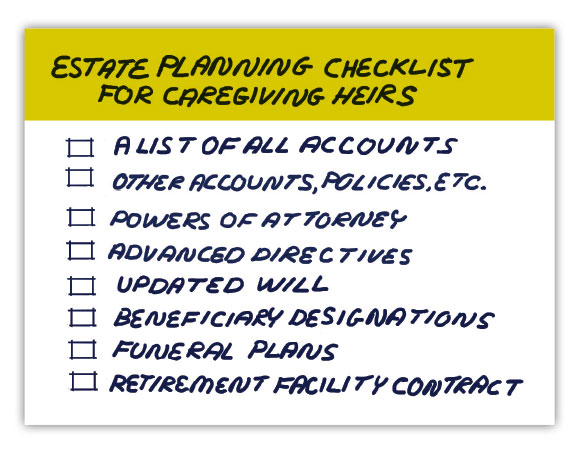
Several key estate documents will help ensure your wishes are carried out.
Make sure yours is updated. Laws change over time, as do families. Fortunately, my in-laws updated their wills.
These will make it easier for someone you trust to advocate for you when needed. The medical power of attorney was invaluable for my wife, allowing her to speak with doctors, access medical records and resolve health-care-related issues.
These were our guiding principles for making late-in-life medical decisions for my mother-in-law. She filled out a detailed form about what she did and didn’t want. We also recommend discussing your wishes with those who will make decisions on your behalf.
Executors, both current and contingent, need access to these documents to help them execute a trust, including establishing, transferring or closing any necessary accounts. In addition, ensure the current and contingent executors know the taxpayer identification number (TIN) for the trust. This will help with issuing tax forms as well as filing the trust’s tax returns.
Do not assume that your heirs or even your spouse/significant other know all the accounts and policies you have. Create a list of every bank, credit union, brokerage and mutual fund account you have. Do the same for any pensions, 401(k) plans or individual retirement accounts (IRAs) you have. Include all credit cards and loans.
Don’t forget about your various policies (life insurance, health insurance, homeowner’s, auto, etc.). Beyond those, note your utilities and mortgage provider. A list of who to pay and what to cancel is very helpful for your heirs, and spouse.
List out anything that needs to be canceled. You may have a cell phone plan, cable TV service, streaming service subscriptions, club memberships and magazine subscriptions that need to be canceled. A list of these will make things easier for your heirs.
In today’s electronic age, being able to access digital accounts matters. After my father-in-law passed, my wife set up digital access for my mother-in-law’s accounts, including her pension. Email accounts and anything you use two-factor authentication for should be included on the list.
If you have a physical safe, your heirs will need to know the code to get into it. Locking key items in a fireproof safe is a smart move; making it difficult to open for those who need access to what is inside isn’t.
Your family members may need copies of the policy benefits, limits and exclusions to either file for or fight for benefits on your behalf. Be sure to list the policy numbers with the actual policies.
If you live in an independent, assisted living or other type of retirement community, share a copy of the contract with your children. There are various stipulations about moving out of the property in those contracts that they should be aware of. For example, my mother-in-law was at a Brookdale independent living community that required 60 days’ notice before we moved her to assisted living.
Your military ID, dates served and discharge papers can be invaluable. We needed my father-in-law’s documents to arrange his funeral at Fort Sam Houston National Cemetery. The documents also matter for those who may qualify for care from a U.S. Department of Veterans Affairs (VA) facility and/or the VA’s Aid and Attendance benefits.
There is one other key document your heirs will need: a list of where everything is located. Physically show your heirs where everything is. Before his passing, I followed my father-in-law around his house with a notebook, writing down where the various documents were kept. This proved immensely helpful.
These actions can also help heirs better take care of your estate.
Safe deposit boxes are frozen upon the owner’s death. It is best not to keep documents like your will, trusts and other related items in a safe deposit box.
My in-laws prepaid for their final arrangements. There were no questions about what they wanted. We also didn’t have to worry about purchasing a plot, deciding which casket to buy, etc.
If you live in a different area from your intended resting place, it is smart to allow your children to consult a local funeral home in advance. My wife did this while her mother was still alive, and it was very helpful. The local funeral home seamlessly handled all the logistics of transporting my mother-in-law from Illinois to Texas.
You likely have more physical objects than you realize. They may be heirlooms, photos, jewelry, furniture, electronics, appliances and/or sentimental tchotchkes. Add in books, clothes, shoes, household supplies and paperwork, and the list keeps growing.
Once you die, your heirs will have to figure out what to do with all of it. While there are certain things they will want, much will need to be sold, donated and disposed of. Sort through your belongings while you’re physically able, and discuss with your heirs what they may or may not want.
Another advantage is that you’ll have fewer belongings to move, especially if the new place is smaller.
Estate planning is about more than just documents—it is about family. Your heirs want to know how to help you and what types of care you desire. Talk to them. Express your wishes. Ask them what would help them. Most importantly, share your values, family history and love with them.
Financial Planning

PRISM Wealth-Building Process

Financial Planning

Robert D from LA posted over 1 year ago:
ROBERT A from NC posted over 1 year ago:
You need to log in as a registered AAII user before commenting.
Log InCreate an account