How Fear and Overconfidence Directly Affect Market Behavior

Investor emotions cause asset mispricing, which leads to temporary market inefficiencies.

Investor emotions cause asset mispricing, which leads to temporary market inefficiencies.

Researchers examined the relationship between emotions and performance by developing stock emotion betas and studying their effects on stock returns. The study employed regression models to assess how investor sentiment influences market returns over time. High-emotion beta stocks were found to have traits of being small, growth, less profitable, more volatile and illiquid.
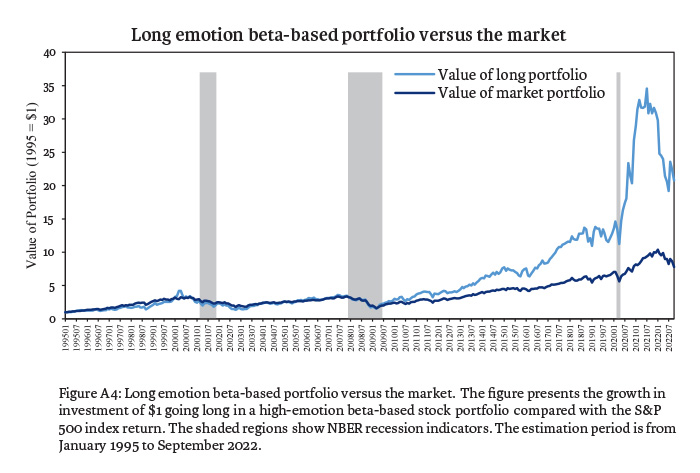
Long emotion beta-based portfolio versus the market

The results show that investor emotions have a measurable effect on performance. However, a market premium is only generated for about six months, suggesting that the influence of emotions on performance is temporary and short-lived.

The researchers propose that a trading strategy taking a long (short) position in high- (low-) emotion beta stocks can complement other active trading strategies. During the 1995–2022 study period, their long-short emotion beta-based trading strategy generated an annualized excess return ranging from 6.36% to 9.00%. The researchers stress that while emotions can provide opportunities for a short-term premium, these opportunities diminish over time as market participants adjust.

For investors, the study reinforces the lesson that understanding the impact of emotions on asset prices and performance can help manage risks. The uniqueness of this study is its focus on emotions directly related to the actual investment decision, whereas most research examines incidental emotions, such as sentiment.

Source: “Investor Emotions and Asset Prices,” by Shehub Bin Hasan, University of Reading; Alok Kumar, Miami Herbert Business School; and Richard Taffler, Warwick Business School; November 2024.

Discussion

BARRY J from TX posted over 1 year ago:

Tudor, thanks for the tip to read this study. I misread your review to think it was about MY PERSONAL (any individual investor’s) emotions that the authors studied. When I downloaded their article, it became clearer, and made more sense, that the authors were ATTEMPTING to study (and therefore create) "collective" emotions (Is that possible? Or is that an artifact of INFERRED from bestowing names on past EFFICIENT market behaviors?) of the "collective" (or merely aggregated and labeled?) actions of unorganized participants," not individual participants. (Thus, a "egg or chicken" issue?) Believe me, we AAIIers do NOT have any meetings outside the Michigan Ave clubhouse, and we hardly ever agree on anything that can be characterized as a "collective emotion." The authors were trying to CORRELATE the length of performance of historical long-short portfolios -- the preferred tools of the market anomalies / factors crowd (Fama and French et al) – size, value, quality, growth, and momentum, etc. -- to superior market alpha during recent market “runs.” Like most second/third tier “researchers,” they found and bagged the pink elephant they were tracking. The elephant rifle they used to bring down the “collective market emotions” beast was tables and tables and tables of “just so” data anchored in “fuzzy” definitions of “collective" and "emotions” (the proverbial elephants in the room) which they stuffed and mounted as a NEW “anomaly” in their trophy room then went over to South Beach for mas mojito. My take: they were trying to justify the existence of a phantom “emotional market premium” as the source of (current and past) market over-valuations rather than the simpler Occam's Razor, "efficient market" price movements. Interesting? As "they" say, “Yes, No.”


ROBERT A from NC posted over 1 year ago:

The author starts off well: "Investor emotions cause asset mispricing, which leads to temporary market inefficiencies." Warren Buffett has been saying that for decades. Unfortunately, the rest of the article is about as useful as a bagpipe on a deer hunt. I will take my friend Barry's word for the utility of the underlying study.


You need to log in as a registered AAII user before commenting.
Create an account

Log In

Get your free copy of our special report analyzing the tech stocks most likely to outperform the market.

Download the FREE Report Here: