

Related

Behavioral Finance
How one longtime market observer became a big believer in behavioral finance over the years.

Charles Rotblut leads a class in AAII's new Essential Investing Video Course. Go to https://www.aaii.com/ves for more information and to subscribe.
Bob Pisani is the senior markets correspondent at CNBC. He is also the author of “Shut Up and Keep Talking: Lessons on Life and Investing From the Floor of the New York Stock Exchange,” (Harriman House, 2022). I spoke to Pisani about the investing insights he has picked up throughout his career, including his embracement of index investing and behavioral finance.
How do you decide what to report on? I’m sure you get a lot of information and hear from a lot of people every day.
You come in in the morning and there’s a whole bunch of sticky notes on the wall. Each one has some fact about what’s happened that morning or the night before. They’re facts that you think are somehow relevant, and your job as a journalist is to connect those facts.
That’s what journalism is. Journalism is making a narrative out of facts that exist out there. You can weave in people’s opinions, of course, because a lot about the stock market boils down to opinions.
I found my old 1999 contact list a few years ago and I was amazed that I was talking to 500 people. Today, I speak to a fraction of that. Part of this is because Wall Street is smaller than it was in 1999. Plus, when you get older and more seasoned—this is my 32nd year at CNBC—you learn how to filter out information as well as sources.
To have a fairly well-informed opinion, you don’t need to talk to five oil analysts, or five Apple analysts if you’re an Apple reporter. To be a senior stock correspondent, you need a 30,000-foot point of view. So, what you really want is to talk to not hundreds of people but rather a smaller group of people whose opinions you respect and who you believe know what they’re talking about. They also need to give you an honest opinion.
I can’t give you a hard and fast rule, but I can tell you after doing it for 32 years that there are people I call and ask their opinion who are often not very famous at all but I think very highly of. There are other quite famous people who I don’t talk to that much because I don’t see much value in some of the things they say. It’s really a matter of seasoning.
For individual investors, any suggestions on how to decide what to pay attention to and what should be filtered out?
What I would really filter out is the urge to constantly trade. If there is any classic mistake that I have seen, it is the sudden urgency that you might feel to do something. In most cases, you’re wrong.
Vanguard founder John Bogle, who I talk about a lot in my book, is the person who had the single biggest influence on me. I met Bogle in the mid-to-late 1990s and it changed my life. One of the things he used to say is “Don’t just do something, stand there.” I know that sounds silly, but he meant that generally once you have a plan, deviating from it does not help.
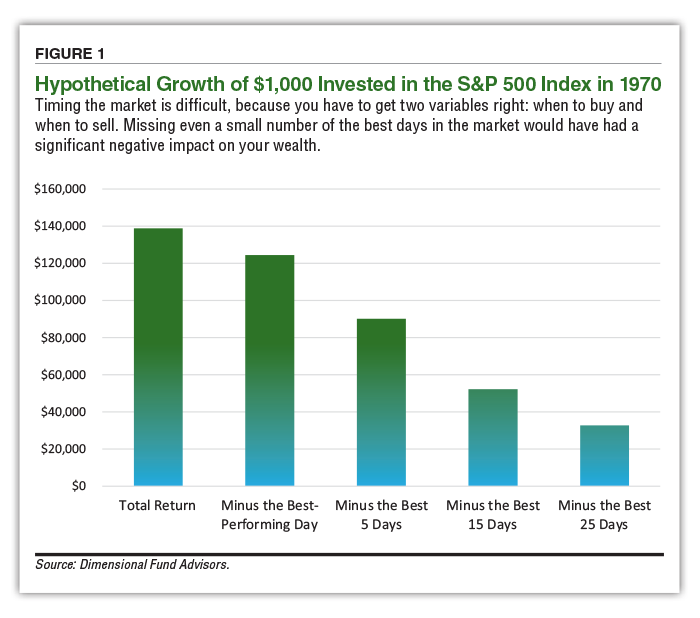
One thing we know is that in almost every case, market timing does not work. You have to be right going in and going out. The academic literature is overwhelming on this. The more that you trade, the more mistakes you make.
If you had $1,000 invested in the S&P 500 index in 1970, it was worth $138,908 50 years later, near the end of 2019. But if you weren’t in the market for the 15 best days over that period, you would only have $52,246, more than 50% less (Figure 1).
Nobody really knows when the best and worst days are going to come; therefore, it behooves you to stay in the market because the market overall tends to rise over time. It’s very simple mathematics when you really look at it.
The S&P 500 has gone up 72% of the time year over year since 1926. And it tends to go up a lot. The S&P 500 has risen by 10% or more during 56% of the years since 1926. The S&P 500 is down 10% or more only 12% of the time. Now, obviously, there can be several years where you’re flat to down like we’re experiencing this year. But, statistically, over the long term you want to stay with the market. If there’s anything that has become glaringly obvious to me over 30 years, that’s it.
Since you mentioned Bogle, it might surprise some people that you are a big proponent of index investing given who you talk to on a daily basis.
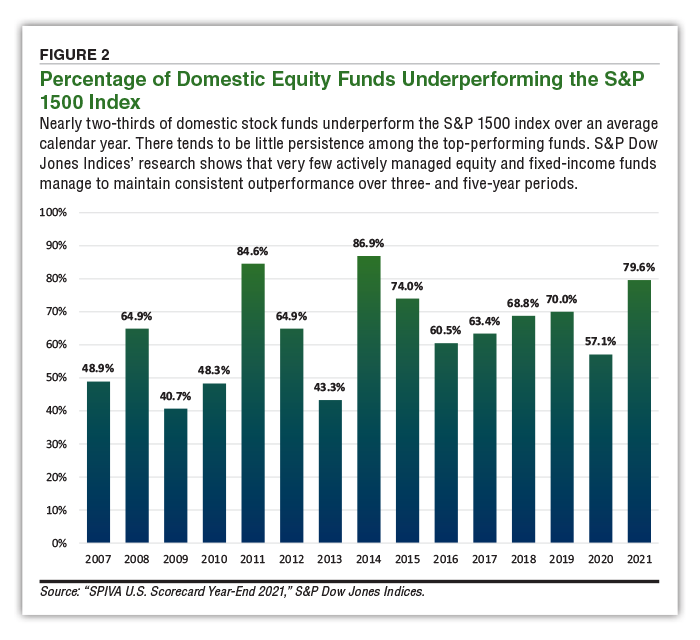
The evidence is overwhelming that active stock picking is not a very successful endeavor. It’s extraordinarily difficult to do.
You’ve seen the studies, Charles. The one that I follow the most is the S&P Dow Jones Indices annual SPIVA report (Figure 2). They track active managers and have been doing it for 25 years. Most active managers do not outperform their bogeys. Over 10 years, 90% of big-cap active fund managers underperform their bogey.
I think you can ask yourself a very interesting question: Why is everyone bad at this? It’s not just amateur stock pickers that are bad, portfolio stock pickers are bad too. Economic forecasting is also terrible. The Federal Reserve’s record of economic forecasting, even projecting gross domestic product (GDP) a year out, is terrible.
If you’re around for a long time, you have to look at this and ask “What is going on? Why can’t anybody get anything right?”
There are two big reasons. First, predictions are riddled with biases that limit the quality of the prediction. These biases infect people’s opinions and make it difficult to get accurate forecasts. Second, we don’t have complete information because events happen that are unpredictable and they are going to affect the outcomes.
Think of being a stock analyst whose job is to predict what earnings are going to be like for a company a year from now. There are millions of variables, each of which can affect the outcomes. Some of them are predictable but many are unknowable. When you figure this out, you become a lot humbler.
That leads to another question. You wrote quite a bit about how, in your earlier years, you sought out a “Wizard of Oz” for the financial markets. Could you comment?
This was a fun part of the book to write. In the late 1990s, I was still looking for what I call “The Wizard of Oz”—somebody behind the curtain who knew everything. I wouldn’t need to speak to 500 people, because I would only need to talk to a few people who knew everything.
This is a stupid idea, but I spent several years chasing traders down. I was looking for some world view that would be perfectly informative so that I could sound like a brilliant sage when I was talking about the stock market. Of course, it didn’t exist. But along the way, I did talk to some famous traders about how they approach the market.
The one overwhelming thing that professional traders did to protect themselves was to know when to limit losses and walk away. So many people used to say, “The gains will take care of themselves, it’s the losses that kill you.” Alan “Ace” Greenberg, the former head of Bear Stearns, used to say, “When the going gets tough, the tough start selling.” E.E. “Buzzy” Geduld, who ran Herzog Heine Geduld—one of the two biggest Nasdaq market makers for years—used to say, “Praying is for Saturday and Sunday, not Monday through Friday.” So, limit your losses and don’t fall in love with stocks.
My father was a real estate developer. He used to tell me, “Robert, unless you’re talking about the house you own, it’s a business.” Don’t fall in love with a piece of real estate because you’re going to overpay, you’re going to make a mistake. It’s true with stocks too, don’t fall in love with them.
Regarding the New York Stock Exchange’s (NYSE) trading floor, you have had a front-row seat to the emergence of electronic trading. What impact has this change had on individual investors?
When I got to the NYSE in the 1990s, there were 4,000 people on the floor. They did 80% of the volume. Today, there are 200 guys doing 15% to 20% of the volume.
A lot of other things happened besides the birth of electronic trading. We had changes in pricing structure. When I first started reporting from the NYSE in 1996, stocks were trading in eighths of a dollar. It was a very profitable business to trade in eighths. By 1997, the exchange had gone to sixteenths, six-and-a-quarter cents, as a spread. In 2000, they went to pennies. This collapsed the profitably of the broker system.
Basically, what you saw was technological disruption. As nostalgic as I am about the NYSE floor, it was necessary to have this disruption because it made the overall trading experience, in my opinion, better. Commissions are low or nonexistent, bid/ask spreads are lower and the consumer has gotten, I think, a much better deal.
You also wrote about some mistakes you’ve learned over your career. Would you mind sharing a few of those?
It’s amazing to me that I’ve been with CNBC for more than 30 years and almost nobody asks me what I own. Rather, people will typically stop me and ask what I think of the markets. And by that they mean three to six months; they want a short-term view.
So, I set out to describe my investing journey, which began in the early 1990s when I was hired by CNBC. I had a 401(k), and I opened a Vanguard account for my wife in the late 1990s after talking with Bogle.
As a reporter at CNBC, I’m not allowed to own individual stocks or bonds. I’m allowed to own mutual funds, exchange-traded funds (ETFs) and shares of our company. At the time, General Electric Co. (GE) owned NBC. So, the first thing I did was go out and buy a lot of General Electric stock. By 1999, about 50% of my 401(k) account was in General Electric.
Now, not owning too much of your own company’s stock in your retirement portfolio is a prudent rule. It’s too much risk. Yet, I knew what was going on and I was still making a mistake. The bias I had was overconfidence, in this case in General Electric and particularly in CEO Jack Welch.
I knew him and it is hard to describe the influence Welch had on my generation. He was the number-one CEO in America, and I was buying General Electric stock as a way of saying “I believe in Jack Welch.” That is a classic bias—overconfidence, which is the mother of all biases.
I paid dearly for it because Welch eventually retired in 2000. After the recession combined with the dot-com bust and then 9/11, the stock market was not willing to pay owners of General Electric the multiple they wanted. So, the stock’s price went down.
The second mistake I made was that I didn’t sell until probably early 2008 when shares of General Electric started dramatically dropping. Yet, there I was with that overconfidence in the company.
How could I have made these two basic mistakes when I knew better? It is the power of biases in our heads. That’s when I finally understood what I didn’t understand in 1993: the biases and how they infected my brain. And even when I knew it, I still did not act in accordance with the right principles. That’s how powerful biases can be.
One thing CNBC viewers may not realize is that you embrace behavioral economics.
Yale professor Robert Shiller had a big influence on me. He found that the market’s level of volatility was much higher than you would expect if the market traded on rational fundamentals like the future stream of earnings and dividends. This led him to conclude that there was a certain irrational component to investing where people essentially did not do rational things.
If the market’s always trading at the right price, then there’s a certain irrational component in stock investing that affects the market. The reason is that there are emotional biases.
Shiller and others have identified two groups of these biases.
There are cognitive biases that happen because you have faulty reasoning—an emotional bias like loss aversion. People feel a loss more than they feel a gain. These people hold onto losing stocks for a long time. People are overconfident. They come to believe they’re infallible when they hit a winning streak. Or they believe that their boss is infallible, like I did with Welch. People also engage in herd behavior and will blindly follow what others are doing.
Then you have cognitive biases where people think poorly. People jump to conclusions based on very limited information. They decide they’re going to do something without really thinking it through. They don’t have complete information. People select information that supports what they want to believe—this is known as confirmation bias. Then there’s the gambler’s fallacy. Just because a stock has done well in the past people think it will do well in the future.
I became a very big believer in behavioral finance in the 2000s because I saw irrational behavior. When the market bottomed in March 2009 during the great financial crisis, you’d think people would have started buying. We didn’t know it was the bottom at the time, but unless you think the economy’s going to zero, you don’t sell when the market is down 50%. You buy or hold, but that’s not what happened. Selling accelerated when we hit the final down leg of the 2007–2009 bear market.
Behavioral economics purports to study how people really behave, not how they’re supposed to behave as rational actors. So, a few things were obvious to me by then.
First, behavioral finance gave a big boost to the whole passive investing crowd. Passive investing reduces or eliminates a lot of those biases. You’re just going with the market. Second, I don’t go crazy about efficient markets anymore; stocks can be mispriced on a fundamental basis. That seems pretty clear. The last and most important thing is that I think it’s possible to train people to think more rationally about investing. But, honestly, I don’t expect too much because I think investing wisdom is really in short supply.
Think about this. AAII exists to get more investing wisdom out there, and you do a great job. But financial illiteracy is widespread, and people have no idea about investing fundamentals—despite your best efforts, our best efforts and everyone else’s best efforts.
Furthermore, even people who know better continue to make dumb mistakes because overriding the brain’s tendency to act first and think later is really hard. And I hold myself up as an example of that. I have become much humbler over the last 20 years as I’ve come to understand behavioral economics much, much better.
Behavioral Finance

Portfolio Strategies

Portfolio Strategies

BILL N from FL posted over 3 years ago:
ROBERT A from NC posted over 3 years ago:
DAVID P from FL posted over 3 years ago:
ELLIOTT B from FL posted over 3 years ago:
Peter N from TN posted over 3 years ago:
You need to log in as a registered AAII user before commenting.
Log InCreate an account