


The key drivers of equal-weighted portfolios outperforming value-weighted portfolios over multiple decades in various investment universes was the focus of a Lancaster University study.
Equal-weighted portfolios invest an equal amount of money in each company’s stock that makes up the portfolio. In value-weighted portfolios, individual components of the portfolio are included in amounts that correspond to their total market capitalization, so that larger-company stocks receive a higher weight.
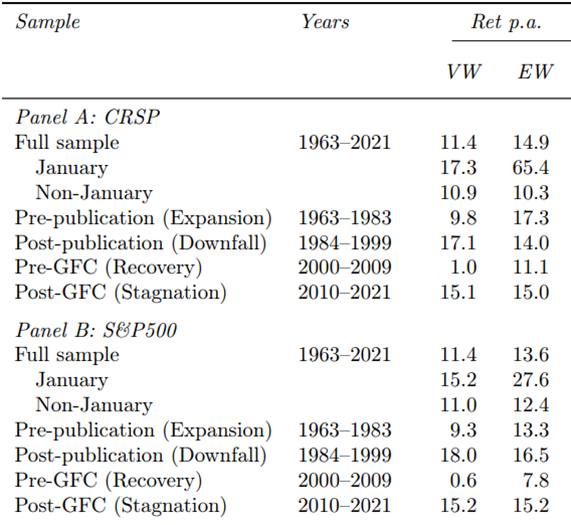
Between 1963 and 2021, an equal-weight portfolio comprising the entire universe of stocks outperformed similar value-weight portfolios by 3.5%; an equal-weight portfolio of S&P 500 index stocks outperformed by 2.2%.
The researchers found the size factor to be “the most significant driver of the performance” difference between the equal-weight and value-weight portfolios. The size factor refers to the long-term outperformance of small-company stocks relative to large-company stocks. The study further found a strong impact of size during January, when smaller-company stocks have tended to outperform.
The Effect of Equal-Weighting Across Sample Periods and Universes
Other factors at play are momentum (outperforming stocks tend to continue outperforming) and volatility. The spread (difference) between equal-weighted and value-weighted portfolios was found to be negatively correlated with momentum, due to the regular rebalancing used by equal-weight portfolios. Volatility was also shown to be negatively correlated with the spread.
In summary, over time an equal-weight portfolio has historically resulted in a higher return than that of a value-weight portfolio due to giving greater exposure to small-cap companies. Equal-weight portfolios rebalance more, which can provide a benefit from short-term reversals, but also have a negative result from momentum exposure.
Source: “Why do equally weighted portfolios beat value-weighted ones?,” by Alexander Swade, Sandra Nolte, Mark Shackleton and Harald Lohre; Lancaster University, 2022.

Related

Discussion
FREE REPORT

Get your free copy of our special
report analyzing the tech stocks
most likely to outperform the
market.
No comments have been added yet. Add your thoughts to the discussion!
You need to log in as a registered AAII user before commenting.
Log InCreate an account