

Related

Beginning Investor
By understanding how compounding works, starting early, reinvesting earnings and staying consistent, you set yourself up for success.

One fundamental financial principle distinguishes successful long-term investors from the rest: compounding. Compounding is a powerful mechanism through which wealth accelerates as capital gains and income begin to generate their own returns over time. Understanding how to harness the power of compounding can help modest investments grow substantially.
Time, reinvestment and consistent investments will help fuel returns, but there are pitfalls to beware of and avoid.
At its core, compounding is the process by which an investment generates earnings that, in turn, generate their own earnings. This contrasts with simple interest, where only the original principal, or initial amount invested, earns interest.
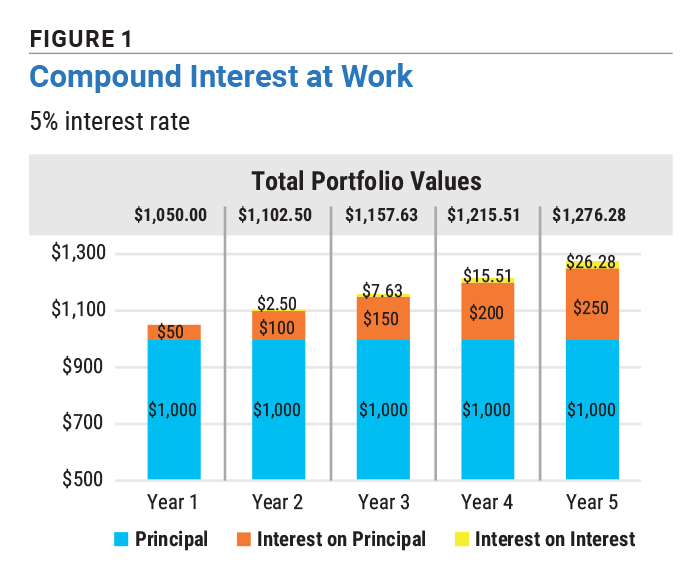
With an interest-bearing asset, the initial interest payment is calculated based on the starting balance—e.g., 5% interest earned on $1,000 is $50 of income. Assuming no withdrawals, all subsequent interest payments are calculated on both the original balance and the accumulated interest (“interest on interest”). This allows a savings account earning a 5% interest rate to grow to $1,276 after five years, rather than just $1,250 with simple interest (Figure 1).
The same concept applies to loans where the total interest charged increases if the principal is not reduced over time.
Initially, the effects of compounding on a portfolio may appear modest. However, over time, the impact grows exponentially as interest accumulates on both the principal and the previously earned interest. For instance, a $1,000 investment with a 10% annual return—reflective of long-term large-cap stock performance—can grow to over $17,000 over 30 years, assuming no withdrawals (Figure 2).
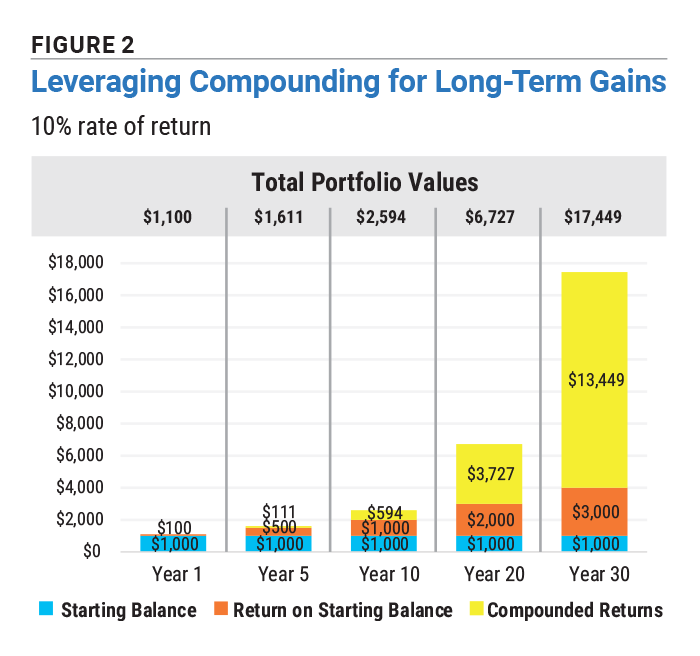
This exponential growth underscores the importance of early and consistent investing, allowing compounding to work effectively over extended periods.
The Rule of 72 is a mathematically intuitive tool for understanding compound growth. This shortcut approximates how long it will take for your investment to double. Simply divide 72 by your expected annual return.
For example, if you expect a 7% return, it would take approximately 10.3 years to double your money (72 ÷ 7). Your investment would then double approximately every 10.3 years, provided no withdrawals are made. This rule isn’t exact, but it’s remarkably useful for quick, back-of-the-envelope calculations. It reinforces why higher returns and longer time horizons make a dramatic difference in wealth accumulation.
In practicality, it can quickly provide context around investment decisions.
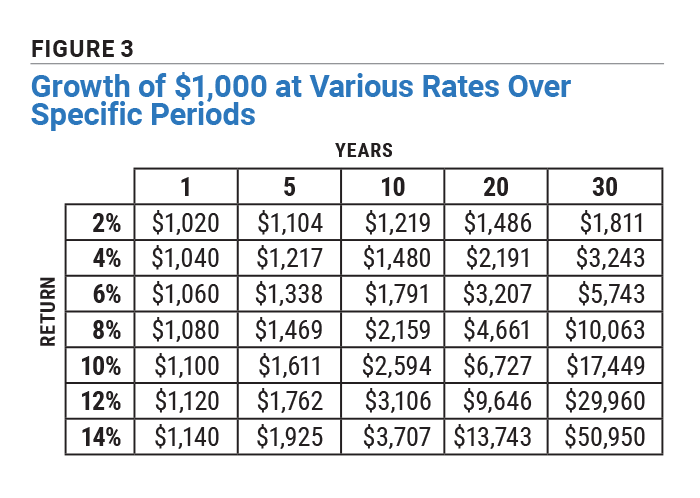
When it comes to compounding, time isn’t just helpful, it’s essential. The earlier you start, the more powerful the results. The duration of your investment and the rate of return are pivotal factors in growing your wealth. Figure 3 illustrates how a $1,000 initial investment can appreciate over time, assuming no additional contributions and various annual return rates.
The experiences of two investors demonstrate how time and compounding affect wealth. Henry and Helen have both bought new homes and note that in 20 years they will need to fund roof and siding replacements. Henry immediately invests $10,000 in a financial instrument paying 6% interest each year and leaves his money alone for the next 20 years. Helen decides to wait 10 years before acting. She then invests $2,000 each year at 6% for the next 10 years. Surprisingly, Henry has about $32,100 at the end of the 20-year period, whereas Helen has almost $28,000. Although Henry invested half as much as Helen ($10,000 versus $20,000), it had 10 extra years of compounding.
Not making your investment for five or 10 years can dramatically reduce your future wealth. Time lost is an opportunity cost.
Reinvestment is the fuel that drives the compounding engine. When you reinvest dividends and interest, you increase the base amount on which returns are calculated.
Most brokerages, including Charles Schwab and Fidelity Investments, allow investors to automate the reinvestment of dividends and capital gains. This facilitates the purchase of additional whole or fractional shares of the same stock, exchange-traded fund (ETF) or mutual fund. The process is commission-free.
Investors who take advantage of reinvestment programs benefit from compounding by owning more shares. The large number of shares creates more dividend income that can be reinvested again to realize even more compounding.
You can choose reinvestment for existing holdings or when purchasing a new security. Otherwise, cash received from dividends and capital gains will accrue to the cash component of your brokerage account.
Compounding benefits are also applicable to investments made within individual retirement accounts (IRAs) and workplace retirement plans, such as 401(k)s. Instead of taking your earnings out or placing them in a cash investment, you’re using them to generate additional returns—an effect that gains speed and size over time.
Another key to unlocking the full potential of compounding is making consistent contributions. Even small, regular investments can grow significantly over time.
Dollar-cost averaging—investing a fixed amount regularly regardless of market conditions—can reduce the impact of market volatility. It ensures you’re buying more shares when prices are low and fewer shares when prices are high, which improves long-term performance.
For example, $100 per month invested in a diversified portfolio over 30 years could grow to nearly $123,000 with a 7% return. Contrast this with trying to time the market and invest a lump sum at the “perfect” moment—a strategy that often leads to missed opportunities.
In the end, building wealth through compounding is less about timing and more about time in the market. Consistency beats perfection.
For more on building wealth over time, see AAII’s Lifetime Investment Strategy guide. It’s accessible by all AAII members and lays out a simple plan for investing, starting with establishing a cushion and moving through wealth accumulation to retirement.
Despite its power, compounding can be undermined by a few common mistakes. It’s important to watch for these dangers and sidestep them.
Patience and discipline will pay off. The market will have ups and downs, but staying invested and sticking to your plan allows compounding to do its job.
Compounding is not just a financial concept—it’s a mindset. By understanding how it works, starting early, reinvesting earnings and staying consistent, you set yourself up for success.
Modest investments, if given enough time and care, can blossom into significant wealth. Avoid the pitfalls, stay the course and let the power of compounding work in your favor.
Beginning Investor
Portfolio Strategies

Stock Strategies

ROBERT A from NC posted over 1 year ago:
BARRY J from TX posted over 1 year ago:
You need to log in as a registered AAII user before commenting.
Log InCreate an account