


Paul Merriman leads a class in AAII's new Essential Investing Video Course. Go to https://www.aaii.com/ves for more information and to subscribe.

Featured Tickers:
- Key differences between traditional and nontraditional index funds
- How factor-based strategies like small-cap value can boost long-term investment returns
- Research-backed reasons for considering custom index funds over standard index options
If you think all index exchange-traded funds (ETFs) and mutual funds are created equal, I have news for you: They aren’t. This is good news for investors willing to venture beyond core index funds like those offered by Vanguard, Fidelity, BlackRock and others.
The payoff of a nontraditional approach can be substantial, whether you’re seeking returns from a total market index fund or something more specific like small-cap value stocks. When I say substantial, I mean it.
My goals in this article are to:
- Clarify what a nontraditional index fund is;
- Differentiate it from an actively managed fund;
- Show some real-time results from nontraditional index funds;
- Explain how those results came about; and
- Suggest how you can use nontraditional funds to boost your returns without going too far out on a limb.
An Overview of Index Funds
Traditional index funds that follow well-known benchmarks like the S&P 500 index, the Dow Jones U.S. Total Stock Market index and the Russell 2000 index are relatively easy for investors to understand. They require little work from the fund managers. Most have extremely low recurring expenses, low turnover (hence, low tax impact) and often give investors exposure to hundreds or even thousands of companies in a single package.
Nontraditional index funds use additional criteria to select individual stocks, in effect creating custom bundles of securities to track asset classes such as small-cap stocks or small-cap value stocks.
For example, such a custom index may emphasize issues with momentum or quality of earnings. Based on the idea that a stock’s recent outperformance or underperformance is likely to continue in the short to medium term, momentum fund managers may buy more of the current overachievers and sell more of those stocks that are lagging. Momentum can also be applied to trends in profits or the published reports of analysts.
Although a nontraditional index approach is rules-based and mechanical, it requires a lot more management than a traditional index fund. That means higher expenses and strategies that can be harder for investors to understand.
Unlike traditional index funds that must conform to the makeup of indexes they do not control, nontraditional funds typically may rebalance their portfolios at any time. This lets them minimize trading costs and quickly take advantage of relevant changes in individual holdings.
These nontraditional funds are thus nimbler than the S&P 500. For example, the S&P 500 is typically reconstituted quarterly, near the end of March, June, September and December. The Russell 2000 has been reconstituted annually but announced that it will adopt a biannual schedule starting in 2026.
Is the nontraditional approach toward rebalancing a form of active management? I don’t think so. That said, I suppose you could use “active management” to describe any stock or bond index that’s subject to periodic changes.
Value Indexes Differ in Composition and Returns
Next time you see a reference to the large-cap value index or the small-cap value index, you might want to mentally substitute “a” for “the.” There are a half dozen of each. You might think of them as maps that all lead in the same direction, but to different destinations.
When you choose an index fund, you’re also signing up for the fund manager’s choice of which index to follow. And just like those maps, each index can take you to a different place.
In many years, their returns are quite similar. But occasionally the variations are great. In 2023, the best-performing large-cap value index outperformed its worst peer by 13.9 percentage points. In 2009, the best-performing small-cap value index outperformed the worst by 19.7 percentage points.
To show how much some seemingly arcane details can matter, let’s look at a group of six large-cap value indexes. They are listed from largest to smallest number of times during the most recent 16 calendar years that each landed in the top three for performance.
- The CRSP US Large Cap Value index uses the book-to-price, forward-earnings-to-price, historical-earnings-to-price, dividend-to-price and sales-to-price ratios. Its holdings fall within the largest 85% of the stock market based on market capitalization. It has been a top-three performer in this group during 12 of the most recent 16 years.
- The Russell 1000 Value index measures the performance of value stocks that are among the 1,000 largest publicly traded companies based on market cap. It has been a top-three performer during 11 of the most recent 16 years.
- The Wilshire Large Value index focuses on the largest 90% of the stock market based on market cap. Higher value scores are based on the book-to-price, cash-flow-to-price and forward-earnings-to-price ratios. It has been a top-three performer during nine of the most recent 16 years.
- The Morningstar US Large-Mid Value index uses five value factors and five growth factors. Its holdings fall within the largest 90% of the stock market based on market cap. It has been a top-three performer during six of the most recent 16 years.
- The S&P 500 Value index measures companies from the S&P 500 index that are classified as value stocks based on three factors: the ratios of book value, earnings and sales to price. It has been a top-three performer during six of the most recent 16 years.
- The MSCI USA Value index measures performance of large- and mid-cap companies based on the ratios of book to price and 12-month forward earnings to price, as well as dividend yield. It has been a top-three performer only once during the most recent 16 years.
I think the lesson is loud and clear: When you’re choosing an index fund, details matter.
The Subjective Side of Active Management
In most, if not all, mutual funds, managers apply fundamental decisions in choosing what companies to own. These are choices like growth versus value, company size, financial health as shown on balance sheets and income statements, and various ratios such as book-to-market and dividend yield.
Actively managed funds also rely on managers’ subjective judgments about things such as industry prospects and trends, strength of management, brands and competition, and even the credibility of corporate announcements. In short, actively managed portfolio decisions can amount to applying a “gut feeling” to choosing stocks and timing purchases and sales.
This sort of management is inevitably expensive, and it’s not what I recommend. So, my focus here is on index funds, both traditional and nontraditional.
Nontraditional Funds’ Better Mousetrap
If you’re managing a traditional index fund like the Vanguard 500 Index Admiral fund  (VFIAX), your main job is to make sure the portfolio includes the approximately 500 stocks in the benchmark index, in the right proportions. If you want to stand out from your competitors, there’s not much wiggle room, since you essentially have to look just like them. Your most likely path to success as a manager is to keep expenses as low as possible.
But if you’re managing a nontraditional index fund, your job is to find ways to “build a better mousetrap” so that your shareholders make more money over the long term. If you do that successfully and keep your costs down, your shareholders can get some very impressive returns. As we discuss later in this article, there’s a lot of academic research showing how this is possible.
Let’s turn to the small-cap value asset class for a comparison.
Table 1 compares three funds. To represent the traditional index camp, I turned to the iShares Russell 2000 Value ETF (IWN), which tracks the well-known Russell 2000 Value index, and the Vanguard Small-Cap Value Index Admiral fund (VSIAX), which seeks to track the performance of the CRSP US Small Cap Value index.
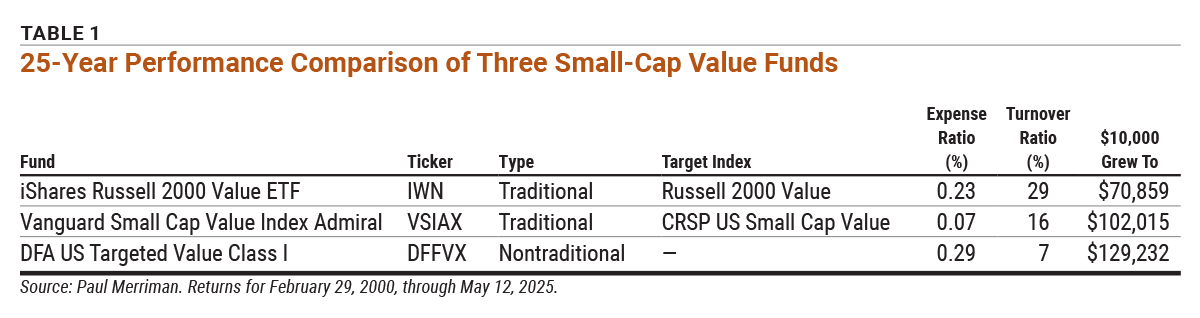
For the nontraditional side of this comparison, I chose Dimensional Fund Advisors’ DFA U.S. Targeted Value Class I fund (DFFVX). The mutual fund opened in the year 2000. Its goal is long-term capital appreciation from investing in the cheaper half of U.S. small-cap value stocks.
In the far-right column of Table 1, if you subtract the initial $10,000 investment, you’ll find that the actual gains range from $60,859 to $119,232.
That is an example of what I meant when I used the word “substantial” to describe the potential payoff from a nontraditional index fund.
Those results occurred over a period of more than 25 years. That’s generally considered long enough to be meaningful, while eliminating the noise of shorter-term market swings.
You may wonder: What has a nontraditional index approach to small-cap value done more recently?
Table 2 shows how these same three funds fared starting on September 30, 2019. (I’ll explain why I used that date momentarily.)
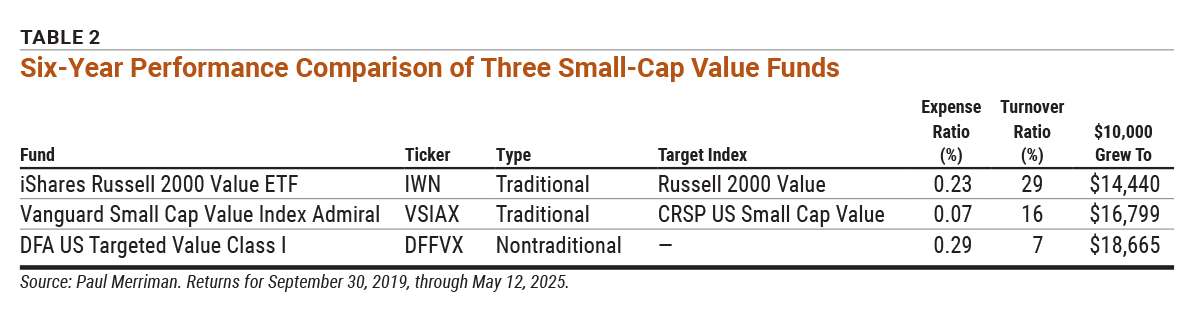
Once again, in this much shorter time frame, if you subtract the initial $10,000, the differences in growth are dramatic, ranging from $4,440 to $8,665.
I didn’t choose the starting date for that comparison at random. That was the day when investors could first put money into a nontraditional small-cap value ETF from Avantis Investors: the Avantis U.S. Small Cap Value ETF (AVUV).
September 2019 is not far enough in the past to indicate truly long-term results. Still, it’s a decent way to get a feel for how a fund’s managers are performing.
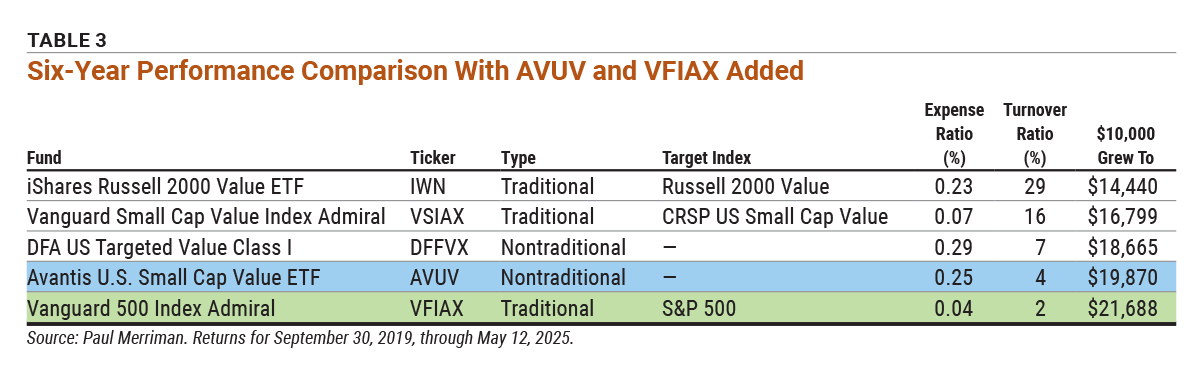
Table 3 includes the Avantis U.S. Small Cap Value. It is shaded in blue.
Merriman Financial’s Favorite Nontraditional Index Fund Families
Dimensional Fund Advisors launched its first mutual fund in 1981 and has deep roots in academic research and rules-based systematic investing. Avantis Investors was started by former Dimensional Fund Advisors executives and began operations in 2019.
These two companies emphasize investing in stocks with higher expected returns, smaller market capitalization, higher book-to-market ratios, higher profitability and broad diversification. Their strategies are grounded in financial research.
Avantis Investors is a division of American Century Investments and has grown rapidly over the past five years. The largest of its 37 stock and bond funds is the Avantis U.S. Small Cap Value, with about $14.6 billion in assets.
The company also offers the Avantis U.S. Equity ETF (AVUS), a worthy nontraditional alternative to a total market index fund, with about $7.8 billion in assets. (Click here for more on this fund.)
In selecting stocks for their funds, both of these companies focus on value and profitability. Dimensional Fund Advisors uses a traditional price-to-book-value (P/B) ratio to measure value, while Avantis Investors measures book value after subtracting nonphysical items like goodwill. For example, it’s much easier to assign a meaningful dollar value to a factory than to the value of a brand name.
These two companies didn’t just dream up the idea that price and book value might provide a path to superior long-term results. This conclusion is based on academic research going back to the 1920s. These factors have held up through world wars, depressions, and all manner of favorable and unfavorable markets.
The Groundbreaking Academic Research Behind These Funds
The brainpower behind this research comes from two finance professors:
- Eugene Fama, the Robert R. McCormick Distinguished Service Professor of Finance at the University of Chicago, a 2013 Nobel laureate and one of the world’s most widely quoted economists.
- Kenneth French, the Roth Family Distinguished Professor of Finance at Dartmouth College.
The two worked together and created what has become known as the Fama-French Three-Factor Model to explain asset pricing and portfolio returns. Previously, most investors believed that returns depended mainly, if not exclusively, on market risk, which is also known as beta.
In 1992, Fama and French identified two additional important factors: company size (or market capitalization) and value. Size captures the historical tendency for small-cap stocks to outperform large-cap stocks. Value captures the tendency for stocks with high book-to-market ratios (the inverse of price-to-book ratios) to outperform those with low ratios. Fama and French found that this three-factor combination explained the returns of stocks, especially diversified portfolios, much more fully than reliance on beta alone.
In 2015, they added screens for profitability and the nature of corporate investment strategies, with conservative investments outperforming more aggressive investments. Fama and French demonstrated that companies with high profitability and conservative investment strategies tend to outperform.
These factor models are now widely used in finance, especially in designing passive investment strategies for ETFs. Until this research was published and disseminated, most investors only dimly grasped the long-term power of small-cap value stocks, if at all.
Since I’m focusing on the small-cap value asset class, I want to briefly address a question I often encounter. It goes something like this: “Sure, small-cap value has produced impressive long-term results. But is this premium now past its prime, either dying or dead?”
While I can’t predict the future any more than you can, I can say the question reminds me of something Mark Twain wrote in a letter to a newspaper reporter in 1897: “The report of my death was an exaggeration.” Table 4, which looks back again to the year 2000, adds a line for the S&P 500. This index is represented by the Vanguard 500 Index Admiral, which is shaded in green. The wealth created by this fund is lower than any of the three small-cap value funds above it.
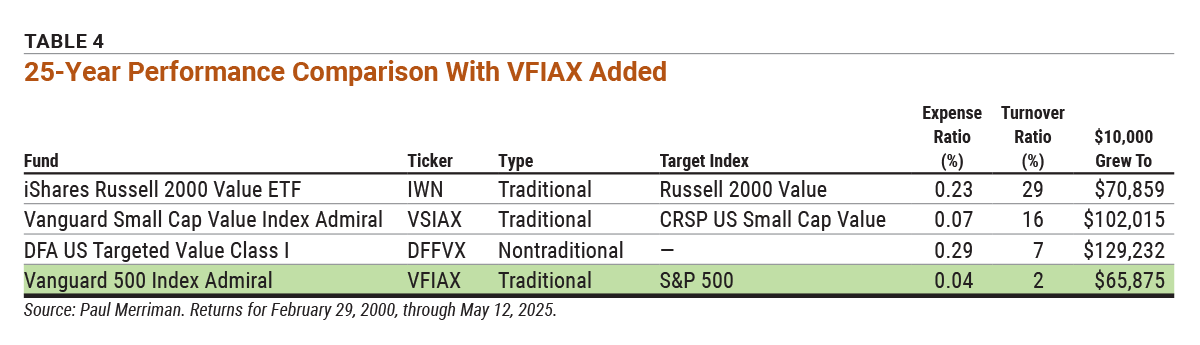
So, I think it’s safe to say that for the past quarter century, the small-cap value premium has been nowhere near “dead.”
In the more recent past, the picture is a bit different. Table 3 also shows how the S&P 500 (large-cap) compares to small-cap value.
Over this approximate six-year period, small-cap value did not demonstrate a performance premium over the S&P 500. However, all the academics will tell you this is too little time to mean much. It’s easy to find periods that long, or longer, when an asset class has lagged behind, only to resume its long-term progress.
If someone has a bad cold, or even the flu, that’s totally different from being dead. So, I am back to Mark Twain’s point of view.
Tapping the Power of Nontraditional Funds
I don’t mean to suggest that you ditch your traditional index mutual fund or ETFs. But if you’re interested in higher returns, I think you should at least consider allocating some of your portfolio in a way that takes advantage of Fama and French’s research.
If, for example, you’re putting money into a traditional small-cap value fund, you could switch to an offering like the Dimensional US Small Value ETF (DFSV) or the Avantis U.S. Small Cap Value. The latter emerged as the winner of its category in Merriman Financial’s research into the best-in-class ETFs that track various asset classes.
At the very least, you now know there are alternatives to traditional index funds. As experienced cooks know, there’s more than one way to peel a potato.
In Search of a Better Total Market Index Fund
If you’re committed to achieving the results of the S&P 500 index, a low-cost index fund will probably meet your needs just fine.
But many investors turn to total market index funds to squeeze more performance from the U.S. stock market without either market timing or active management. This means investing in virtually all publicly traded U.S. companies, regardless of their size.
Late Vanguard founder and CEO John Bogle embraced this notion with the creation of the Vanguard Total Stock Market Index Admiral fund (VTSAX) as an alternative to the Vanguard 500 Index Admiral fund (VFIAX). Yet, both funds are dominated by a handful of huge companies. The 10 largest holdings in the S&P 500 make up 34.8% of its assets. Nine of those holdings are giant technology companies. The same 10 holdings make up 29.7% of the Vanguard Total Stock Market Index Admiral’s portfolio.
Since the Vanguard Total Stock Market Index Admiral opened in 1992, its long-term returns have been very similar to those of the Vanguard 500 Index Admiral. According to Morningstar, an initial investment in each fund since April 30, 1992, with dividends and capital gains reinvested, would have grown to $254,718 in Vanguard’s S&P 500 fund and to $248,717 in its total market fund.
In my view, investors who want meaningful diversification against the S&P 500 would do well to look further.
I consider the Avantis U.S. Equity ETF (AVUS) to be a good alternative. This exchange-traded fund (ETF) has been available to investors since September 30, 2019, when it was created by Avantis Investors’ chief investment officer (CIO) Eduardo Repetto. Repetto’s long and successful career at Dimensional Fund Advisors means he is certainly not a newcomer to index funds that are based on solid academic research.
Throughout his career, both at Dimensional Fund Advisors and at Avantis Investors, Repetto has insisted on avoiding stock-picking and instead has taken a strict rules-based approach. The Avantis U.S. Equity’s portfolio turnover is only 1.0%, according to Morningstar.
The stocks in the Avantis U.S. Equity are not as heavily cap-weighted as those in the Vanguard Total Stock Market Index Admiral, so giant technology names like Alphabet Inc. (GOOGL), Apple Inc. (AAPL) and Microsoft Corp. (MSFT) don’t dominate the portfolio quite as much.
According to Morningstar, an initial investment in the Avantis U.S. Equity on its opening date in 2019, with dividends and capital gains reinvested, would have produced a cumulative gain of 83.39% by May 7, 2025. The Avantis U.S. Equity is best compared with the Vanguard Total Stock Market Index ETF (VTI), which produced a cumulative gain of 82.85% over the same period.
Although the Avantis U.S. Equity’s outperformance is far from spectacular, it occurred during a period that was unusually kind to the large-cap stocks that dominate Vanguard’s total market index.
Obviously, results going back only to 2019 aren’t very meaningful to long-term investors, and the Avantis U.S. Equity won’t be every investor’s cup of tea. It is worth looking at by those who believe, as I do, that small-cap stocks and value stocks will continue to outpace large-cap blend stocks over the very long term. It is a total market fund that emphasizes those parts of the market.
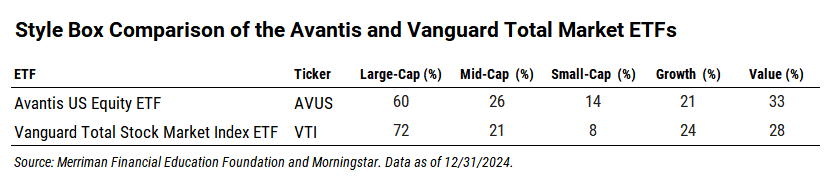
The differences in allocation percentages shown in the accompanying table are not large. However, the Avantis U.S. Equity has more of its portfolio in asset classes that I expect will continue to reward patient investors. Should the Avantis U.S. Equity outperform traditional total market funds by 1% or more—not an unreasonable expectation given historical returns—that could easily be worth an extra $1 million over a typical investor’s lifetime.

Related

Portfolio Strategies
Tilting AAII's Asset Allocation Models to Match Your Growth or Value Style
Related

Portfolio Strategies
Getting the Same Return With Less Risk: The Power of Factors
Discussion
FREE REPORT

Get your free copy of our special
report analyzing the tech stocks
most likely to outperform the
market.
BARRY J from TX posted over 1 year ago:
JOHN L from NJ posted about 1 year ago:
JAMES M from WA posted about 1 year ago:
Andrew D from CT posted 9 months ago:
You need to log in as a registered AAII user before commenting.
Log InCreate an account