


Related

Computerized Investing
With the initial wave of users onboarded, leading robo-advisers are shifting their focus to profitability.
by Ken Schapiro | July 2025

Condor Capital Wealth Management publishes The Robo Report, a free, comprehensive quarterly newsletter covering the digital advice industry. The report currently tracks 33 live accounts across 24 robo-advice providers. Our mission at Condor Capital Wealth Management remains the same: to bring transparency to automated investment services and help investors understand how the major players stack up.
With a few exceptions, the portfolios we track represent moderate to moderately aggressive risk profiles, targeting roughly 60% equities and 40% fixed income. All portfolio performance commentary in this article is for the period ended March 31, 2025.
Each spring, we review the prior year’s developments and provide AAII members with an update on robo-advice products, corporate activity and portfolio results. Since Betterment and Wealthfront launched in 2008, digital advice has moved from a start-up novelty to a mainstream channel, yet the past 12 months underscore how difficult it is to scale low-cost advice while earning a profit.
Major exits and acquisitions continued following the completion of robo-service Marcus’ sale of its investment accounts to Betterment and the closure of JPMorgan Chase & Co.’s  (JPM) robo-adviser offering in 2024. Adding to this trend, Ellevest, a platform initially focused on women investors, announced the closure of its digital robo-adviser service earlier this year to concentrate on serving higher-net-worth clients. Most recently, UBS decided to sunset its Advice Advantage robo-adviser. Stand-alone robos without banking or brokerage cross-sell remain a rarity.
With the initial wave of adopters onboarded, leading robo-advisers are shifting their focus to profitability. After seven years of free service, SoFi implemented a 0.25% annual management fee in late 2024. While some robo-advisers increased fees, Vanguard sought to widen its reach by reducing the minimum for its Digital Advisor service to just $100. Meanwhile, Wealthfront recently announced that it has achieved profitability by maintaining its low-cost digital model and supplementing income with cash management services, demonstrating that a path to profit exists with the right strategy and scale.
As the industry matures, innovation is moving toward portfolio customization. Firms are adding more sophisticated options: For example, Betterment launched its Goldman Sachs Tax-Smart Bonds portfolio in July 2024, and Wealthfront introduced its Automated Bond Ladder in May 2024. SoFi began offering alternative investments, such as private credit and real estate funds. This expansion typifies a broader shift where features like direct indexing (owning the individual stocks instead of an index fund) and thematic tilts give seasoned investors more granular control while preserving a guided path for newcomers.
Artificial intelligence (AI) represents the next major battleground, but its deployment is constrained by strict fiduciary regulations. While firms like Robinhood—which acquired AI planner Pluto in July 2024 and launched its robo-adviser in March 2025—aim to build personalized strategies, these features are often framed as suggestions rather than formal advice. Regulators are watching closely, with the U.S. Securities and Exchange Commission (SEC) penalizing firms for “AI washing” in 2024 and making AI in portfolio management and marketing a 2025 examination priority. Consequently, firms must implement robust governance to manage algorithmic biases and prevent misleading claims.
Our top pick this year for best overall robo-adviser is Vanguard Personal Advisor.
Vanguard offers a two-tier structure that strikes a balance between accessibility and depth. Vanguard Digital Advisor is a fully digital service that needs only a $100 opening balance and caps costs at 0.20% per year. Vanguard Personal Advisor is the hybrid solution that pairs investors depositing $50,000 or more with licensed advisers for just 0.30%–0.31% per year. Both tiers inherit Vanguard’s trademark focus on low fees and straightforward planning tools, with intuitive goal-tracking and clear progress reports that earned some of the highest feature scores in our Robo Ranking Winter Edition.
Vanguard dedicates the fixed-income sleeve to municipal bonds, a decision that has recently boosted aftertax returns as municipals outpaced corporates. Coupled with Vanguard’s legacy of broad, low-cost index exposure on the equity side, this mix has propelled Vanguard Personal Advisor near the top of our three- and five-year performance tables. The combination of disciplined asset allocation, cost efficiency and optional human guidance firmly establishes Vanguard Personal Advisor as the best overall robo-adviser for investors who want digital convenience without sacrificing comprehensive advice.
Fidelity Go is our top pick for new investors.
It removes entry barriers with no management fee on the first $25,000, and it charges 0.35% only on accounts exceeding $25,000. Its clean, mobile-friendly dashboard simplifies goal-setting and progress-tracking, complemented by Fidelity’s extensive learning resources.
Substantial large-cap equity allocation has driven robust three- and seven-year performance. Low costs, an intuitive experience and a proven track record make Fidelity Go an ideal launchpad.
Robo-adviser Empower sets the benchmark for digital financial planning.
Its robust suite handles diverse goals (retirement, home purchases, college funding) with specialty modules like a retirement fee analyzer. Users can model multiple spending goals and debt paydown and view aggregated finances from linked accounts in one dashboard. The Investment Checkup feature diagnoses portfolio drift and suggests tax-aware rebalancing, even for external holdings. While detailed, its breadth and flexibility empower personalized road maps, making it this year’s best digital planner.
For individuals with complex financial planning needs, digital tools provide valuable insights, but combining robo-adviser services with access to live financial advisers often delivers the most comprehensive support.
Vanguard Personal Advisor remains the top choice for complex financial planning, offering a blend of digital and human advisory services for sophisticated needs. Vanguard’s hybrid model service tier is appealing for its affordability and accessibility. With a minimum investment of $50,000, clients can engage with a live adviser for a 0.30%–0.31% management fee. Investors allocating $500,000 or more gain a dedicated adviser, maintaining the same competitive fee structure. This approach allows investors to model multiple financial goals and manage assets more effectively at a significantly lower cost than the traditional 1% fee typically charged by human advisers.
Table 1 and Figure 1 show returns for the major robo-advisers over the trailing one-year, three-year, five-year and seven-year periods ended March 31, 2025, as tracked by The Robo Report.
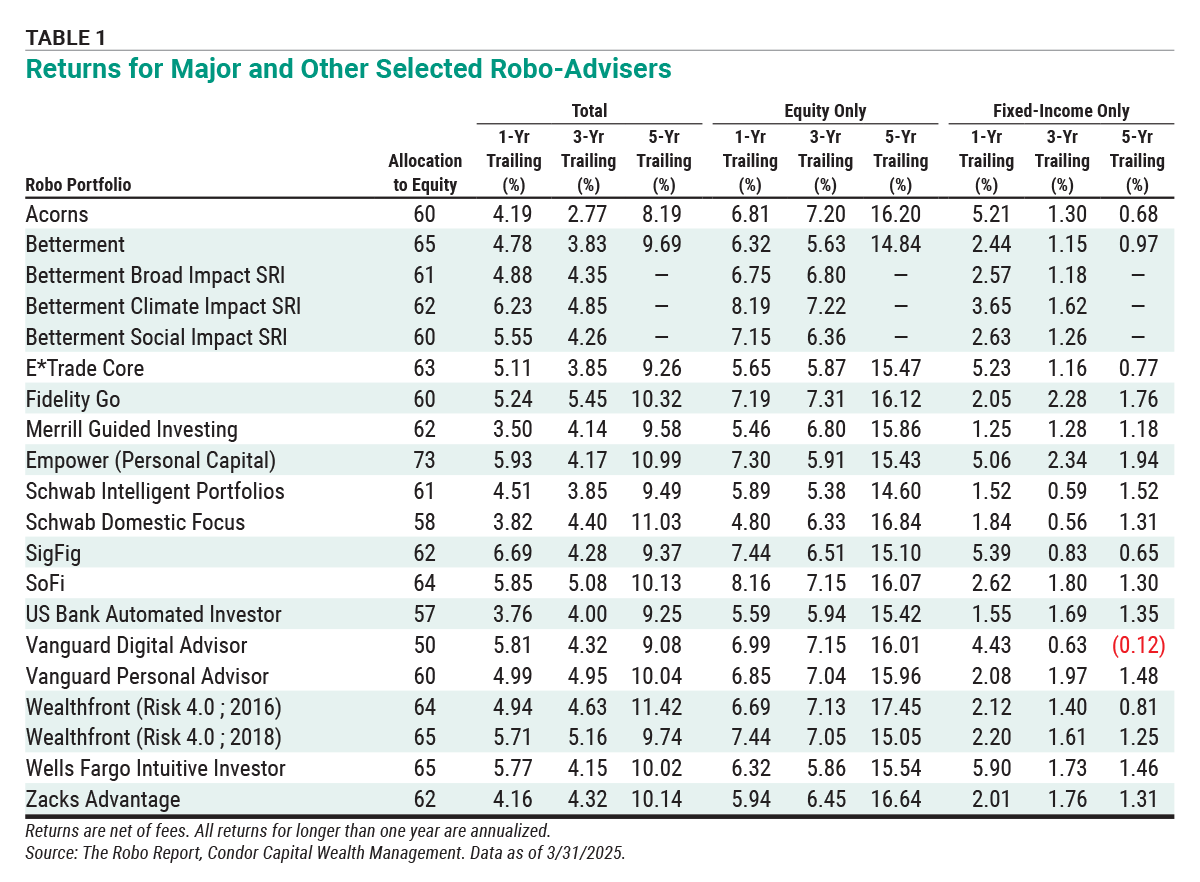
Over the past three years ended March 31, 2025, Fidelity Go, SoFi and Wealthfront delivered the strongest total returns, largely due to their significant allocations to U.S. equities. The S&P 500 index returned an annualized 9.03% during this period, substantially outperforming the MSCI EAFE index’s 6.68% annualized return and the MSCI Emerging Markets index’s 1.84% annualized return. Notably, Wealthfront and SoFi each allocated 76% to domestic equities, while Fidelity Go allocated 69%, all of which are above the typical robo-adviser allocation of around 66%.
The interplay between growth and value stocks continued to influence returns, though the performance gap has narrowed in recent three-year periods. The Russell 3000 Growth index returned an annualized 9.62%, compared to 6.24% for the Russell 3000 Value index. SoFi, with a 31% allocation to growth stocks (above the peer average of 27%), benefited from this tilt. Fidelity Go and Wealthfront, holding around 25% in growth stocks, also captured upside from the relative strength of large-cap growth leaders, which dominated the broader U.S. market.
In fixed income, municipal bonds played a crucial role in bolstering portfolio performance for these leaders. This focus proved beneficial, as evidenced by the Bloomberg Municipal Bond index’s annualized return of 1.53% over the period. This contrasted favorably with the Bloomberg US Corporate Bond index, which posted a 1.14% annualized loss, underscoring the resilience and tax advantages municipal bonds offered during this time frame. All three top-performing portfolios incorporated significant municipal bond allocations.
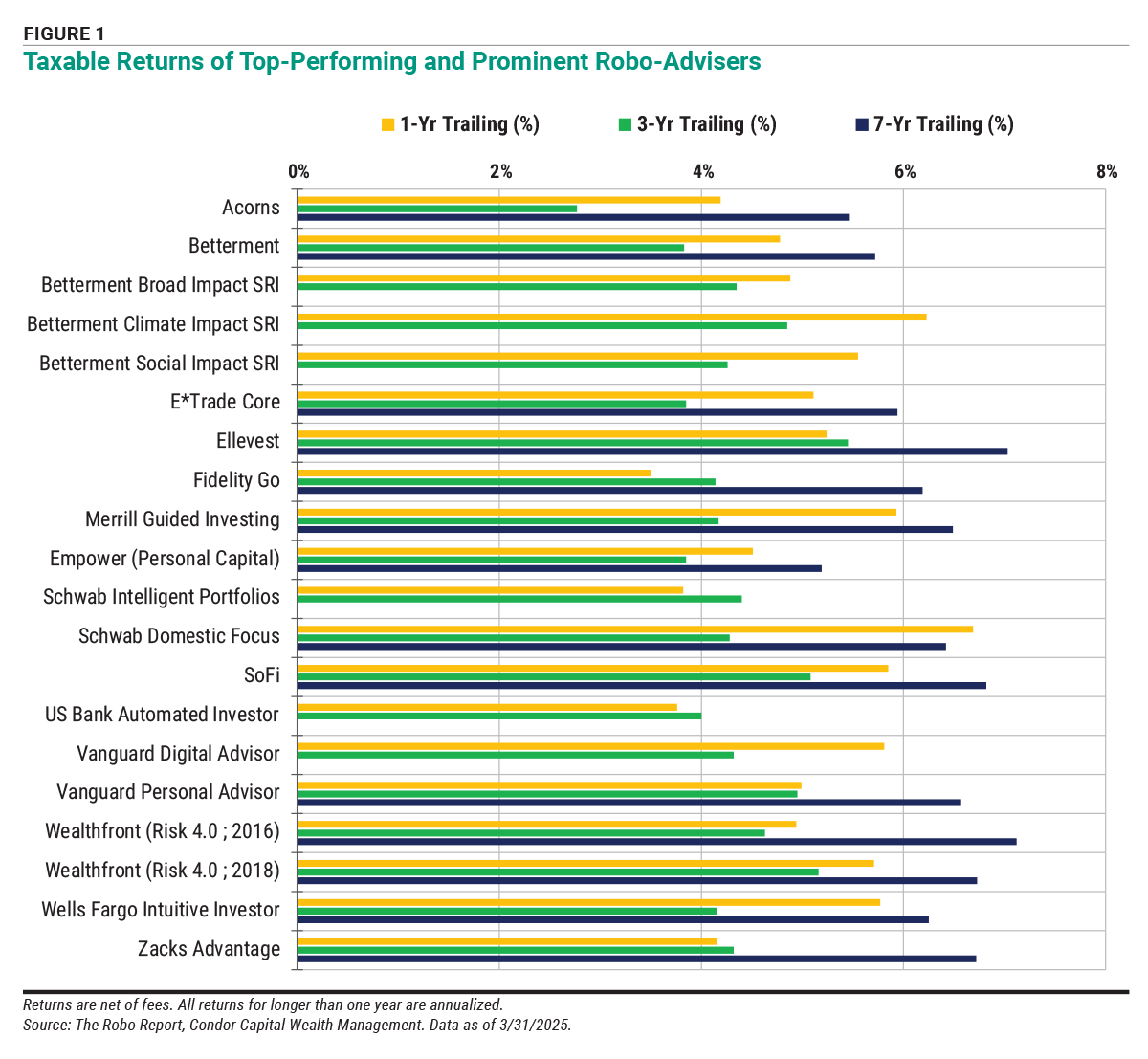
Over the past seven years, Fidelity Go, Wealthfront and Zacks Advantage were the standout performers, concentrating on large-cap U.S. stocks and anchoring their bond sleeves with municipal securities. This U.S.-centric approach proved highly advantageous, as the S&P 500 generated an impressive 13.21% annualized return, significantly outpacing the MSCI EAFE’s 5.96% return. Zacks Advantage held a prominent 81% in domestic equities, while Wealthfront and Fidelity Go, with 73% and 69% domestic allocations, respectively, also maintained strong U.S. tilts.
The dominance of large-cap equities over small caps was a persistent theme. The Russell 1000 index delivered a 12.92% annualized return, which was significantly higher than the Russell 2000 index’s 5.37% annualized return. Growth stocks also continued to outpace value over this extended period, with the Russell 3000 Growth returning 15.37%, versus 8.92% for the Russell 3000 Value. Interestingly, despite its 35% value allocation, Wealthfront still outperformed due to its U.S. mega-cap holdings. In comparison, Fidelity Go and Zacks Advantage’s more balanced growth/value exposure—25% growth/29% value for Fidelity Go, 25% growth/30% value for Zacks Advantage—underscored that broad U.S. large-cap exposure was key.
In the fixed-income arena, municipal bonds provided stability and competitive returns. The Bloomberg Municipal Bond returned 2.07% annually over seven years, outperforming the Bloomberg U.S. Aggregate Bond index’s 1.57% return, though it trailed the Bloomberg US Corporate High Yield index’s 4.94% return over the same period. Fidelity Go (91% of fixed income in municipals), Zacks Advantage (97%) and Wealthfront (80%) all featured substantial municipal bond allocations. These tax-advantaged securities helped cushion portfolios against the impact of fluctuating interest rates and provided a steady income stream.
By combining a persistent tilt toward large-cap domestic equities with a disciplined municipal bond core, Fidelity Go, Zacks Advantage and Wealthfront effectively captured the upside of a long U.S. bull market while managing risk, solidifying their standing as leading robo-advisers over the past seven years.
Computerized Investing

Portfolio Strategies

Investor Professor

BARRY J from TX posted over 1 year ago:
ROBERT A from NC posted about 1 year ago:
You need to log in as a registered AAII user before commenting.
Log InCreate an account