


Charles Rotblut leads a class in AAII's new Essential Investing Video Course. Go to https://www.aaii.com/ves for more information and to subscribe.
- Key OBBBA tax changes include enhanced senior deduction, higher standard deductions, expanded SALT deductions and child tax credits
- Planning strategies for charitable deductions, AMT changes, 529 plans, and estate and gift taxes
- Temporary and permanent provisions affect high-income, senior and family taxpayers with guidance on timing deductions and income
The passage of the One Big Beautiful Bill Act (OBBBA) in July brought certainty to individual taxpayers. Had new legislation not been passed and signed into law, many of the key tax breaks in the Tax Cuts and Jobs Act (TCJA) of 2017 would have expired at the end of this year.
The OBBBA created new tax-saving opportunities, as well as questions about how to navigate the new rules. Many of the OBBBA’s changes are already in effect, with additional provisions going into effect in 2026.
In this special tax update, we discuss tax-planning steps you can consider taking before the end of 2025 as well as in 2026 and beyond. We focus on the changes likely to impact most individual investors.
This article uses the information and guidance available as of our print deadline in mid-August. Not all rules have been clarified, nor has the Internal Revenue Service (IRS) published revised tax brackets, limitations, phaseouts and deductions for 2026. Still, we have enough information to allow you to start determining what impact the OBBBA will have on your taxes.
Since there are many details, loopholes and pitfalls within the tax code, it is impossible for us to provide enough details to cover specific tax situations. If you have questions, consult a tax professional. It is your tax return, and the IRS will hold you responsible for any errors made on it.

Tax-Year 2025 Changes Already in Effect
The OBBBA contained several provisions that went into effect immediately.
Enhanced Benefits for Seniors
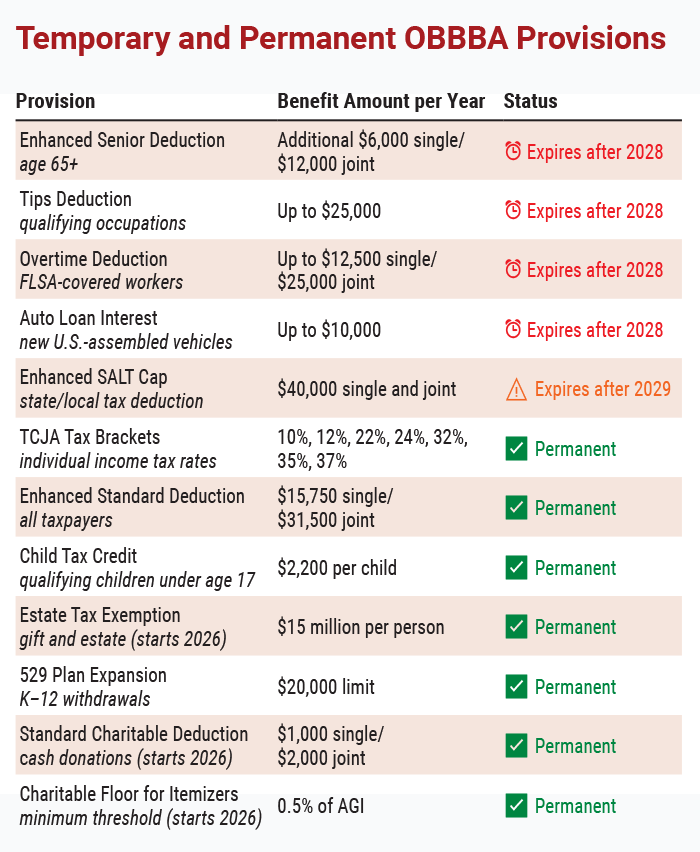
Taxpayers who attain age 65 on or before the last day of a taxable year can qualify for an additional $6,000 deduction ($12,000 for married couples filing joint returns where both spouses qualify). This extra deduction for seniors is in effect for 2025 through 2028.
The IRS lists two key requirements to claim the deduction:
- Include the Social Security number of the qualifying individual(s) on the return, and
- File a joint return, if married, to claim the deduction.
The deduction phases out for taxpayers with modified adjusted gross income (MAGI) over $75,000 for single filers and $150,000 for married couples filing jointly. The phaseout is complete at $175,000 for singles and $250,000 for married couples filing jointly.
Qualifying seniors can take the additional deduction whether they itemize deductions or claim the standard deduction. Furthermore, the enhanced benefit is on top of the existing additional standard deductions for older adults and those who are blind. These deductions remain at $1,600 for married couples filing jointly and $2,000 for single filers in 2025.
For seniors below the income phaseout thresholds, there is an opportunity to make some planned taxable moves—such as Roth individual retirement account (IRA) contributions—while the larger enhanced senior deduction is in effect. Married couples filing joint returns can effectively offset an additional $12,000 of taxable income with the larger deduction. The new deduction also creates an incentive for those near but over the phaseout thresholds to seek ways to reduce their taxable income if a legal means to do so is available.
Increased Standard Deductions
The OBBBA makes the standard deduction amounts from the TCJA permanent, though the OBBBA increases it for 2025. The new standard deduction amounts are $31,500 for married filing jointly, $23,625 for heads of household and $15,750 for single filers. These represent increases of $1,500, $1,125 and $750, respectively, from pre-OBBBA amounts.
These higher standard deductions raise the threshold for itemizing, particularly for those who are close to the pre-OBBBA levels. The new state and local tax (SALT) deductions along with the new 2026 rules regarding charitable deductions may also play a role in the tax-planning process.
SALT Deduction Expansion
The cap on SALT deductions has increased from $10,000 to $40,000 for tax-years 2025 through 2029. It had previously been scheduled to expire at the end of this year. The deduction includes state and local income taxes as well as property taxes.
The higher cap phases out for high-income taxpayers, beginning at MAGI of $500,000 for both married filing jointly and single filers. (The deduction cannot be reduced below $10,000 due to the phaseouts.) Both the cap amount and income thresholds will increase 1% annually from 2026 through 2029, after which the SALT deduction cap will revert to $10,000. (The previous cap was a fixed amount.)
The higher SALT deductions particularly benefits itemizing taxpayers in high-tax states who were previously limited by the $10,000 cap. This higher cap should be taken into consideration when deciding whether to claim the standard deduction or take actions to itemize. For example, making a large charitable donation this year instead of in a future year may make sense from a tax standpoint.
Enhanced Child Tax Credit
Beginning this year, the child tax credit increases from $2,000 to $2,200 per qualifying child under the age of 17. The credit is permanent and will be indexed for inflation beginning in 2026. The income phaseout thresholds remain unchanged at $400,000 for married filing jointly and $200,000 for other filers.
The OBBBA tightens eligibility requirements by mandating that both taxpayers and children have Social Security numbers issued to U.S. citizens or lawful permanent residents. Previously, only the child needed a Social Security number, and parents could claim the credit with an individual taxpayer identification number (ITIN).
Auto Loan Interest Deductible
Interest on loans for new passenger vehicles for personal use purchased after December 31, 2024, and before January 1, 2029, is deductible up to a limit of $10,000 per year. The deduction phases out beginning at MAGI of $200,000 for married filing jointly and $100,000 for single filers. It is completely phased out at MAGI of $250,000 for married filing jointly and $150,000 for single filers.
Final assembly of the vehicle must occur in the U.S. to qualify for the deduction. The deduction does not apply to lease financing.
The deduction can be claimed even if the standard deduction is claimed. It expires after December 31, 2028.
New Worker Deductions
The OBBBA creates two temporary deductions available from 2025 through 2028 that may benefit those who are working. First, workers in customary tipping occupations can deduct up to $25,000 of qualified tips. Second, qualified overtime compensation can be deducted up to $12,500 ($25,000 for married filing jointly). The overtime compensation must be covered by the Fair Labor Standards Act and reported on Form W-2.
Both deductions can be taken regardless of whether a taxpayer itemizes or takes the standard deduction. The deductions begin to phase out at MAGI of $150,000 for single filers and $300,000 for married filing joint returns.
Trump Accounts for Minors
The new Trump accounts introduced by the OBBBA allow savings for minors to grow on a tax-deferred basis. The accounts will be seeded by the U.S. Treasury with $1,000 for every U.S. citizen born between January 1, 2025, and December 31, 2028. Contributions of up to $5,000 can be made to Trump accounts for children under the age of 18 once accounts become available for contributions in 2026.
Contributions are not tax-deductible. No withdrawals are permitted before the beneficiary turns 18 years old. Withdrawals of contributions are tax-free, but earnings will be taxed as ordinary income. Nonqualified withdrawals made before the beneficiary turns 59½ years old also incur a 10% penalty. Withdrawals for “covered expenses”—such as college tuition, a first home purchase or certain business start-up costs—do not incur the penalty.
Contributions to these accounts should be compared to alternatives such as 529 plans and making a direct gift.
Tax-Year 2026 Changes to Plan for Now
Several of the TCJA’s tax breaks and suspensions that had been set to expire after December 31, 2025, have either been extended, made permanent or modified.
Reduced Tax Brackets Maintained
The lowered tax brackets mandated by the TCJA were set to sunset on December 31, 2025. The OBBBA makes them permanent. In addition, the new law added an additional year of inflation adjustments to the 10%, 12% and 22% tax brackets. This will increase the amount of marginal income that is taxed at those levels instead of at higher rates.
New Itemized Deduction Limitation
Beginning in 2026, the OBBBA will replace the suspended Pease limitation with a new restriction on itemized deductions. The new limitation will reduce itemized deductions by 2/37ths (5.4%) of the lesser of total itemized deductions or the amount by which taxable income exceeds the threshold for the 37% tax bracket.
This limitation effectively caps the tax value of itemized deductions at the 35% tax rate for high-income taxpayers. Unlike the previous Pease limitation, this new restriction applies to all itemized deductions, including the enhanced SALT deduction. However, it does not affect the determination of the qualified business income deduction for pass-through entities.
Taxpayers who expect to be affected by this limitation should consider accelerating charitable contributions and other itemized deductions into 2025, if possible.
Charitable Contribution Changes
Beginning in 2026, taxpayers who take the standard deduction can deduct up to $1,000 of charitable cash contributions ($2,000 for married filing jointly). Charitable contributions of cash (regardless of the amount) to any qualified charity must be supported by a dated bank record (such as a canceled check) or a dated receipt from the charity that includes the name of the charity, the date and the amount of the contribution. This change is permanent unless altered by future legislation.
Taxpayers who itemize will face a new limitation: Charitable contributions will be deductible only to the extent that they exceed 0.5% of the taxpayer’s contribution base, which is typically adjusted gross income (AGI). This change creates a floor below which charitable contributions provide no tax benefit for itemizers. For example, a taxpayer with $200,000 of AGI would receive no deduction for the first $1,000 of charitable contributions.
The 60% of AGI limitation on cash gifts to public charities will become permanent. Excess contributions that cannot be deducted due to the new 0.5% floor can be carried forward for up to five years, subject to meeting the floor test in future years.
It can make sense for those who itemize to make larger charitable donations this year instead of next year. Conversely, those who take the standard deduction may wish to postpone cash contributions until next year. Before doing so, consider the needs of the charity you wish to support.
Alternative Minimum Tax Changes
The higher alternative minimum tax (AMT) exemption amounts established under the TCJA—$88,100 for single filers and $137,000 for married filing jointly—are maintained under the OBBBA and will continue to be indexed to inflation. They had been set to revert to pre-TCJA levels until the passage of the OBBBA.
The OBBBA does, however, reduce the AMT exemption phaseout thresholds to 2018 levels: $500,000 for single filers and $1 million for married couples filing joint returns, down from the current levels of $626,350 and $1,252,700, respectively. More significantly, the new law doubles the phaseout rate from 25% to 50%, meaning that once taxpayers exceed these thresholds, their AMT exemption disappears twice as quickly. This accelerated phaseout effectively expands the reach of the AMT among high-income taxpayers while maintaining protection for middle-income families.
The combined effect creates a more targeted AMT system that narrows the income range where taxpayers can avoid the tax. While middle-income taxpayers benefit from permanent higher exemptions and certainty, high earners will face AMT liability at lower income levels than under current law. This will require more careful tax planning around income timing strategies, including for stock option exercises.
Education Savings Expansion
Beginning in 2026, the annual limit for tax-free K–12 withdrawals from 529 plans will increase permanently from $10,000 to $20,000 per beneficiary. Additionally, effective immediately for distributions made after July 2025, the definition of qualified K–12 expenses is expanded to include curriculum materials, books, online educational materials, qualified tutoring services, standardized test fees, dual enrollment fees and educational therapies for students with disabilities.
Estate Tax and Lifetime Gift Exemptions Stay at Higher Levels
The estate tax exemption will increase to a permanent base of $15 million per person in 2026. The lifetime gift tax exemption will also be set at $15 million next year. Both had been set to return to pre-TCJA levels after December 31, 2025. The new limits will continue to be indexed to inflation.
This change provides certainty to estate plans.
The annual gift tax exclusion of $19,000 was not changed by the OBBBA.
Miscellaneous Itemized Deductions Permanently Eliminated
The OBBBA makes permanent the elimination of most miscellaneous itemized deductions that were temporarily suspended under the TCJA, with a specific exception preserved for educator expenses. The deductions that have been permanently eliminated include, but are not limited to, investment fees and tax preparation fees. Non-reimbursed job-related expenses for eligible educators will become an itemized deduction starting in 2026.
Additional OBBBA Tax-Planning Considerations
The enhanced standard deduction amounts along with the higher SALT deduction can change whether or not itemizing makes sense for you. It would be prudent to estimate whether you will itemize in 2026 and determine if there is taxable income or deductible expenses you have control over recognizing during either this year or next year.
Those age 65 or older should now consider the phaseout limitations on the new enhanced senior deduction. This larger deduction adds an extra layer beyond the taxation of Social Security benefits and Medicare income-related monthly adjustment amounts (IRMAAs) to consider from an income perspective. The considerations include the timing of Roth IRA rollovers.
High-income taxpayers should also consider accelerating charitable contributions into 2025 before the new 0.5% floor takes effect in 2026. Bunching multiple years of charitable giving into 2025 could provide greater tax benefits than spreading contributions across multiple years.
Several OBBBA provisions are temporary, creating planning challenges and opportunities. The enhanced senior deduction and enhanced SALT cap expire between 2028 and 2029, for instance.
As with any major tax legislation, individual circumstances vary significantly, and taxpayers should consult with qualified tax professionals to develop strategies appropriate for their specific situations.

Related

Tax Strategies
Guide to Tax on Your Personal Investments 2024

Discussion
FREE REPORT

Get your free copy of our special
report analyzing the tech stocks
most likely to outperform the
market.
BARRY J from TX posted about 1 year ago:
KEVIN V from NC posted about 1 year ago:
You need to log in as a registered AAII user before commenting.
Log InCreate an account