


- View life choices and money decisions as continuous investments of time, energy and resources for future benefit
- Learn how early, consistent saving and understanding personal risk capacity build lasting financial security
- Discover how target-date funds, small-cap value exposure and automation enhance long-term investing success
Every choice we make is an investment decision. How will we use our time and energy now and in the future? Will we work or play, rest or exercise? Will we eat healthily or splurge? Will we scroll on a screen or be present? Will we seek first to understand or to speak?
Consciously or unconsciously, we constantly decide how much and where to invest our time and energy for imagined or hoped-for returns. We don’t think of life in these terms because it is core to our essence as living things. It’s the same reason we aren’t aware of our breathing or heartbeat.
Why is financial investing considered mysterious and different, and how can we make it look natural, familiar and less threatening?
Today Versus Tomorrow
Few things in life are as important as becoming friends to our future selves.
When we eat well, exercise, invest in our spiritual and mental health, develop relationships with friends and family and learn how to help others, we invest in our future. It takes willpower and discipline. Plus, the returns are both uncertain and in the future, just as with financial investing.
Our first decision in personal finance is to not spend everything today so we’ll have more later. Our life experiences shape how easy it is to make this decision. If someone grows up in an environment where things that are theirs stay theirs, saving is easier than if they grow up in an environment where property is up for grabs.
Regardless of the ease of the decision, the impact of saving early will likely be dramatic.
The Importance of Saving Early and Consistently
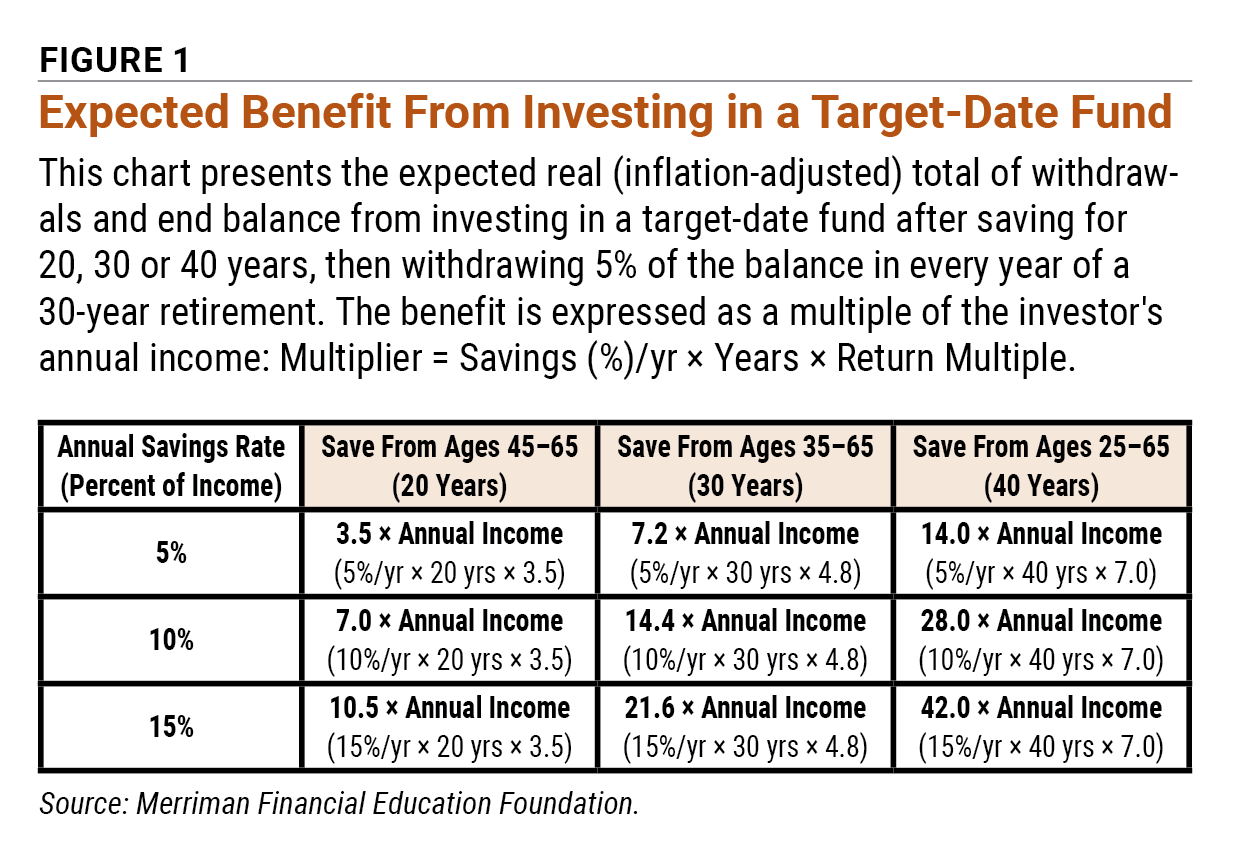
Since target-date funds are a nearly ubiquitous choice among young people in 401(k) plans today, let’s look at the impact of saving for all 40 years of a career, compared to only saving for the last 20 or 30 years. I assume a 30-year retirement with 5% flexible withdrawals (dollar value fluctuates with the portfolio balance) and use the Merriman Financial Education Foundation asset class return data from 1970 through 2024.
Backtesting shows that the real (inflation-adjusted) expected return for the 70-year scenario, including 5% annual flexible withdrawals and the end balance, is 7.0x the total real dollars invested (Figure 1). That return drops to 4.8x if one starts saving 10 years later and 3.5x if one only saves in the last 20 years of their career.
Starting early made a huge difference.
The total real lifetime investing benefits in Figure 1 were found by multiplying those expected return factors by the number of saving years and the percentage per year saved. For someone who saved 15% per year for 40 years, their total portfolio growth was worth more than their total income over their career. This means their prudent strategy more than doubled their lifetime purchasing power compared to someone who saved nothing.
Know Your Capacity for Risk
Risk is ever-present, personal and hard to quantify.
There must be a history of starvation somewhere in my family tree, because I’m often concerned that I’ll miss a meal. I’m also extremely careful near ledges where I could fall and get hurt. Some of my family members say I have an irrational fear of heights. I say it’s better to be safe than sorry.
My fear of heights and minor food insecurities are examples of my personal risk tolerance. They’re psychological and shaped by my instincts. In both cases, my risk capacity is greater than my tolerance. I have navigated chain sections of hiking trails with steep drops and gone days without food when needed. I didn’t like it, but I could do it.
Our financial risk profiles are similarly personal. Research shows that investors who live through the equivalent of financial starvation—like a big bear market for stocks—early in their investing careers tend to hold lower percentages of stocks over their lifetimes. Similarly, investors who live through the financial equivalent of a dramatic fall, like a big loss in one or more of their holdings, often become more risk-averse and sometimes abandon stock investing altogether.
Knowing the level of risk we can tolerate in our investing portfolios is critical to our success. Taking on too much risk makes us more likely to lock in losses in a down market, while taking too little risk could result in lower lifetime wealth and financial security.
I have yet to find a tool that accurately predicts one’s investing risk tolerance, but we can approximate risk capacity.
Our financial risk capacity depends on how much time and energy we have to recover from hardship, bad luck or mistakes. Someone on the verge of retirement with no savings or investments has little financial risk capacity. A young, able-bodied, well-educated person with no money has a lot of human capital and years to exchange it for income and investment returns. Consequently, they have a lot of financial risk capacity. So does a retired person with more than sufficient investments to meet their needs.
Assuming you can see where you might fit on this spectrum, you would ask, “How much risk is in my investing approach?”
Let’s return to our target-date fund example and consider two risk metrics: worst-case drawdowns and 30-year safe withdrawal rates.
- Worst-Case Drawdowns: The peak-to-trough decline in the balance of an account with a lump-sum investment. They represent the worst time in an investor’s experience for a particular asset allocation portfolio. This is a good proxy for the volatility an investor must endure to get that portfolio’s expected return.
- 30-Year Safe Withdrawal Rates: The percentage that can be withdrawn in the first year of a 30-year retirement, then adjusted for inflation each subsequent year until the end of retirement without running out of money. This is a good proxy for sequence of returns risk. The higher the number, the more resilient that portfolio has been to sequence of returns risk in the past.
These metrics are more intuitive and relatable than traditional measures like standard deviation. I think most people would prefer an investment that doesn’t decline precipitously in value and can deliver a high level of predictable purchasing power throughout retirement with a low risk of running out of money.
Because the target-date fund has a time-varying asset allocation that reduces equities and increases fixed income or bonds over time, I examined these two metrics and the expected return for several time frames relative to retirement. The compound annual growth rate and worst-case drawdown backtests shown in Table 1 use return data from 1970 through 2024, while the 30-year safe withdrawal rates use return data from 1928 through 2024 to capture the worst periods in the 1960s. We modeled Vanguard-like target-date fund asset allocations for the backtests.
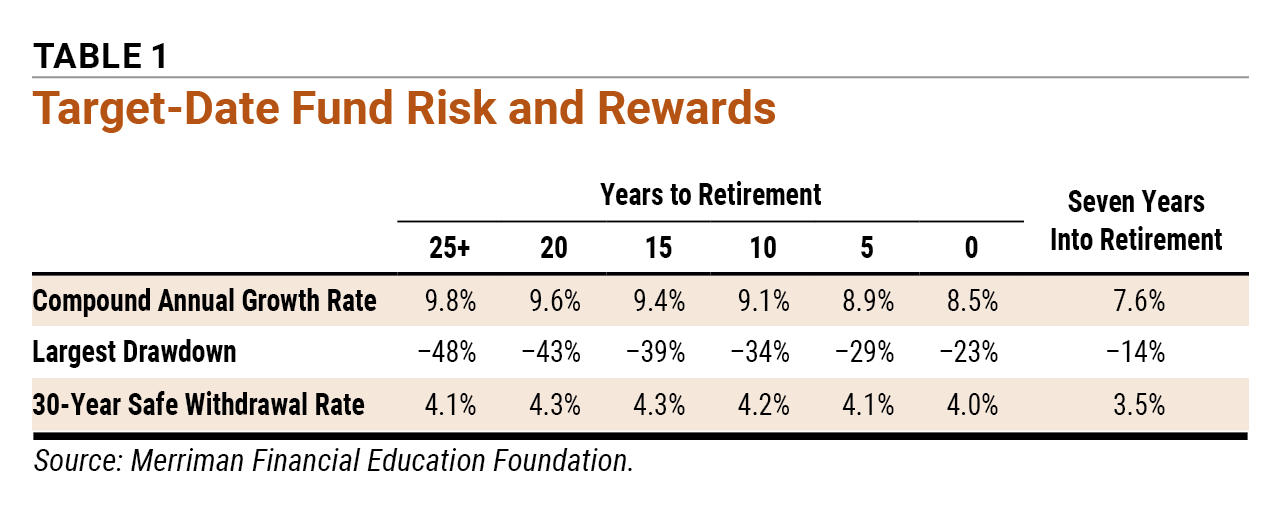
Target-date funds are designed to fit the risk capacity of the average person who starts saving and investing in their 20s, continues for a roughly 40-year career and then retires. Table 1 shows that they do just that, with the highest growth rates and worst drawdowns appearing early, then declining and becoming less severe throughout retirement.
Some may ask whether retirees should have a more aggressive retirement allocation if they have historically higher safe withdrawal rates. The answer lies in the associated drawdowns. For investors closer to saving too little or just enough, the smaller uncertainty in the size of their nest egg approaching retirement can provide invaluable reassurance. The 23% and 29% largest drawdowns for the allocations in the year of retirement and the five years before retirement, respectively, are significantly smaller than the 39% to 48% uncertain drawdowns of the allocations in the 15 to 25+ years until retirement.
Whether an investor uses a target-date fund or builds their own time-varying asset allocation with exchange-traded funds (ETFs), mutual funds, or stocks and bonds, they should understand how much risk they are taking and how it varies with their risk capacity throughout their life. The Fine Tuning Tables on the Merriman Financial Education Foundation website are an excellent resource for do-it-yourself (DIY) investors who want to manage their time-varying risk profile using stock and bond ETFs or mutual funds.
Five Key Investing Concepts to Learn
The way we make daily investment decisions changes as we learn new things.
The U.S. government’s dietary recommendations have changed several times in my lifetime. Likewise, I’ve changed my eating habits, or at least the guilt I feel when I splurge. If I want to live a long and healthy life, I’ll try to eat better and exercise daily.
Many investors have little appetite for learning about personal finance or investing, making them perfect candidates for the target-date fund. It was built for them and has benefited them substantially. Before the introduction of target-date funds, the average young investor was just as likely to be invested in money market funds or bonds as they were in equities. That doesn’t mean target-date funds are the best solution for everyone.
Someone willing to learn more can do better in investing. Here are five concepts I suggest learning:
- Some parts of the stock market have higher risks and higher expected returns.
- The companies in those parts of the market tend to be smaller and cheaper (value stocks) with better financials and positive recent momentum.
- Their returns are not perfectly in sync with those of the S&P 500 index or the total stock market, and they can outperform when the broader market underperforms.
- Almost all those attributes are found in the best U.S. small-cap value ETFs or mutual funds.
- Since we don’t know when the outperformance will occur, it’s prudent to combine these higher-risk and higher-return assets with a diversified portfolio, such as a target-date fund.
To illustrate the powerful diversification and return benefits of small-cap value, let’s examine a bold scenario from the Merriman Financial Education Foundation’s Two Funds for Life investing approaches: a 50/50 combination of a target-date fund and U.S. small-cap value. The results are shown in Table 2.
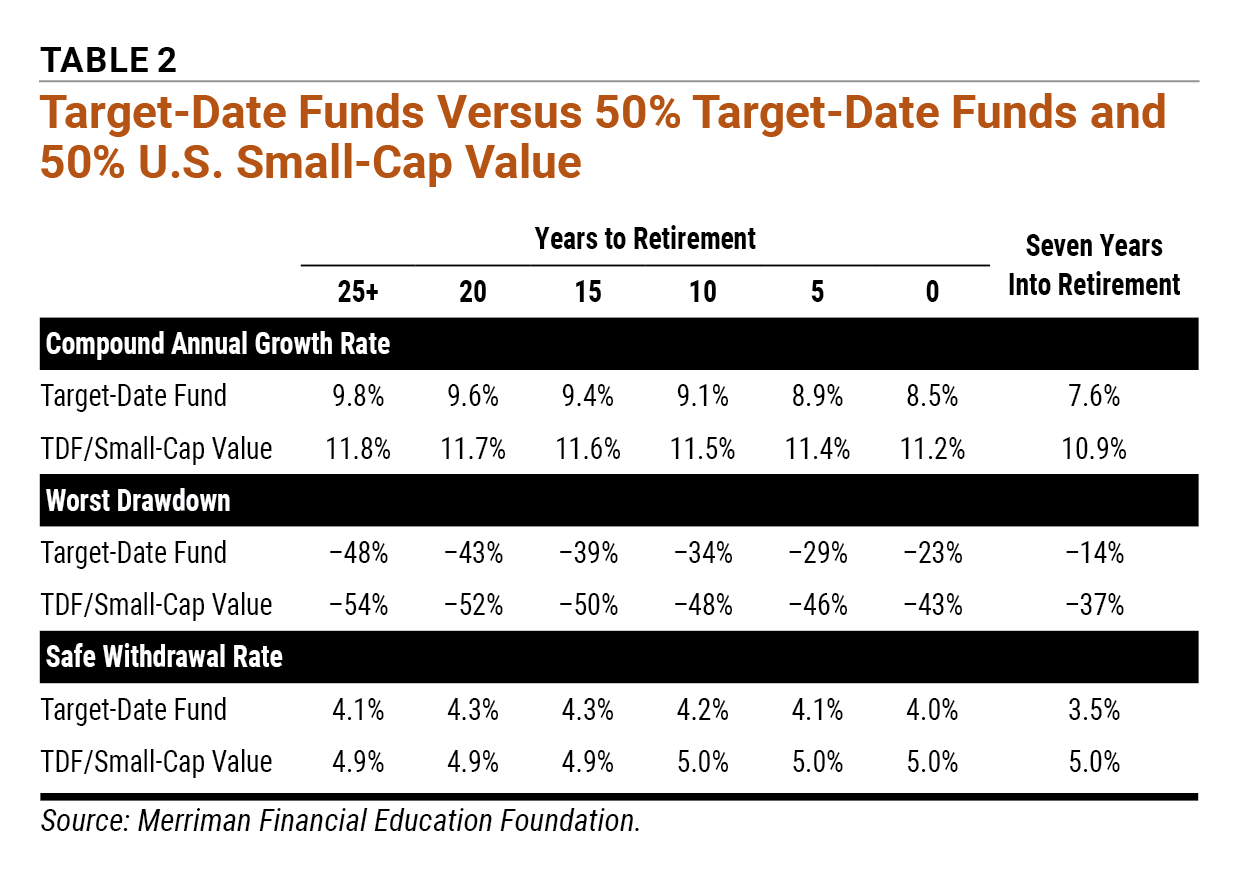
It’s not hard to see why target-date fund designers don’t include a tilt to small-cap value. Although the expected return of small-cap value is substantially higher, it comes with added drawdown risk and the possibility of the premium not showing up for years. Even those who believe that small-cap value stocks should help in the future might hesitate to put 50% of their portfolio into that asset class.
Why did I suggest a 50% allocation to small-cap value? Because that’s where the data takes me. There is no point in my backtests, up to a 50% allocation, where the expected return or safe withdrawal rate gets worse by increasing the allocations to small-cap value.
Do I expect many investors to use a 50% allocation to small-cap value? No. Many investors will wisely conclude that they lack the knowledge or conviction to stick with a 50% allocation. For them, a 10% to 20% allocation could be perfect.
Do I think a 50% allocation to small-cap value is crazy? No. Paul Merriman’s Ultimate Buy and Hold Portfolio is half in large cap, half in small cap, as well as half in blend (growth and value), half in value. A young investor gets almost the same allocation with the 50% target-date fund/50% small-cap value combo. A retiree with a 50/50 combo would have a greater tilt to small-cap value but a significant bond allocation, which provides a high level of meaningful diversification. Seven years into retirement, many retirees would prefer a 10.9% expected return, a 5.0% 30-year safe withdrawal rate and a 37% worst-case drawdown to the target-date fund’s 7.6% expected return, 14% worst-case drawdown and 3.5% safe withdrawal rate—especially those who have oversaved.
What would be the lifetime impact of this 50/50 Two Funds for Life approach? Figure 2 shows the backtested results.
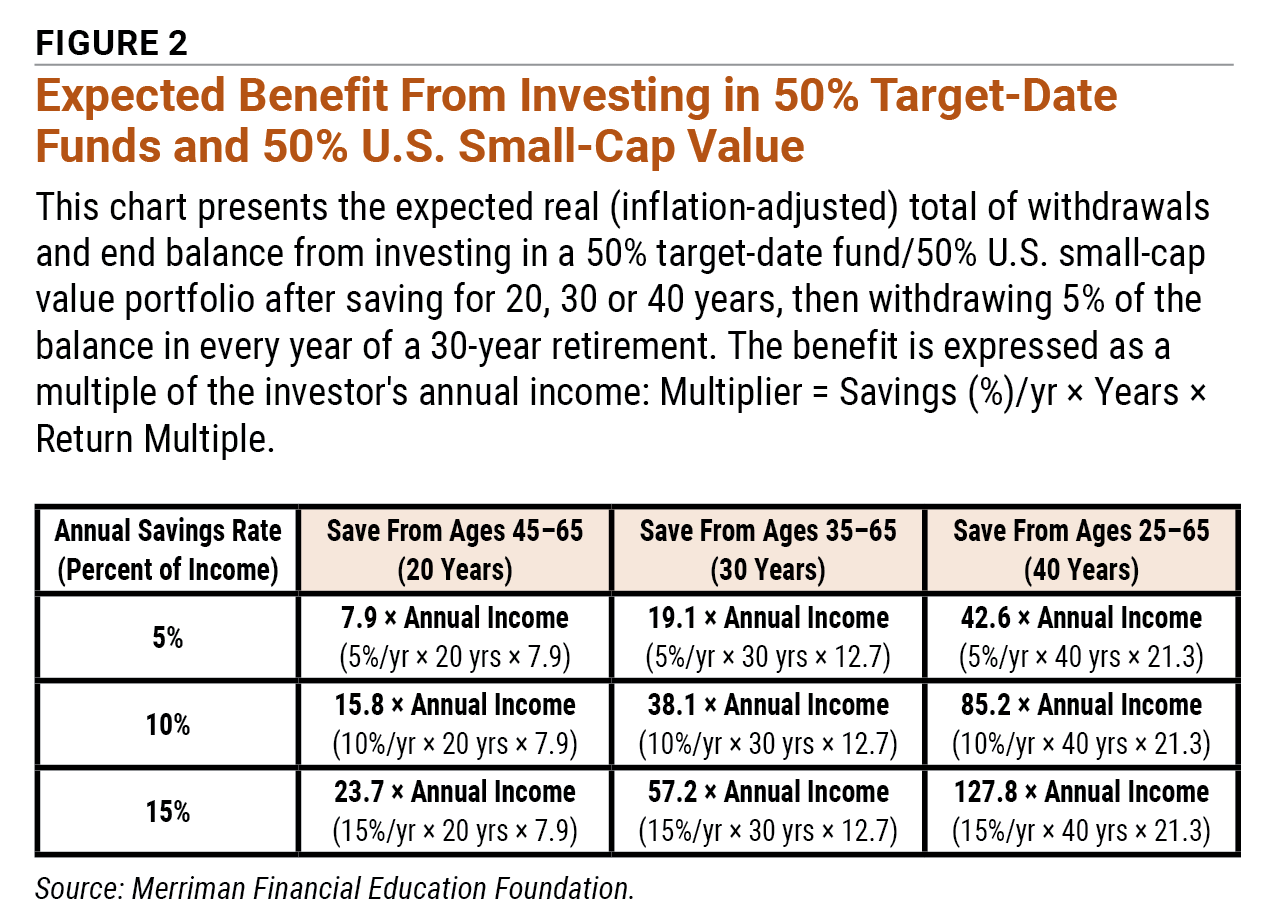
It probably seems unbelievable that someone who saves 15% over a 40-year career and then takes out 5% for 30 years could multiply their real invested purchasing power by more than 100 times, but that’s the power of compounding over a lifetime. Since few people will have the conviction to invest in the 50% target-date fund/50% small-cap value combo, let’s also look at the lifetime impact of a 90% target-date fund/10% U.S. small-cap value combo. Compared to the target-date fund alone, the 90/10 Two Funds for Life strategy produced real (inflation-adjusted) expected total lifetime wealth results that were 17%, 21% and 24% higher than the target-date fund alone for the 20-, 30- and 40-year savings scenarios, respectively. That may not sound like a lot, but if you consider it a 20% retirement income raise, I think most investors would rather have it than not—especially when they learn that it increased worst-case drawdowns by less than 5%.
Put Your Savings and Portfolio on Autopilot
We make most of our daily investment decisions on autopilot. Habits are powerful and hard to break, and they can be good or bad.
I am addicted to my daily walks because they get me outside and boost my endorphins. Along the way, I buy and consume large diet sodas. This may not be the best habit, but it gives me an added incentive to keep up my walks.
One of the great things about financial investing today is that so much of it can be automated.
If a 401(k) investor wants to set up a 90% target-date fund/10% U.S. small-cap value allocation for current and future contributions, they can do it in 15 minutes and not touch it again until they retire. In so doing, they’ll set up several things that incentivize them to stay the course. First, they’ll be making regular contributions, which, in the early years, will mask the effects of short-term market downturns. Second, since they’re dollar-cost averaging, they’ll purchase more shares when they are cheap and fewer shares when they are expensive. Third, since they know that professionals manage target-date funds at very low cost, they will likely have the confidence to look away for extended periods, giving their investments a greater chance to compound and provide the investor with the market returns they deserve.
Research shows that one of the most significant benefits of target-date funds is their stabilizing influence on investors. Target-date fund investors are some of the least likely to trade or switch allocations in a down market. This attribute alone is likely to contribute several percentage points to their long-term expected annual return compared to investors who switch investments frequently to try to time the market.
The ability to look away, ignoring the ups and downs of our portfolio, like Rip Van Winkle, is a superpower.

Related

Mutual Funds
How Target-Date Funds Work
Related

Discussion
FREE REPORT

Get your free copy of our special
report analyzing the tech stocks
most likely to outperform the
market.
MEERA S from CA posted 11 months ago:
BARRY J from TX posted 11 months ago:
ROBERT A from NC posted 11 months ago:
ROBERT A from NC posted 11 months ago:
STEVEN K from CO posted 9 months ago:
You need to log in as a registered AAII user before commenting.
Log InCreate an account