



The “one-stop shop” for retirement savings that target-date funds offer is attractive to both investors and employers. The concept is simple: a single fund that provides a diversified portfolio and alters its allocation as shareholders approach the date when cash withdrawals will be taken. Yet, behind the simple concept are complex strategies that offer more volatility and risk than these funds are perceived to have.
A target-date fund is a mutual fund designed in a way that its allocation evolves as a specified date nears. The date is listed in the fund’s name—for example, the BlackRock LifePath Index 2050 fund  (LIPAX) designates a target date of 2050. An investor planning to retire in 2050, or within a few years of that date, would consider investing in this fund.
As the target date moves closer, these funds change their composition to adjust for the level of risk the fund manager believes shareholders should be taking. The current allocation and how often the allocation changes vary from fund to fund. Additionally, at the target date, a fund can either adopt a final allocation or continue to evolve.
Target-date funds are funds of funds. They own shares in other funds from the same family rather than individual securities. For instance, BlackRock’s target-date funds invest in other BlackRock funds. As a result, the target-date fund manager can concentrate on choosing allocations without worrying about what securities should be kept. The drawback is that an investor is bound to the target-date fund’s family and has no influence over the funds they select.
Target-Date Funds: Room for Confusion
While the allure of a target-date fund is a strategy that evolves as the investor evolves, not all individuals are cut from the same cloth. Target-date funds are designed to do what their name states: evolve to meet a target date for retirement. An individual’s fluctuating goals and needs may not be accommodated by the “glide path,” meaning the preset adjustment schedule that a fund’s allocation is set to follow. The requirements of individuals may change as they age.
What happens if you are forced to retire much sooner than the target date or opt to work longer? A target-date fund could leave you unprepared in certain unforeseen situations. Additionally, there is no assurance that the returns of the fund will maintain pace with inflation. There are no assurances that the fund will help you reach your retirement goals. A target-date fund is not an annuity; it is a fund designed to grow wealth over time with the promise of a stream of income at a certain date. These funds are vulnerable to risk and underperformance, just like any investments, no matter the allocation strategy. (Following the passage of the 2019 SECURE Act, there is some movement to allow investors in employer-sponsored retirement plans to purchase annuities with their target-date fund dollars. This option is currently very new and not widely available.)
Finding the ideal balance between long-term return and risk is one of the objectives of a long-term allocation strategy. While a sound allocation plan does not guarantee achieving a certain level of wealth, it does help realize a mix of return potential and volatility that is suitable for a particular investing time horizon.
Investors considering or holding target-date funds should read the fund prospectuses. Prospectuses for target-date funds contain information on how the allocation is intended to evolve over time, as well as what will occur at the target date and afterward. These documents, available at the fund family’s website, also detail a fund’s structure, investment approach, costs and other crucial details.
Allocation of Target-Date Funds
Target-date funds adjust their strategies by maintaining a higher allocation to stocks for longer-dated funds and a smaller allocation to stocks for shorter-dated funds. This is most evident when comparing target-date funds offered by the same fund family. Vanguard’s Target Retirement 2050 fund (VFIFX) has 87.7% of its portfolio allocated to stocks and 9.4% allocated to bonds. Conversely, Vanguard’s Target Retirement 2025 fund (VTTVX) has 54.4% of its portfolio allocated to stocks and 43.0% allocated to bonds. Both funds share the same managers, William Coleman and Walter Nejman (since 2013). The difference is that shareholders in the 2050 fund have a longer period until retirement and therefore can financially withstand more volatility.
Tables 1 and 2 show how the current and final allocation strategies vary for 2050 target-date funds from four fund families. Also included for comparison is the L 2050 fund from the federal government’s Thrift Savings Plan. These funds assume shareholders will retire in 2050. (Typically, target-date funds are offered in five-year increments.) The funds displayed are the largest for this category.
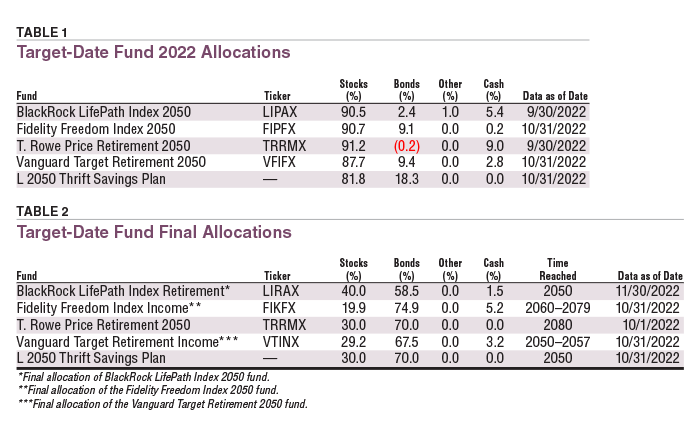
Target-date fund allocation strategies are often separated into “to” and “through” approaches. The allocation can be changed using the “to” strategy up until the target date, after which it is finalized. A “through” strategy keeps adjusting the allocation after the target date. The majority of target-date funds, as shown in Table 2, continue to change their allocations past the target point, evolving up until a set point after the target date. Glide paths differ for each fund company both in terms of how long they continue evolving after retirement and what their final allocation will be.
Looking at the tables, some fund families have a more aggressive allocation at the target date than others. For example, the T. Rowe Price Retirement 2050 fund (TRRMX) follows a “through” approach with an allocation of 55.0% to stocks and 45.0% to bonds at the target date of 2050 that eventually reaches a 30.0% allocation to stocks and 70.0% to bonds in 2080. Meanwhile, the BlackRock LifePath Index 2050 fund follows the “to” approach and will have an allocation of 40.0% to stocks and 60.0% to bonds and cash at the target date (and beyond 2050). The final allocation is part of the strategy followed by the fund manager and fund family, so understanding the allocation strategy and glide period is important when determining whether a particular target-date fund is suitable for you.
You can find out how the allocation of a target-date fund evolves over time and what happens to the allocation at and after the target date by reading the fund’s prospectus.
Choosing a Target-Date Fund
When determining which target-date fund is right for you, there are two main considerations beyond the determination of whether you want to manage your own allocation or have a fund manager do it for you:
- The amount of volatility you are willing to be exposed to leading up to your retirement date and
- The allocation required after retirement to fulfill your financial goals.
While the target date of the fund is the intended date at which the investor will reach their retirement age, there are no restrictions on which target date an investor can select. If you plan to retire in 2030 but are not expecting to rely solely on your portfolio for retirement income—because you have a pension, for example—you could choose a 2050 target-date fund. By choosing a date later than your expected retirement date, you allow your portfolio to have a greater allocation to stocks and therefore more long-term growth. Conversely, if you wish to limit your exposure to equities in case a bear market occurs at or near the time you retire, you could choose a fund that has a shorter date, say 2025 for an expected 2030 retirement date.
In exchange for choosing a fund with a date that is either before or after your retirement date, you either forfeit potential portfolio growth or expose yourself to higher market volatility. Although target-date funds have the attractiveness of simplicity, they do not eliminate the difficult choices that an investor must make in terms of what level of potential return and volatility they want.
After a date is chosen, the specific allocation glide path is then put under the microscope. As previously discussed, each fund has a specific strategy to reach its final allocation. For example, the Fidelity family of funds reaches its final allocation—an allocation similar to that of its Fidelity Freedom Index Income fund (FIKFX)—10 to 19 years after the target date. On the other hand, the Vanguard family of funds reaches its final allocation—an allocation similar to its Vanguard Target Retirement Income Fund (VTINX)—within seven years of its target date. The Fidelity family provides a longer glide path to its final allocation, giving your portfolio more time to grow during your retirement years at the risk of increased volatility. The Vanguard strategy will give you a more conservative, income-producing strategy sooner in retirement.
While none of the funds move out of stocks entirely after the target date, some reduce their exposure to stocks at a faster rate than others once that target date has been achieved.
Another consideration is expense ratios. Due to target-date funds being funds of funds, they tend to have higher expense ratios than individual funds targeting specific asset classes and asset class families. Additionally, they rebalance to match their glide path, so they are more active than other index funds.
Target-date funds are included in AAII’s Mutual Fund Guide (in the Allocation group). Data on these funds and all other funds—more than 23,000 funds in total—is updated monthly.
Target-date funds can be compared head-to-head with AAII’s fund comparison tool, as shown in Figure 1. Both are benefits available to all AAII members.

Funds whose performance ranks in the top 20% for their respective category are assigned an A+ Investor Grade of A. Funds ranking in the bottom (best) 20% for any risk and expense metrics are also assigned a grade of A.
A+ Investor and Platinum subscribers interested in target-date funds and who are not limited to the choices offered in their 401(k) or other workplace retirement plan, can also use the Funds+ Screener to identify target-date funds with specific characteristics. For example, if you want to find the best-performing target-date funds for a certain retirement date, you can screen these funds based on returns.
Conclusion
Target-date funds provide the allure of being a single investment that investors can use to save for retirement over time. They are commonplace in retirement plans and frequently serve as the “default investment,” especially for 401(k) and similar types of plans with an auto-allocation feature. However, target-date funds vary by fund family in several respects. Thus, it is important to understand what you’re investing in and how it fits into your strategy for building retirement savings.

Related

Mutual Funds
Which Funds Fit Your Needs? Here’s How to Decide
Related

Discussion
FREE REPORT

Get your free copy of our special
report analyzing the tech stocks
most likely to outperform the
market.
ROBERT A from NC posted over 3 years ago:
You need to log in as a registered AAII user before commenting.
Log InCreate an account