

Related

Alternative Investments
A new set of investing platforms has emerged to expand individual investors’ access to asset types such as cryptocurrency, private debt, private real estate and fine art.

Charles Rotblut leads a class in AAII's new Essential Investing Video Course. Go to https://www.aaii.com/ves for more information and to subscribe.
Alternative investments refer to investments other than traditional publicly traded stocks, bonds and cash. Traditional assets include mutual funds, exchange-traded funds (ETFs) and closed-end funds (CEFs) that hold stocks, bonds and cash. Publicly traded real estate investment trusts (REITs) can arguably be included in this group too.
Historically, alternative investments available to most individual investors have been limited to commodities and currencies. Cryptocurrency is a more recent entrant. Other types of alternative assets such as private debt, private real estate and fine art have been largely out of reach for most individual investors.
A new set of investing platforms has emerged, most within the past 10 years, to expand individual investors’ access to these other types of alternative assets. Among their benefits are lower investment minimums, the ability to participate without being an accredited investor, simplified tax reporting in many cases and potentially lower costs.
Many of you may have seen or heard advertisements for some of these platforms. They position themselves as offering diversification against the volatility of the stock market. The returns of the asset classes they provide access to are often touted. Missing are the important details about what investors are actually investing in, liquidity (how easy it is to buy and, more importantly, sell), account minimums, fees and tax implications.
In this article, we provide such information on five of the leading alternative investment platforms.
Accredited investors are allowed to purchase investment offerings that are exempt from registration under federal securities laws.
Individuals can qualify to be accredited if they meet the following financial thresholds:
Professional criteria to qualify as an accredited investor:
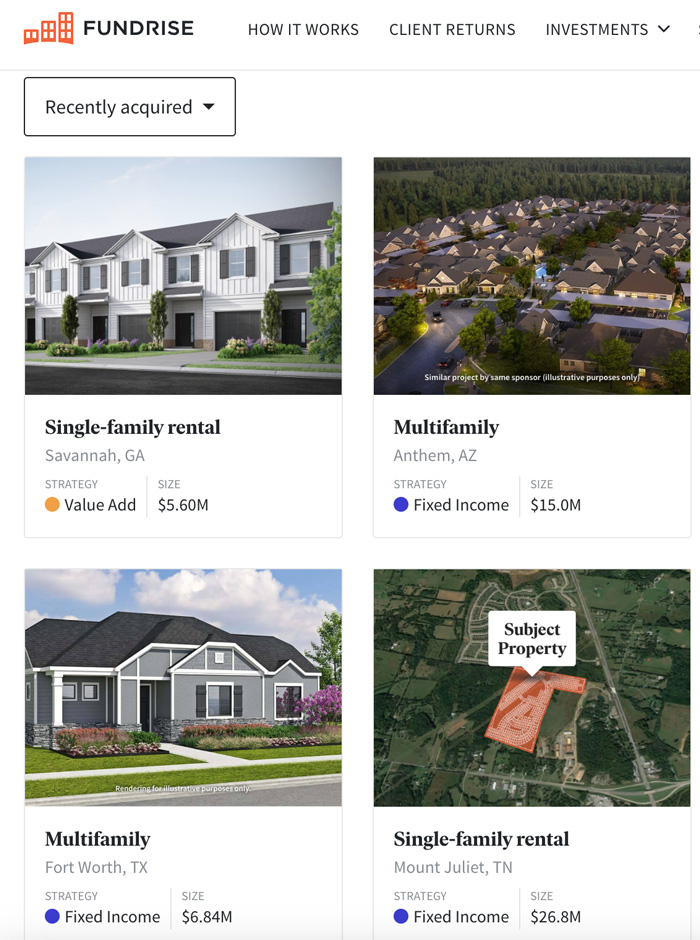
Fundrise allows individual investors to invest in private real estate. Investors can choose among real estate funds managed by Fundrise that provide exposure to a diversified portfolio of private real estate properties.
There are two types of primary fees charged. There is a 0.15% annual advisory fee as well as an annual asset management fee of up to 0.85% for every dollar invested.
Traditional and Roth IRAs are allowed. The $125 annual fee is waived for first-year investments of at least $3,000. A recurring fee waiver is available for retirement accounts over $25,000. Those seeking to take their required minimum distribution (RMD) from Fundrise must submit a liquidation request and have the funds sent to a custodial account at Millennium Trust Company.
Liquidation rules vary by fund. The Fundrise Flagship Real Estate fund and the Income Real Estate fund allow investors to redeem their shares on a quarterly basis without penalty or cost. A penalty of approximately 1% of the total share value is levied on withdrawal requests of eREIT fund and eFund shares held for less than five years. Liquidation requests are typically reviewed on a quarterly basis. Requests are reviewed monthly for the
Fundrise eFund following a 60-day waiting period. Redemption requests may be restricted during real estate market downturns.
The minimum investment is $10 for the starter account level. Minimums are higher for the other four levels, ranging from $1,000 for basic to $100,000 for premium. Access to customization and more sophisticated strategies increase with each level. Only the premium level includes offerings requiring accredited investor status.
In terms of taxes, investors can expect to receive a Form 1099-DIV for aggregate distributions exceeding $10 in the given tax year. A Schedule K-1 form is issued for Fundrise eFunds.
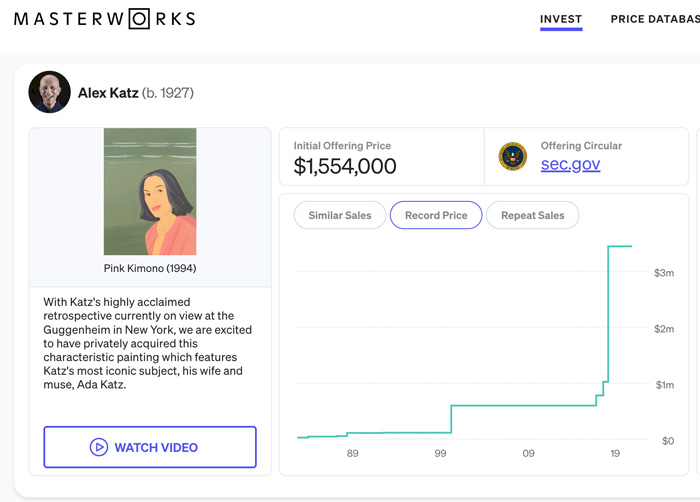
Masterworks allows investors to buy shares in what it describes as “investment grade” paintings. The company purchases a painting, files an offering with the U.S. Securities and Exchange Commission (SEC) for the artwork and then offers shares representing fractional ownership in the artwork. Investors purchase shares in a partnership, formed as a limited liability company (LLC), that holds the painting.
Artwork purchased by Masterworks is held for a period of three to 10 years. (In a video, the company gave a typical holding time frame of three to seven years.) If a painting is sold at a profit—and there is no guarantee that it will be—investors receive a proportional amount of the proceeds less a 20% fee.
Investors also have the ability to buy and sell their shares in a painting on Masterworks’ platform. Participation on the platform requires investors to open and fund an account through DriveWealth, a registered broker-dealer. (The platform itself is operated by another broker-dealer, Templum.) There are no fees for buying or selling shares on the platform, though the shares are non-public securities with no market existing outside of this platform. Trades are settled in one to two business days. Cash withdrawals typically take three to five business days.
An annual 1.5% management fee is assessed, paid in the form of equity.
Because the shares represent an ownership interest in an LLC, investors holding shares in one or more offerings receive a Schedule K-1 form. The company’s website does not address what tax form(s) will be issued in response to the sale of shares on its platform or how capital gains will be taxed.
The minimum investment is $15,000. Investors do not need to be accredited. Nonetheless, Masterworks requires an introductory call to discuss an investor’s intentions and suitability before an account can be opened.
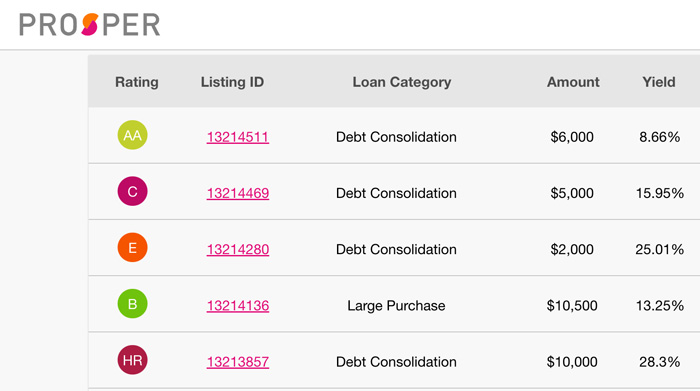
Prosper is a peer-to-peer lending marketplace. The company offers opportunities to invest in personal loans and home equity loans. These fixed-rate loans—what Prosper calls “Notes”—range from $2,000 to $50,000 for periods of two to five years. Investors can consider the interest rate, along with borrowers’ credit scores, ratings and the histories and category of the loan before choosing to invest. Prosper handles the servicing of the loan, including the collection and distribution of borrower payments and interest back to investors.
Investors do not need to be accredited to invest on the Prosper platform. However, they may be required to meet suitability requirements established by their state of residence.
Borrowers make monthly payments over the duration of their loan. Uninvested cash is held in an account insured by the Federal Deposit Insurance Corp. (FDIC) and can be withdrawn at any time.
Both taxable accounts and IRAs are allowed (including a traditional IRA, Roth IRA, SEP IRA or SIMPLE IRA). An annual servicing fee of 1% of the outstanding loan balance is charged by Prosper. The fee is deducted from each payment received on a prorated basis.
IRAs are placed with custodians Millennium Trust and Alto IRA. A $50 custodial fee is reimbursed if the account balance is at least $5,000 at the end of the first year and $10,000 at the end of all subsequent years. Prosper clarifies that “these minimums refer to the amount invested in Prosper Notes—cash balances will not be counted.”
Investors earning more than $10 in what Prosper describes as “net interest” will receive a Form 1099-OID. A Form 1099-MISC will be issued when more than $600 of borrower late fees, referral awards, bonuses, “and the like” are received in a single year. If any notes with corresponding loans are charged off, a Form 1099-B will be issued.
The minimum investment for “individual general investment accounts” is $25. Prosper refers to the $5,000/$10,000 minimums for waiving the custodial fees when discussing minimum investment amounts for IRA-type accounts.
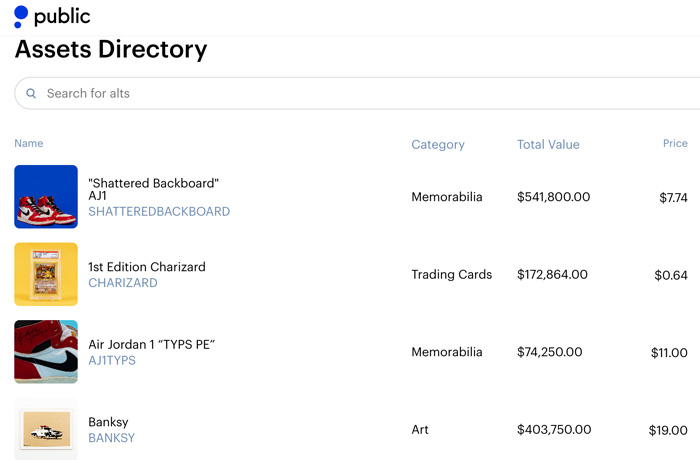
Public is unique in that it combines characteristics of a traditional broker and an alternative asset platform. Stocks and ETFs can be bought and sold on a commission-free basis. As we went to press, Public was close to adding the ability to buy and sell Treasury bills. Additionally, the platform offers the ability to invest in cryptocurrency, NFTs, fine art, rare trading cards, comics and memorabilia. All assets are available to non-accredited investors.
Cryptocurrency trading is offered through a partnership with Apex Crypto. Customers who purchase crypto-currency on Public will have their assets stored in an Apex Crypto account. Fees range from $0.49 to $6.29 per transaction for cryptocurrency trades between $0.01 and $500; transactions of $500.01 or more are charged 1.25% of order amount. Recurring cryptocurrency orders are charged a 1.25% fee regardless of the amount.
Other alternative investments are offered via fractional shares in either a “series” (which Public likens to a “mini company”) of one of its subsidiaries or a stand-alone company. Following the initial offering, investors can buy or sell those shares on Public’s platform. Public can also conduct a “buyout” of shareholders if it chooses to sell the asset.
Shares in alternative investments trade less frequently and Public warns investors of the possibility that they may not be able to sell such shares “at any price.” A 2.5% commission per transaction is charged on fractional shares of alternative investments.
As noted, stocks and ETFs trade commission-free during normal trading hours. Treasury securities held will be charged a 0.05% monthly management fee. Public Premium costs $8 per month and unlocks certain data, allows users to set custom notifications and unlocks research reports from Morningstar.
IRAs and other retirement accounts are not currently offered on Public.
Public provides a consolidated Form 1099 to investors. A separate annual tax statement will be provided to investors who bought or sold crypto assets.

Yieldstreet describes itself as “the leading platform for private market investing.” The company offers opportunities to invest in art, cryptocurrency, legal, private credit, private equity, real estate, short-term debt, transportation and venture capital. The platform does not generally allow direct investments into these assets, but rather gives exposure to them via varying investment structures. Those structures include funds, short-term notes, special purpose vehicles (SPV), borrower payment dependent notes (BPDN) and REITs.
The Yieldstreet Prism fund provides access to a diversified set of alternative investments. Unlike mutual funds and ETFs, only quarterly withdrawals from this fund are allowed.
Stricter restrictions regarding withdrawals exist on other investments offered by Yieldstreet. The platform states that most investments are often locked throughout their duration, meaning that investors cannot sell their investments. Some may allow periodic liquidity investments, during which some withdrawals can be taken. All investments are run through the Yieldstreet platform and cannot be transferred to another account.
The Yieldstreet Wallet is operated through an FDIC-insured account. This is equivalent to a cash savings account. There are no limitations on withdrawals from the wallet.
Fees vary by investment and account type. Yieldstreet charges management fees ranging from 0% to 2.5%. Annual fund expenses, which vary by each investment, can also be charged. Additional annual fees of $299 and $399 are levied on traditional and Roth IRA accounts with balances below and above $100,000, respectively.
Depending on the investment, a Form 1099 or Schedule K-1 form will be issued. Unrelated business taxable income (UBTI) can create tax complications for an investor receiving a K-1 form in an IRA.
Generally, the minimum investment amount is $5,000, though some offerings have higher minimums. Investors do not need to be accredited to invest on the Yieldstreet platform, but some investment offerings may be restricted to accredited investors.
Successful investing is dependent on having a defined asset allocation strategy and sticking to it. Investors should focus first on defining what the appropriate mix of stocks, bonds and cash for them is (even if it is mostly stocks) before adding in additional asset classes such as alternative investments.
In most cases, these platforms are not offering direct investments but rather shares of an entity that provides exposure to an alternative asset. This impacts the returns and expenses.
The market for alternative investments offered by these platforms is smaller than those for publicly traded investments. This means a greater chance of mispricing and more opaque valuations. Some investments and underlying assets may be difficult to sell.
The value of non-revenue-generating assets, such as artwork and collectibles, is dependent on popularity. Shifts in preferences can lead to wide swings in the value of these assets and the pool of potential buyers.
Though some of the platforms offer FDIC-insured cash accounts and the stocks and ETFs held through Public are covered by the Securities Investor Protection Corp. (SIPC), federal protections generally stop there. Alternative investment offerings may also be beyond the scope of the SEC’s and the Financial Industry Regulatory Authority’s (FINRA) regulatory reach.
Each of the five platforms described here provides more information on their website about their specific investment offerings. After looking at each platform, we suggest reading the details about current investment offerings before opening an account to determine if a given platform is a good fit for you.
Alternative Investments

Investor Professor


BARRY J from TX posted over 3 years ago:
MARK D from MI posted over 3 years ago:
JOHN F from AZ posted over 3 years ago:
SCOTT E from MN posted over 3 years ago:
NARENDRA P from GA posted over 3 years ago:
ROBERT A from NC posted over 3 years ago:
Jeff C from PA posted over 3 years ago:
Andrew O from MD posted over 3 years ago:
JAY M from RI posted over 3 years ago:
BARRY J from TX posted 24 days ago:
CHARLES R from IL posted 24 days ago:
You need to log in as a registered AAII user before commenting.
Log InCreate an account