

Related

AAII Model Portfolios
A clearly defined process for making sell decisions prevents emotions from taking over. One method is to base your rules on the criteria used for considering a stock.
by Matt Markowski | March 2023

Stock investing requires individuals and institutions to have a repeatable process. Much like a week of camping in a remote forest requires planning and strategy, so does investing in stocks. Both require research and discipline for success to occur. Too often people are so enamored by what could go right, they forget to think about an exit plan. Knowing what would cause you to sell a stock is critically important to a successful investment strategy.
Predefined sell rules help you answer the question of whether to hold or sell a stock. In addition, sell rules remove emotions from the decision. For example, say you follow a value-based strategy and bought a stock that rose 50% over the course of a year. Your continued analysis of the stock tells you that it is potentially overvalued, but given the stock’s performance, you believe that it still has some upside. What should you do?
It’s not unusual to become attached to a stock you own that’s having a good run. However, the decision to hold based on this emotional attachment ignores whether the stock actually has upside potential based on its investment characteristics. Though this is a hypothetical situation, many investors have experienced a version of it in their investing journeys. Well-defined sell rules can help you make better decisions when faced with such choices.
Not only can you limit the impact emotions have on your decisions with sell rules, but it is also easier to know what to do when you have concrete rules to follow. Once a stock is added to a portfolio, you continue to hold it until it meets one of your sell rules. The ultimate goal is to remove stocks when they no longer adhere to your strategy.
Building sell rules doesn’t have to be tricky. A basic place to start is to model them on the initial considerations used in your stock purchasing strategy. In this context, a well-developed stock portfolio is constructed with three major steps: 1) determining a strategy that fits your investment needs, 2) developing a screen to find appropriate candidates for purchase and 3) creating sell rules for removing stocks when they no longer fit your strategy.
For the purpose of this discussion, a popular stock strategy from the AAII Stock Screens is used—the O’Shaughnessy Tiny Titans screen.
The strategy looks for micro-cap stocks (with market capitalizations between $25 million and $250 million). Additionally, these stocks must have price-to-sales (P/S) ratios below 1.0. In his book, “What Works on Wall Street,” James O’Shaughnessy found that a low price-to-sales ratio is a good way to identify “cheap” stocks and these lower ratios consistently produced higher returns. The screen filters the stock universe on these two factors and then ranks the results on their 52-week relative strength to the market and takes the top 25 stocks. Relative strength is a measure of momentum, with higher values indicating that a stock has been performing better than its peers.
To create sell rules for this strategy, you want to maintain the strategy and adhere to the criteria that allowed you to find the right stocks in the first place.
For example, since the strategy initially screens for stocks with price-to-sales ratios less than 1.0, a potential sell rule could be if the price-to-sales ratio exceeds 2.0. (This threshold is approximately the median price-to-sales ratio for all exchange-traded stocks in AAII’s Stock Investor Pro database.) Price relative to sales is a valuation metric; as it increases, the stock is likely to become overvalued. Valuation metrics are very useful for setting sell thresholds for value-based strategies. (They may not be appropriate as sell rules for other strategies such as pure growth.)
When setting the sell threshold, be careful not to make it too close to your purchase criteria (using, say, 1.25 in this case) or you will eliminate any room for the stock to appreciate in price.
Similarly, you could create a sell rule based on market cap. The strategy identifies micro-cap stocks with market caps up to $250 million. The AAII Model Shadow Stock Portfolio uses an upper threshold of $900 million as the dividing line between micro-cap and small-cap stocks. Once a stock reaches this size, it may no longer represent a Tiny Titan stock.
TABLE 1. Example Sell Rules Based on a Stock Screen
The AAII O’Shaughnessy Tiny Titans screen seeks micro-cap stocks trading at low price-to-sales (P/S) ratios. It then ranks those stocks based on their relative strength, favoring those with the strongest momentum. The example sell rules presented here are based on the inverse of those criteria. Stocks are eligible to sell when they no longer qualify as value or micro-cap stocks, or no longer exhibit strong relative strength (momentum).

Another potential sell rule for this strategy is based on the relative strength required for purchase. With all momentum strategies, you want stocks that maintain their outperformance in comparison to the market. Though this screen ranks stocks meeting the valuation and market criteria based on their relative strength, you could use an absolute relative strength metric for determining when to sell. An A+ Investor Momentum Grade of D (weak) or F (very weak) is assigned when a stock’s weighted four-quarter relative price strength rank falls to 40 or 20, respectively.
Table 1 compares the initial screening criteria for the O’Shaughnessy Tiny Titans strategy to these possible threshold-based sell rules. This is just one example of how you might create sell rules based on a set of buy criteria; it is not necessarily the specific rules that O’Shaughnessy uses.
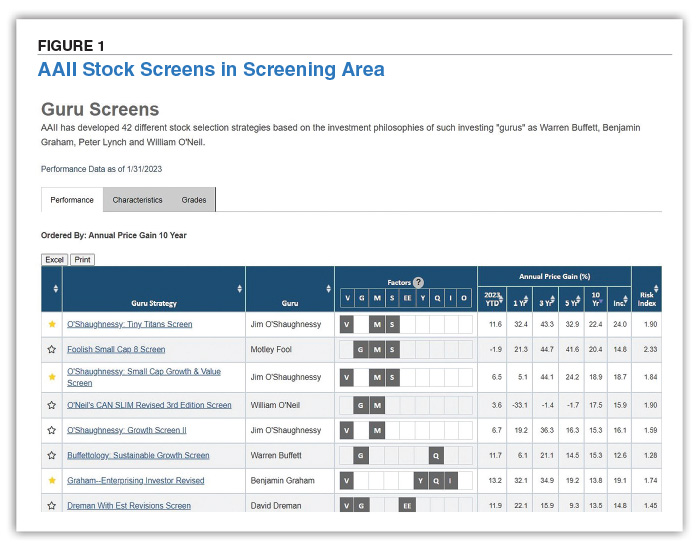
All AAII members have access to the criteria used for the passing companies list of each stock screen—see the Screening area of AAII.com (Figure 1). If you are using a particular screen to identify possible purchase candidates, you can use the initial criteria to construct sell rule thresholds that work for you.
All of the strategies used by AAII’s model portfolios—the Model Shadow Stock Portfolio, Dividend Investing, Growth Investing, Stock Superstars Report and VMQ Stocks—base their deletion rules on the criteria used for adding a stock, since it leads to a clearly defined process instead of relying on emotion or intuition. It also enforces following a disciplined, repeatable process.
All five AAII model portfolio strategies also use more than a single data point for deletion decisions, though meeting any deletion rule can prompt the removal of a stock. Each rule is well-defined to provide clarity on whether a change to the portfolio needs to occur. See the Model Portfolios area at AAII.com for a sample of each portfolio.
Keep in mind that there can be circumstances not covered by your initial set of sell rules that you will need to consider—for example, when a company you own receives an acquisition offer from another company. As these situations occur, add to your sell rules so you have guidelines to follow should something similar occur in the future.
Most importantly, keep in mind that the purpose of sell rules is to provide you with clarity about whether to sell or not. Without sell rules, an investment strategy has no direction, and you may find yourself struggling to make decisions in your portfolio.
AAII Model Portfolios

The Big Question


ROBERT A from NC posted over 3 years ago:
JIMMIE S from GA posted over 3 years ago:
ROBERT A from NC posted over 3 years ago:
You need to log in as a registered AAII user before commenting.
Log InCreate an account