Tracking Dividends Versus Buybacks

Recent tracking of S&P 500 stocks shows that companies are clearly spending more on buybacks than dividends. 
Derek Hageman leads a class in AAII's new Essential Investing Video Course. Go to https://www.aaii.com/ves for more information and to subscribe.

Companies reward their shareholders in two main ways—by paying dividends or by buying back shares of their stock. An increasing number of companies are doing both. Dividend payments and stock buybacks make a potent combination that can significantly boost shareholder returns.

The main difference between dividends and buybacks is that a dividend payment represents a definite return in the current time frame that will be taxed, whereas a buyback represents an uncertain future return on which tax is deferred until the shareholder sells their stock.

This month, we look at the dividend payout and share repurchase profiles of the S&P 500 index.

As of September 30, 2022, both dividend distributions and stock buybacks recently reached all-time highs a little over two years after the start of the coronavirus pandemic, as measured by the S&P 500.
S&P 500 Dividend Payout Versus Stock Buybacks

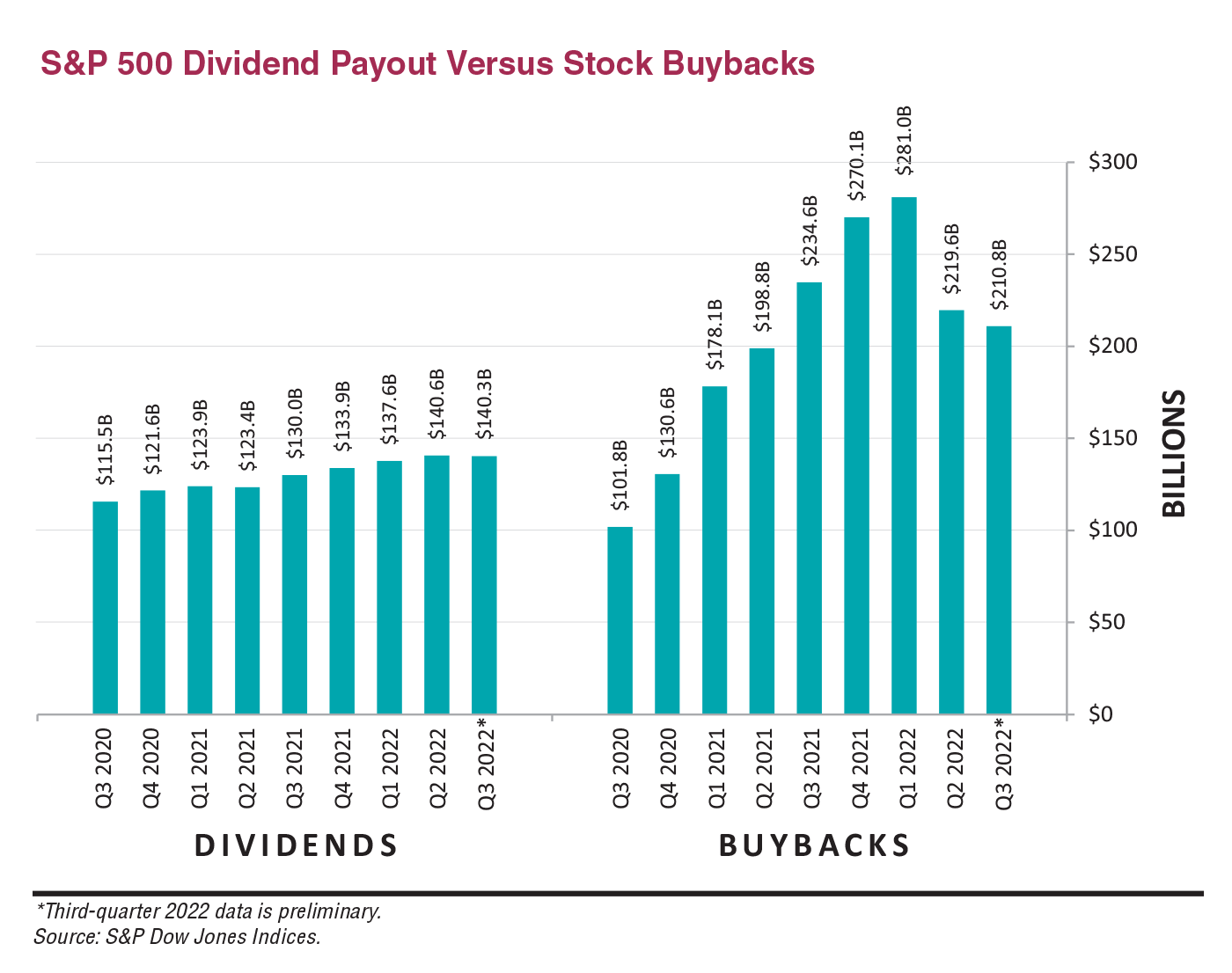
Included in the figure here are the dividend distributions and share buybacks for the past nine quarters. Companies are clearly spending more on buybacks than dividends.

According to data from S&P Dow Jones Indices, the all-time high for the S&P 500’s quarterly dividend payout was $140.6 billion distributed in the second quarter of 2022. Second-quarter 2022 marked the 23rd consecutive quarter in which dividend payouts exceeded $100 billion. Looking back over the last few years, the low point was $47.2 billion in dividends paid out in third-quarter 2009.

The preliminary number on third-quarter 2022 share repurchases is $210.8 billion, down 4.0% from second-quarter 2022’s $219.6 billion expenditure and down 10.1% from third-quarter 2021’s $234.6 billion. A record high of $281.0 billion in buybacks was hit in the first quarter of 2022.

The preliminary number on third-quarter 2022 dividends is a decrease of 0.2% to $140.3 billion from the previous quarter’s record but is 7.9% higher than the year-prior third quarter at $130.0 billion.

According to S&P Dow Jones Indices, as of third-quarter 2022, the S&P 500 sectors that were most aggressive in repurchasing their stock (by percentage of all stocks repurchased) were information technology (28.8%), communication services (14.4%), financials (10.9%) and energy (10.4%).

Discussion

RICHARD B from WI posted over 3 years ago:

Assuming the shareholder requires income from his/her holdings, what are the tax implications of selling appreciated stock vs. receiving qualified dividend income? Given the double taxation of dividends why are dividends preferred over buybacks? How can you measure the shareholder value of buybacks?


MICHAEL D from CA posted over 3 years ago:

The cash paid out for both dividends and buybacks is the "after-corporate-tax" cash remaining from corporate earnings. Corporate is the first level of tax. The potential second, "double", level of tax is at the stock ownership level, which may be an individual or another type of owner entity - even a non-taxable charitable organization, or a non-taxable municipal entity. At that potential second level of tax, a dividend usually represents ordinary taxable income (similar to interest income), a stock buyback represents short or long-term capital gain.


MICHAEL D from CA posted over 3 years ago:

Shareholder value of stock buybacks depends on whether you are a seller or a remaining (i.e., continuing) shareholder - so here are the facts: Dividends are a payment posted directly to, and as a reduction of, Equity – and they are paid to all common stockholders, proportionately to their ownership percentage. Stock buybacks are a payment posted directly to, and as a reduction of, Equity – and they are most-often only paid to a discretionarily-selected small number of stockholders (in reality usually fewer than 10), who may have allocated their holdings to a multitude of different “holding” entities and “holding” funds which they own and control, in order to avoid their total accumulated ownership being easily identified.


MICHAEL D from CA posted over 3 years ago:

Further consider, regarding the value to a shareholder of buybacks: Buybacks direct billions of dollars of cash from the corporate bank account to only a very few large stockholders (usually less than 10) who want to sell their holdings - resulting in a dollar-for-dollar reduction in the corporate Equity owned by all the remaining stockholders! A payment out of the corporate bank account which could have instead come out of “Mr. Market’s” bank account. Because: a. It didn’t purchase any new assets or pay any bills/liabilities/debts; b. It didn’t pay any costs of operations; c. It didn’t benefit all stockholders; d. It will no longer be available to protect the remaining common stockholders from losing everything in a crisis requiring government “bailouts” (e.g., as happened in 2008 to all the common stockholders of GM, and those of Lehman Brothers, and other companies)!


MICHAEL D from CA posted over 3 years ago:

Remember, common stockholders only own one thing when they hold a corporation’s stock! It is the ultimate dissolution cash-value of the corporation’s “Equity” (i.e., the net cash left after all the assets are sold and all of the liabilities and debts have been paid)! A stock buyback is a reduction in a corporation’s most for-sure and real asset, its cash. Consequently, one would think all remaining shareholders should want any corporation in which they continue to own shares, to accumulate and retain as much cash as possible!! And when a corporation is being dissolved, there can be no re-issuing of more stock to acquire cash!


MICHAEL D from CA posted over 3 years ago:

A stock buyback isn’t “accretive” to the remaining shareholders value of their ownership - even though their percentages of ownership have increased. Because, when that new larger percentage is multiplied times the new lesser “Equity”, their dollar value of Equity is exactly the same as before the stock buyback occurred. What’s changed is a few very large stockholders have reduced their ownership (or perhaps sold all of their ownership). It might be appropriate for the remaining shareholders to wonder why?? And, especially to wonder why the corporate management suite and Board of Directors thought it was in the best interests of the corporation to facilitate the seller’s exit, by utilizing the corporation’s “Cash in the bank” (and sometimes even borrowing to have enough cash) – instead of telling those who want to sell “You need to sell your shares to ‘Mr. Market’, who is always willing to buy your shares for a fair price”??


MICHAEL D from CA posted over 3 years ago:

Speaking as a retired CPA: There is no value attributed to the stocks bought back, because they cannot be reissued (i.e., re-sold) without an extensive paperwork, and an approval process, occurring. And what "Mr. Market" would pay for them is anybody's guess! Consequently, accounting rules simply reflect the buyback payout as the reduction in cash that has occurred, and reflect the corresponding reduction, or loss, of the cash asset from Equity. No value can be assigned to a buyback’s shares, they aren’t considered to have any asset value - they often become part of un-issued stock in the corporate "Treasury"!


MICHAEL D from CA posted over 3 years ago:

Let's face it, if those billions of dollars of stock buybacks had been left in those companies (and "Mr. Market" had taken care of the buying of the stocks sold in those buybacks), those companies would have billions more in "cash" equity, a real positive in terms of justifying a stock's per share market value! If we consider the buybacks over the past 20+ years, we are talking about trillions of dollars - of additional support, and protection for the investment made by the individual, or IRA, or 401k, or pension plan or ... you get the idea.!! The various indicators that the current market is over-priced, at a level last seen in 1929, probably wouldn't be there?


HARRY A from HI posted over 3 years ago:

Michael D has given an excellent analysis of why corporations buy back shares and how in REALITY they serves the interest of the largest shareholders and I may add the self serving top officers and directors of the company, while hurting the small investors. I have watched several "analysts and talking heads" on CNBC who have unanimously spoken against government restricting/taxing the buybacks. These people have become totally self serving and mouthpieces of big corporate executives and do not serve the interests of general public. The chart accompanying the article shows the maximum buybacks happened in the first quarter of 2022, the high point in the market, So in fact the timing of the buybacks couldn't have been worse, as most shares lost value after that. So unless people sold soon thereafter, they were losers. And we know who actually sells after finding out the big buybacks.


M E from NJ posted over 3 years ago:

Is this a stupid question: what about stock issuance? Isn't it the opposite of buybacks? In the news, and right here on AAII you hear only about buybacks and their consequences. A company is doing a buyback. But did they recently create more stock? Or will they soon? Can someone explain this bigger picture?


MICHAEL D from CA posted over 3 years ago:

Very simply, more shares, unless every shareholder receive an amount proportionate to their current holdings (e.g., as happens in a stock dividend, or a stock-split), means a dilution/decrease in all existing stockholder's share of Equity.


Robert R from TX posted over 3 years ago:

"Michael D", you are completely missing why the government is bad mouthing stock buy backs - they generate NO taxes. That is the reasoning behind taxing them, reasoning that is OK with me. Now, "Harry A" I agree with you in that stock buy backs are VERY SELF SERVING to corporate executives that get lavish stock grants or options, therefore that is where the government focus should be - either limiting those (as a former public CEO even I think things have gotten out of hand) or putting in limits. That would be a good discussion at the political level that corporate executives would have a hard time "pulling the wool" over the public's eyes.


Donald S from ND posted over 3 years ago:

Was it not under Pres. Reagan that stock buybacks were made legal?


ROBERT A from NC posted over 3 years ago:

I'd be okay with buybacks if corporate management could be relied upon to properly value their own stock. That is, if management only bought shares when the price was depressed, I'd see their actions as prudent. But they usually pay WAY too much. Buybacks reduce the total number of shares outstanding, which essentially gives each unpurchased share a larger piece of the pie. That's all well and good, but paying too much for the shares is a waste of shareholder money.


JOHN L from NJ posted over 3 years ago:

Does it really matter? Recent research by Larry Swedroe shows that dividend paying stocks historically have no return advantage (alpha) over non dividend paying stocks. Badly timed or otherwise, the stocks of companies using buybacks perform the same as dividend paying stocks. If you need cash flow; selling a few shares works just a well as creating a portfolio of dividend paying stocks!


MICHAEL D from CA posted over 3 years ago:

John L., To some extent one person's definition of alpha may be different from another's. The independently audited performance of hulbertratings.com for the buy & hold dividend growth investing site BuySellDoNothing.com may cause you to change your opinion. See Hulbert's scoreboards for the trailing-12-months, the trailing-3-years, and the trailing-5-years, and don't forget to scroll to the bottom of each of those lists and checkout the comparative "Performance Benchmarks" provided by Hulbert.


MICHAEL D from CA posted over 3 years ago:

John L., Also, Mr. Swedroe's article was appropriately - and correctly in my opinion - rebutted by Mr. J. R. Robinson at https://www.apviewpoint.com/join-the-convesation?view=topic&catid=94&id=55193


You need to log in as a registered AAII user before commenting.
Create an account

Log In

Get your free copy of our special report analyzing the tech stocks most likely to outperform the market.

Download the FREE Report Here: