


Related

Editor's Note
Learning about the main concepts governing when to sell funds from your portfolio can help you set up a disciplined process.
by Matt Markowski | April 2023

Just as it’s important to have a repeatable and disciplined process for investing in stocks, it is also important when buying and selling mutual funds. While the amount of information available may seem overwhelming, paying attention to a set of key metrics can make the decision to hold or sell a fund easier and lead to formulating a disciplined, repeatable process that works for you. These metrics keep you posted on poor performance relative to peers, a change in strategy or a change in risk.
This article covers some of the main concepts governing when to sell mutual funds from your portfolio. Many of these concepts are also applicable to exchange-traded funds (ETFs).
Key to analyzing how a mutual fund is faring is to measure it against a relevant benchmark. This helps you determine if a fund is underperforming or outperforming on a relative basis. The benchmark selected to do this comparison matters. A benchmark index should align with the asset class category of the fund.
Mutual funds usually state the indexes that they are tracking. For example, the Fidelity Growth & Income fund  (FGRIX) focuses on large-cap stocks that pay dividends. The fund’s benchmark is the S&P 500 Total Return index. You can find the benchmark listed in the Fund Details box on Fidelity Growth & Income’s Fund Evaluator page on AAII.com. In cases where a benchmark index is not designated, you can select one that tracks similar assets of the same size, type and sector.
It is important to note that funds hold cash, incur trading costs, charge expenses and have inflows and outflows of investor funds, whereas indexes do not. These factors all contribute to fund performance differences relative to their index.
Additionally, investors should compare a mutual fund’s performance to its category peers. Using the previous example, Fidelity Growth & Income is part of the large value category, so it should be compared to other large value funds. Peer comparisons are particularly important because a mutual fund’s performance is determined by the types of assets it invests in and the style it follows. Large value funds, for instance, perform differently than government bond funds or even small growth funds.
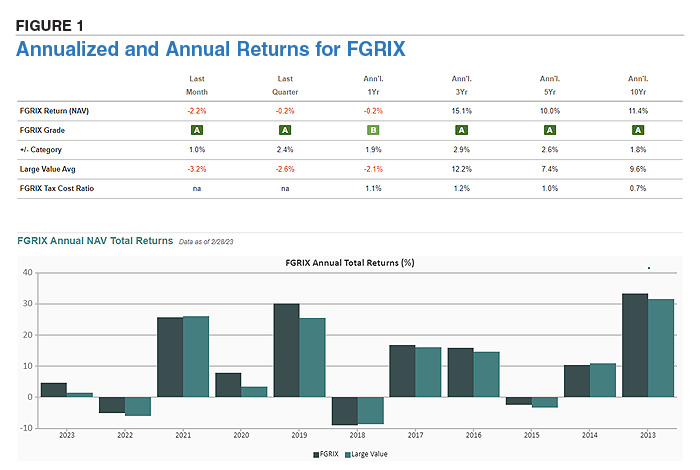
AAII’s A+ Investor Fund Grades make such performance comparisons easy (Figure 1). A fund with an A grade for its one-year return means that the fund ranks in the top 20% (quintile) for its category over that time period. If your chosen fund is underperforming its peers, it will be assigned a grade of D or F for the time period.
Knowing how to compare fund performance is only the first step in deciding when to sell based on performance. Looking at both short-term and long-term returns helps you to determine if a fund is consistently underperforming or if it simply lagged its peers during a specific year. We suggest considering both annual and annualized return numbers.
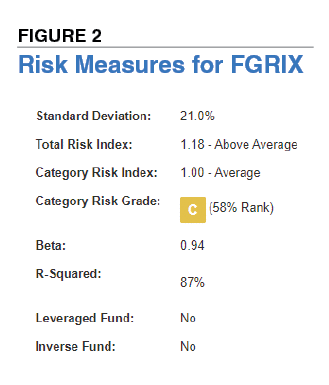
Annual refers to a fund’s return for a calendar year. It’s useful for viewing short-term performance and analyzing performance during years when market conditions were favorable or unfavorable. When comparing short-term performance, the category risk index can be used to determine whether a fund is more volatile or less volatile than its peers. Funds with category risk indexes above 1.00 have experienced more volatility and are prone to greater underperformance and outperformance than other funds in their category.
Annualized performance takes into account the compounding of returns over a specified period stated on a 12-month basis. It shows the increase or decrease in a fund’s net asset value (NAV) over a period of years, the sequence in which distributions and the reinvestment of those distributions occurred, and the effect of compounding. Annualized returns are presented in the Fund Evaluator for periods of one, three, five and 10 years and are updated monthly.
Note that a stellar year can boost annualized returns, while a bad year can drag them down. Thus, it is important to pay attention to both calendar-year and annualized returns.
All mutual funds follow objectives that are specified in their prospectuses. These objectives can be revised or changed over time. Even when objectives don’t change, the way in which the objective is carried out by the manager of the fund can change. This is why we suggest paying attention to any management changes among the mutual funds you own or track. When management changes, the new manager may use a different process, have different biases or otherwise make different decisions than the previous manager.
Analyzing the turnover ratio can sometimes provide insight. If a fund’s turnover ratio increases, it may signal a change in the approach followed. This may occur more often when there is a single manager as opposed to a team of managers with staggered tenures.
A lot of information can be drawn from a fund’s prospectus, including the fund’s investment objectives and strategies. Funds update their prospectuses once a year, allowing investors to monitor the objectives. If a fund’s manager writes a regular letter to shareholders, that can be insightful as well.
Another metric to monitor is assets under management (AUM). A significant increase in AUM can lead to style drift by forcing the manager to expand the universe of stocks or bonds they would consider investing in. This is more of a problem for funds using a specialized strategy, targeting less actively traded assets, investing in smaller markets, targeting specific industries or seeking stocks sized below a certain market capitalization.
Significant outflows (meaning investor withdrawals) can also have a negative impact. They can limit the fund manager’s ability to target the types of investments they have in the past. Additionally, a spike in withdrawals may force the manager to sell investments from the portfolio that they might not otherwise choose to sell. If such investments are sold for a gain, the fund could make an unusually high capital gains distribution. This, in turn, could saddle investors holding shares in taxable accounts with an unexpected tax surprise. Since such outflows typically occur during down periods for the asset class category invested in, they will also negatively affect the performance of the fund.
It is also important to consider asset allocation for both a fund’s portfolio and your own. Check your allocations to large-cap stocks, small-cap stocks, foreign equities, bonds, money market funds and any subcategories. For example, a declining market that results in abysmal short-term performance for your stock-heavy funds would reduce your equity exposure but potentially increase the bond allocation in your portfolio, thereby knocking your overall allocation off target. Assessing your portfolio’s allocation can help you determine which funds should be pared and which are candidates for reinvestment.
A fund’s allocation can be easily checked on AAII’s Fund Evaluator pages. The portfolio composition section shows a percentage breakdown of the fund’s assets by domestic stock, foreign stock, preferred stock, domestic bond, foreign bond, convertible bond and cash, along with the total number of holdings.
Also presented on the Fund Evaluator pages in the Risk Measures section is a fund’s risk profile (Figure 2). Pay attention to the total and category risk indexes, as they measure the fund’s risk relative to all funds and relative to funds in its peer group, respectively. A significant change in a fund’s risk index can also be a sign of a change in the fund’s approach.
On AAII.com the Fund Evaluator, including Fund Grades, is accessible to all members by typing a fund name or ticker in the search box at the top left of most webpages. Choose the fund from the drop-down list to open the evaluator.
Editor's Note

ETFs and Mutual Funds

AAII How-To

No comments have been added yet. Add your thoughts to the discussion!
You need to log in as a registered AAII user before commenting.
Log InCreate an account