

Related

The Big Question
If you have been investing for some time you likely have an assortment of funds that were reasonable investments at the time but may no longer fit your investment objectives or compare favorably to their peers.

It tends to be easier to accumulate items than to let them go. If you have been investing for some time you likely have an assortment of funds that were reasonable investments at the time but may no longer fit your investment objectives or compare favorably to their peers. Mutual funds and exchange-traded funds (ETFs) provide effective diversification along with cost-effective professional security selection and management. Chosen carefully, your fund investments can be held for years with little more than a periodic check. The start of the year is a great time to review your portfolio and keep only those investments that still ‘spark joy.’
Before you start cleaning up your portfolio, you should ask yourself if your financial goals or personal situation has changed and if your asset allocation needs to be adjusted. It is better to start with the big picture and work your way down to the individual fund decision level. It is never too late to draw up an asset allocation plan if you don’t have one. The AAII PRISM Wealth-Building Process is a five-step process to help you establish and review your financial goals and risk tolerance, as well as determine an appropriate asset allocation. AAII members have access to worksheets, articles and videos at the Planning section of AAII.com.
The first step of tidying up your portfolio is to perform a periodic asset allocation review, which should be done at least annually. This entails checking your allocations to segments such as large-cap stocks, small-cap stocks, foreign equities, bonds, money market funds and any subcategories. (See www.aaii.com/assetallocation for three broad types of investors.)
Recognize that your stock funds could decline anywhere from 20% to more than 40% within a few months during a bear market. You might want to check and see how your funds and similar funds did during down periods to get a feel for what could happen during a bear market. If you are uncomfortable with a decline of that magnitude, you should rethink your asset allocation.
Do you need to rebalance your portfolio? To eliminate risk creep, pare back exposure to one or more asset classes that have become overweighted in an aging bull market or add to asset classes that became underweighted during a bear market.
You might even eliminate an asset that’s no longer suitable for your portfolio. Ask yourself if you would buy this fund today given your knowledge of the fund and your personal situation. Inappropriate funds should be sold.
Consider making a more gradual change in your asset allocation by investing any new money into the underweighted categories. This is especially true in taxable accounts.
Continuing poor performance of a fund relative to a relevant benchmark and its peers is the number-one fund-related reason for selling. You should focus on a fund’s returns over the past one, three and five years. Also look at the year-by-year performance and how it compares to its peer group.
While monthly or quarterly returns can be monitored to alert you to signs of deteriorating performance, one-year returns are the shortest relevant performance span for long-term investors to examine. However, that doesn’t mean you should automatically sell if one-year returns turn up weak relative to their peers. Deciding how much time to give a poor performer to rebound is not easy, but you should seriously start to think about selling a fund that has lagged its benchmark and peers for the past two to three years.
Different benchmarks are available for different market segments and investment styles. Peer and index benchmarks are provided in AAII’s Mutual Fund and ETF Guides, which are published annually in the AAII Journal and updated monthly on AAII.com. The AAII mutual fund grades compare fund performance to the category average.
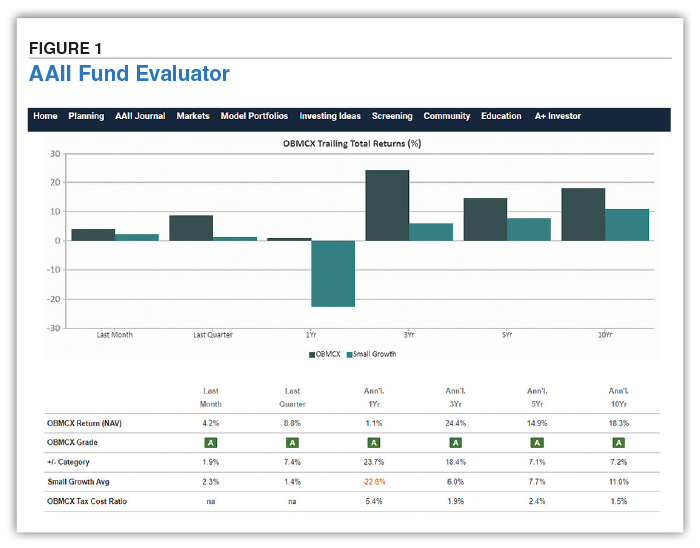
Fund data along with benchmark and category comparisons are also displayed in the Fund and ETF Evaluators on AAII.com (Figure 1). Using the search box at the top of the AAII website, enter the fund name or ticker to look up return information on any mutual fund or ETF with data provided by Morningstar.
The Fund/ETF Evaluator is divided into sections: Overview, Performance, Portfolio and Purchase. The Overview section presents a collection of summary data related to the selected fund, including grades for a variety of performance periods, expense ratio and risk relative to other funds in its category. The Performance section offers trailing and annual performance figures for up to 10 years, along with grades to show how the fund stacks up against funds in its category. The Portfolio section has summary statistics related to the fund’s portfolio holdings, as well as data on the current portfolio composition and risk measures. Lastly, the Purchase section provides important information such as whether a fund is open to new investors, the minimum purchase requirements, load fees (if applicable) and overall expense ratio.
It’s always important to prune out any genuine duds. Some people tenaciously hang onto unproductive investments because they hate to admit that they made a mistake, or they may hate to deal with the tax consequences.
Has there been a change in management? If so, when? This is not always a problem, but be concerned if a star manager leaves or there has been high management turnover for an actively managed fund. Manager changes should not be of concern for index funds.
Have expenses risen significantly? Higher expenses reduce returns, particularly for bond and money market funds because they earn lower gross returns than stock funds. Perhaps a 12b-1 fee has been added or management fees have increased. Newer funds may have been operating with a fee waiver that has recently lifted.
Have assets increased substantially? A surge in assets could have an unfavorable impact on the performance of a small-stock fund if it becomes too large to function effectively. Conversely, a surge in assets may be no problem for many other types of funds, particularly for high-grade bond and money market funds or index funds that could benefit from economies of scale.
Watch out if a fund is rapidly losing assets because investors are jumping ship for some reason. Sizable redemptions can force management to dump good stocks to raise cash. If gains are realized, the fund could make an unusually high capital gains distribution, saddling those who hold shares in taxable accounts with a potentially large tax bill.
Has there been a strategy change? This may or may not be a problem, but consider selling if a fund adopts a new strategy that does not fit with your objectives.
Do you own too many funds? Sell less desirable holdings in a cluttered portfolio to simplify your task going forward. Check for redundancy in your fund portfolio: Funds with different names may in fact share the same objectives and investing style. Your overall performance is likely to improve, and your financial life will be a lot simpler. Plus, it will be much easier to track your asset allocation. The fund/ETF comparison tool on AAII.com allows you to view your funds side by side.
If selling seems warranted by the performance numbers and other factors, you also need to weigh any potential tax liability you would incur by taking a large gain. On the plus side, the tax consequences may be less painful with long-term capital gains taxed at lower rates (the long-term capital gains holding period is 12 months). Nevertheless, if selling would put you in line for a hefty tax bill, it may make sense to give a lazy performer more time. This obviously is not a concern if your fund is held in an individual retirement account (IRA) or other tax-advantaged plan.
Could you realize a significant loss that would offset gains and reduce your tax bill? This is a good reason to sell. If you still want exposure to the asset class, you could switch immediately to a similar fund or buy the same one back after waiting more than 30 days to avoid the wash-sale rule.
Finally, don’t panic and sell just after a market decline. You could lock in a loss and miss any rebound. Panic-selling rarely makes sense because investors tend to overreact to recent bad news, hammering prices to unrealistic lows. But even if a bear market is long and painful, it’s important to remember that stocks have an upward bias and normally gain more in the bullish phases than they lose on the downside—that’s why the long-term trend of the market is up.
The Big Question



Sneha J from IND posted over 3 years ago:
BARRY J from TX posted over 3 years ago:
Sneha J from IND posted over 3 years ago:
Sneha J from IND posted over 3 years ago:
You need to log in as a registered AAII user before commenting.
Log InCreate an account