

Related

Investor Professor
Insights from experienced AAII members on what kinds of funds they choose and why. Plus, lessons they’ve learned along the way.

Charles Rotblut leads a class in AAII's new Essential Investing Video Course. Go to https://www.aaii.com/ves for more information and to subscribe.
Among AAII members who use funds, mutual funds can be found in more portfolios than exchange-traded funds (ETFs). The difference is not large, with 85% of surveyed respondents who hold funds saying they use mutual funds versus 79% who use ETFs. This was among the findings in our latest Big Question survey.
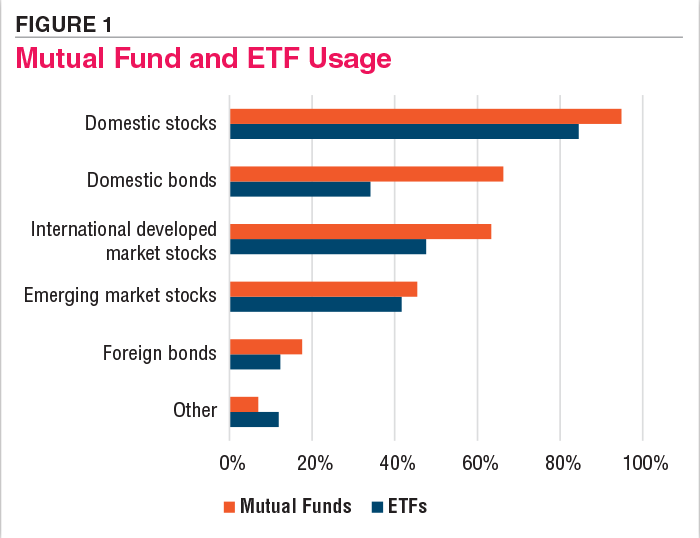
For this survey, we asked two “big questions.” The first was which asset class/asset class categories do you use mutual funds for? The second was similar, with the exception that it asked about ETF usage instead of mutual fund usage. The breakdown is shown in Figure 1.
Domestic stocks were far and away the most selected asset class group among the multiple options given. Almost every respondent using mutual funds (95%) as well as 85% of ETF holders said they use them to invest in domestic stocks.
Domestic bond exposure, conversely, was largely gained through mutual funds. Nearly two-thirds (66%) of mutual fund owners used them to get exposure to bond funds. This compares to just 34% of ETF owners.
By and large, we saw higher percentages of AAII members use mutual funds for a wider array of asset class groups than ETFs. One area where ETF usage stood out was for targeting specific sectors. Though the absolute number of responses was small, we saw far more members say they make use of sector-oriented ETFs than sector-oriented mutual funds.
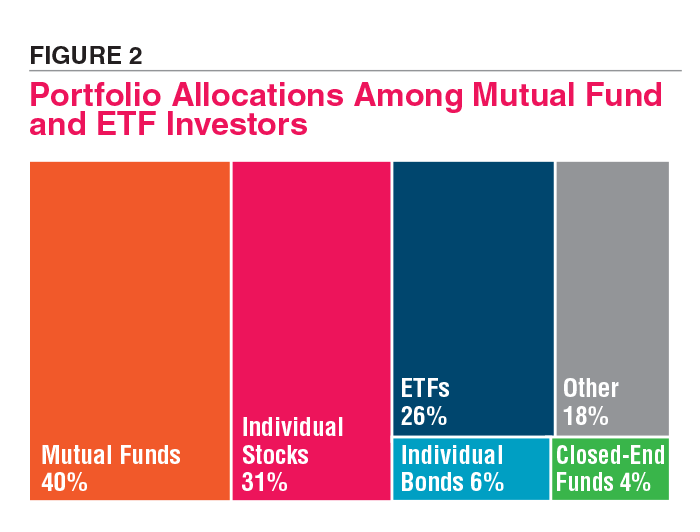
On average, mutual funds accounted for 40% of respondents’ portfolios (Figure 2). ETFs accounted for 26% of their portfolios. This compares to a 31% allocation to individual stocks and a 6% allocation to individual bonds. Behind those averages were wide ranges, with allocations from 0% to 100% for both mutual funds and ETFs.
The Big Question survey is part of a periodic initiative to give AAII members a chance to share their investment decisions and challenges. Each survey asks what we’re describing as a “big question” about a subject of interest to many individual investors. A randomly selected group of AAII members is asked a specific question, as well as follow-up questions intended to provide more clarity and background.
This month’s survey has responses from 321 individual investors who own mutual funds, ETFs or both. Most have been investing for more than 10 years. A little more than 42% of these respondents described their knowledge of investing as “intermediate,” while 29% described themselves as being “advanced” investors. (The number of respondents who did not answer this question was higher than those who described themselves as a “beginner.”)
Diversification was the top reason for using funds (31% of mutual fund owners and 21% of ETF owners). Simplicity, ease of investing and convenience were another common reason (12% of mutual fund owners and 17% of ETF owners). Low costs/expense ratios (18%) and tax efficiency (9%) were also among the key reasons given for holding ETFs.
Member Brock Houston says he uses mutual funds “to form a diversified strategic core for my portfolio. Generally, I buy and hold for the long term.”
A similar rationale was given by John Kropcho as well as several other AAII members. He holds ETFs to have the “core of my portfolio match market index performance.” He also likes the “low expenses, the ability to control the purchase and selling price and the lower tax costs.”
When asked specifically what determines the choice to use a mutual fund or ETF instead of buying an individual stock, diversification was also the top reason given (14% overall). Cost (12%), risk reduction (5%) and a desire to invest in sectors (5%) were also among the most common responses.
“Typically, I’ll focus on return, broad and diverse exposure and the expense ratios for equivalent mutual funds and ETFs,” explained Stephen Carney. “Given roughly equivalent funds and ETFs, I’ll go with the ETF. I’ll use a stock when shooting for a higher return in a specific sector.”
Charles Smith likes “the diversification of mutual funds and ETFs. Stocks and bonds require much more time to manage them.”
Sector funds are commonly used either when an investor lacks specific knowledge about a sector/industry or when it’s difficult to narrow the choice down to one or two stocks. For instance, if Edward Goralczyk “cannot identify some individual stocks as outstanding, he will “decide to simply buy the entire sector” via an ETF.
He later added in a follow-up email, “another reason I will choose to invest in an exchange-traded fund rather than mutual fund is if I am making a short-term trade of less than one or two years. I can set a sell stop order for the ETF—something that cannot be done with a mutual fund. The stop order is used either to lock in a certain profit or to minimize losses if the trade is going the wrong way.”
Ownership of a 401(k) or similar type of account was only listed by 5% of mutual fund owners. While we did not ask respondents for their age in this survey, many AAII members are near or in retirement.
Nearly half of all respondents (44%) indicated a preference for both actively managed and passively managed (index) funds. Many of these respondents expressed a leaning toward index funds in their comments. “I think that passive funds are safer and have a lower cost. Some active managers can beat them, but those managers are hard to find,” wrote Karen Garth.
We also saw individual investors say that the decision to go with active or index funds is based on the asset class category, strategy or type of fund used. Daniel Whalen was one of them. “Market efficient broad indexes are most cost-effective in passive mutual funds and ETFs,” said Whalen. “Some less-efficient areas are better left to active managers. Active bond managers can be less tethered to indexes. In both types of management, cost matters.”
Stephen Carney shared a similar perspective in an email: “If I’m looking for something passive such as an index, an ETF is my choice. If I’m looking for something to outperform in specific groups (sector, small-cap, international or bonds), I’ll choose an active mutual fund that has a manager with a very good track record.”
This compares to just 26% that prefer passive management. Enthusiasm for solely holding active funds was low, at just 9%.
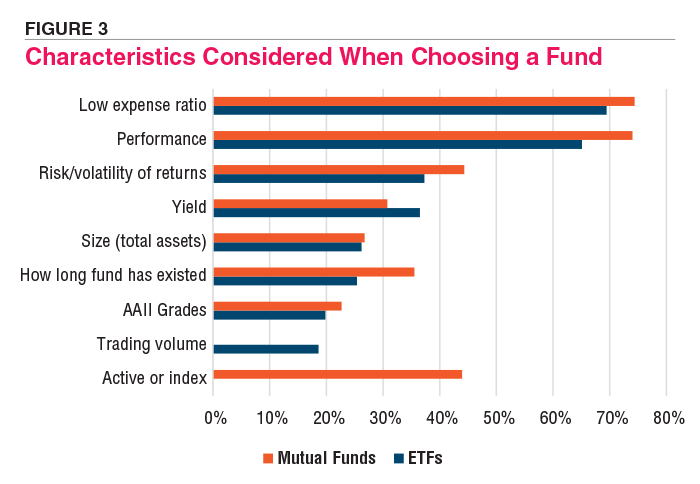
Performance and a low expense ratio were the top characteristics AAII members consider when choosing a fund. Both were listed by 74% of mutual fund investors.
A low expense ratio is given slightly more attention than performance when it comes to exchange-traded funds. Nearly 70% of ETF owners said they look for a low expense ratio, while 65% said they consider performance.
Risk and the volatility of returns was the third-most-commonly selected characteristic (44% of mutual fund owners and 37% of ETF investors). Though ETFs as a group have shorter return histories relative to mutual funds, a fund’s age was considered by proportionately fewer ETF owners (25%) than mutual fund investors (36%).
Jayesh Patel considers a fund’s “performance, risk and expense ratio. There is no way to judge the future except by these factors.”
“In terms of volatility, reasonable stability” is what Ross Goertzen gives emphasis to. He also uses AAII’s A+ Investor Grades to help identify “high-quality funds.”
Performance is also the most common reason for selling a fund. More than one-third of mutual fund owners (35%) and 19% of ETF owners told us poor returns would prompt them to sell.
Many told us they sell when a mutual fund or ETF underperforms over a certain period of time. For instance, Ed Walters will part with a fund if it has “poor long-term performance relative to its peers.” He’ll also sell when a mutual fund manager “changes the ‘rules’ of investment that the fund is following” or an ETF “moves away from the sector I wanted in the first place.”
One out of five respondents (20%) told us that a mutual fund’s or ETF’s tax efficiency has at least some influence on their decision to buy or sell a fund. Though sizable, it is below the 36% who expressly said tax costs have little or no impact on their decisions.
The extent to which taxes mattered depends on the type of account funds were held in.
Fund distributions are not a taxable event for mutual funds and ETFs held in tax-preferred accounts like IRAs, Roth IRAs or 401(k) accounts. Distributions are taxable when made to taxable accounts. Therefore, it was not surprising to see respondents discuss tax efficiency in aftertax mutual fund accounts as being an important consideration. Mahesh Kaneriya summed it up by saying: “It’s not a consideration for ETFs and funds in my tax-sheltered annuity/401(k) account, but tax efficiency in my taxable mutual fund accounts is definitely a consideration.”
Finally, we asked AAII members what lessons they’ve learned from investing in funds and what guidance they would share with others. Commonalities among the responses included investing for the long term, being disciplined and patient, diversifying and doing your own homework.
Randy Moresi pointed out that “the title of an ETF doesn’t always accurately define what the ETF contains or how it operates (e.g., using leverage or hedges).” This makes it important to “read the prospectus!”
“Research carefully and choose well so that replacement of funds can be minimized. Keep enough cash and short-term bonds on hand to cover cash needs for an extended market downturn (e.g., 2–3 years),” wrote Tim Stoker.
Charles Norris believes in “investing through dollar-cost averaging.” He further suggests, “Plan to hold, as time is on your side, and diversify into several funds.
Investor Professor

PRISM Wealth-Building Process

Mutual Funds

BARRY J from TX posted over 4 years ago:
WILLIAM H from CA posted over 4 years ago:
ELLIOTT C from PA posted over 4 years ago:
BARRY J from TX posted over 4 years ago:
You need to log in as a registered AAII user before commenting.
Log InCreate an account