

Related

AAII How-To
PRISM leads you to consider funds appropriate for you and what you are trying to achieve.
by Charles Rotblut | July 2021

Charles Rotblut leads a class in AAII's new Essential Investing Video Course. Go to https://www.aaii.com/ves for more information and to subscribe.
There are more than 24,000 mutual funds and more than 2,500 exchange-traded funds (ETFs) listed in AAII’s Mutual Fund and ETF Guides. Choosing which ones should go in your portfolio can at first seem like a daunting task, given the large number of choices.
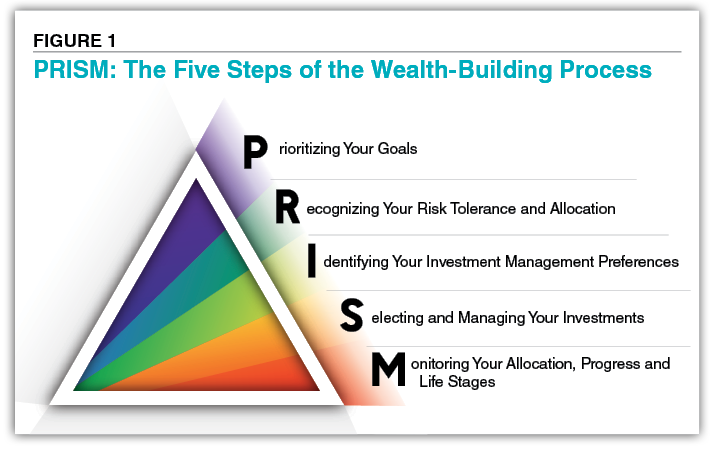
Step 4 of the PRISM Wealth-Building Process begins with selecting your investments, to help guide you to narrow down the large number of investments to a manageable list (Figure 1). In this article, we focus on mutual funds and ETFs. There are enough similarities to create general rules for determining which are attractive and which warrant selling (or avoiding). These same rules can be applied to closed-end funds, if appropriate.
The term “funds” is used here to refer to both mutual funds and ETFs. Both are open-ended types of funds. They can issue or reduce the number of shares depending on inflows (deposits) and outflows (withdrawals) of investor dollars.
There are two broad approaches to selecting a fund.
One is a top-down approach. A top-down approach uses your asset allocation and investment management preferences to guide your choices.
The other is a bottom-up approach. A bottom-up approach calls for seeking out the best fund regardless of your allocation needs or preferences.
PRISM follows a top-down approach. We believe an investor’s allocation should reflect their goals and risk tolerance. The choice of a fund—and even whether to use a fund instead of individual securities—should be reflective of each investor’s investment management preferences. Put another way, the investor’s choice of a fund is an extension of:
This top-down approach personalizes the process of selecting a fund. PRISM leads you to consider funds appropriate for you and what you are trying to achieve. One of the big advantages of PRISM is the clarity it provides. Rather than looking for a needle in a haystack, you are narrowing your search down to a particular bale of hay.
Elizabeth is early in her career and is starting to save for retirement through her employer’s 401(k) plan. Given her young age and long investing time horizon, she is following AAII’s aggressive portfolio allocation model. This model calls for mostly allocating to equities.
She uses this allocation to consider stock-focused funds. She targets specific categories: large-cap, mid-cap, small-cap and international. She ignores sector and industry funds—if included in her 401(k) plan—as she is seeking long-term investments, not funds better suited to tactical approaches.
Elizabeth might prefer index funds. If so, she would seek out passively managed funds in each specific category first. This would simplify the process by immediately narrowing down the list of funds to consider.
The offerings available in her 401(k) plan may place a constraint on her ability to do this. Depending on which fund family the plan is run through, actively managed funds may be her only choices. In this case, Elizabeth would have to be flexible on her preferences. Seeking out the fund with the lowest expense ratio in each category would be a workaround. It would help her to potentially identify those funds most similar to an index fund. (She should look closely at the fund to ensure that this is the case.)
Jane and Bob are married and retired. They are fortunate to have all of their living expenses covered by pension and Social Security benefits. This allows them to focus on their secondary goals of helping to pay college expenses for their two grandchildren.
To provide a contrast with Elizabeth, let’s assume all of the couple’s investment accounts are held with brokerage firms.
Bob and Jane’s choice of allocation depends in part on the age of their grandchildren. When both grandchildren are young, an aggressive allocation would maximize growth of wealth. As each child approaches their college years, the allocation will need to evolve to include more bonds as preservation of wealth grows in importance.
Mutual funds and ETFs are both options. The couple’s PRISM investment management preferences designate them as fund investors. They prefer having a professional manager make the selection of individual securities, and they like the diversification offered by funds. Bob and Jane are open to both actively and passively managed funds.
The couple’s initial selection process involves selecting funds to match their allocation needs. Tax considerations may come into play as a constraint. If they have taxable brokerage-accounts, it may lead them to favor ETFs or index mutual funds with very low tax-cost ratios. Taxes would not be a primary consideration for their individual retirement accounts (IRAs), since neither distributions nor capital gains realized within the accounts are taxed.
(Note: If Bob and Jane were to use a 529 college savings plan instead of a traditional brokerage-accounts, they would be limited in their choice of investment options. The couple’s approach to selecting a fund would be similar to Elizabeth’s.)
Under top-down approaches, such as PRISM, mutual fund and ETF performance is considered after the choice of investment candidates is narrowed down by asset allocation needs and investment management preferences. Once the pool of potential candidates is narrowed down, returns are used to help select a single fund.
It’s important to compare a fund’s performance against its peers. The returns of any mutual fund or ETF are primarily driven by the asset class group(s) they target. Performance of an intermediate-term bond fund is not comparable to that of a large-cap growth stock fund. Similarly, the returns of emerging market stock funds should not be measured against the returns of domestic small-cap value stock funds. Differences in each asset class and each asset class group lead to different return characteristics.
Annualized three-, five- and 10-year returns give you a sense of how a fund has performed over time. A trend of these being above their category averages (designated by grades of A or B in our fund guides) is a good sign.
Calendar-year returns provide context. Keep an eye out for one or two very strong years. If the returns for those years are well above the category average, they may be skewing the annualized returns. This would particularly be the case if the returns for most other years are below average. Below-average returns for a few years shouldn’t be a concern if the returns for most calendar years are above average.
If presented with a wide choice of funds and you don’t have a strong personal preference for active or passive management, which should you choose? Let’s look at the pros and cons of each.
Managers of actively managed funds and their teams handpick the individual securities to hold. Their goal is to beat their respective benchmarks and peers though their analysis and investment methods. The allure of potentially higher returns is what attracts investors to actively managed funds.
Some active managers have enjoyed long-term success. Peter Lynch is among them. Lynch ran Fidelity’s Magellan fund between 1977 and 1990 with great fanfare. During this period, his fund realized an average annual return of 29.2%.
Lynch’s performance was an exception, not the norm. Data from S&P Dow Jones Indices has routinely shown a lack of persistent outperformance by mutual fund managers. The firm looked at how funds that outperformed during the first half of the last decade fared during the second half. Nearly 60% of all funds whose returns ranked in the top-half during the five-year period of 2011 through 2015 did not maintain their above-average returns during the subsequent five-year period of 2016 through 2020. About 11% of the former outperformers either merged with another fund or were liquidated.
Still, there are actively managed funds with a history of beating their peers. AAII’s Fund First Cut screen for Consistent Category Winners (February 2020 AAII Journal; updated monthly for A+ Investor subscribers) seeks no-load mutual funds with both above-category-average returns for the past three-, five- and 10-year periods and below-category-average risk. Most of the passing mutual funds are actively managed.
One school of thought suggests that active management is the better option for certain asset classes and asset class categories. Bond indexes can be difficult to replicate. An active bond manager can use their flexibility to take on more credit risk in search of higher yields and returns or adjust their inflation risk within the parameters allowed by the fund’s objective. Small-cap domestic stocks and smaller international markets are often less efficiently priced and thereby provide more opportunities for active managers.
The challenge with selecting an actively managed fund is finding one likely to outperform in the future. Beyond costs, this is one of the arguments against choosing active management. A fund manager who has been successful in the past may not continue to be so in the future.
There are some characteristics to favor when looking at an actively managed fund. One is a record of outperforming peers. Another is a lower expense ratio. R-squared can tell you how truly active a manager is. (Lower R-squared values are indicative of managers whose performance differs from the performance of the S&P 500 index.) Smaller size relative to category peers can give an active manager more flexibility in what they choose to invest in.
Tenure has traditionally been viewed as another useful characteristic. With more funds using two or more co-managers, it’s become a harder metric to rely on. Still, stability at the top can be a good sign.
Most mutual funds are actively managed. Most closed-end funds are actively managed as well. Attempts to bring active management to ETFs has so far been met with a large level of apathy.
Proponents of passive funds point to their low costs and index-like returns.
Passive funds seek to mimic the returns of an index. This eliminates the need to hire a team of analysts to assess the operations of individual companies. Index fund managers seek to match their portfolios to the construction of an index.
Trading and, thereby, tax costs are frequently lower for index funds. Turnover is limited to the frequency at which the index is rebalanced or adjusted.
Passively managed funds following well-established indexes will not outperform the market. This is by design. These funds’ objective is to deliver the return of the index less expenses. Shareholders holding them will never significantly underperform the stock or bond market, but they also will never beat them either. Proponents cite this as a benefit. The risks of selecting the wrong active manager are eliminated with index funds.
However, not all index funds are the same. It is very important for investors to look specifically at which index a passively managed fund is designed to follow.
Consider the S&P 500. This market-capitalization-weighted index tracks the 500 leading U.S. companies, with larger companies having proportionally greater weight. The S&P 500 Equal Weight index tracks the same companies but with equal weights for each holding. The difference leads to different returns.
There are also a variety of subset indexes. Some are factor-based such as the S&P 500 Pure Growth index or the S&P 500 Dividend Aristocrats index. Others follow thematic approaches, such as the S&P 500 ESG (environmental, social & governance) index and the S&P 500 Catholic Values index. Each deviation from the primary S&P 500 leads to different return characteristics.
Coinciding with the growth of ETFs has been a proliferation of indexes for these funds to track. Some of the indexes are broad in nature. The Dow Jones U.S. Index—launched in 2000—attempts to provide coverage of 95% of U.S. market capitalization. Many other indexes are highly specialized. The WisdomTree U.S. MidCap Dividend index is a dividend-weighted index tracked by a WisdomTree ETF.
Each index has its own return characteristics. While tracking an index is a passive approach to investing, the creation of indexes is not. The methodology for an index can often be found by typing the index name and “methodology” into a search engine such as Google.
Indexing primarily remains within the realm of ETFs, though there are many passively managed mutual funds. For most of the better-known indexes, investors can find both mutual funds and ETFs tracking them. Choosing between the two can often come down to preference. Mutual funds work better for dollar-cost averaging (although fractional-share purchases—offered by some brokerage firms—is changing that). Exchange-traded funds can be bought and sold throughout the trading day.
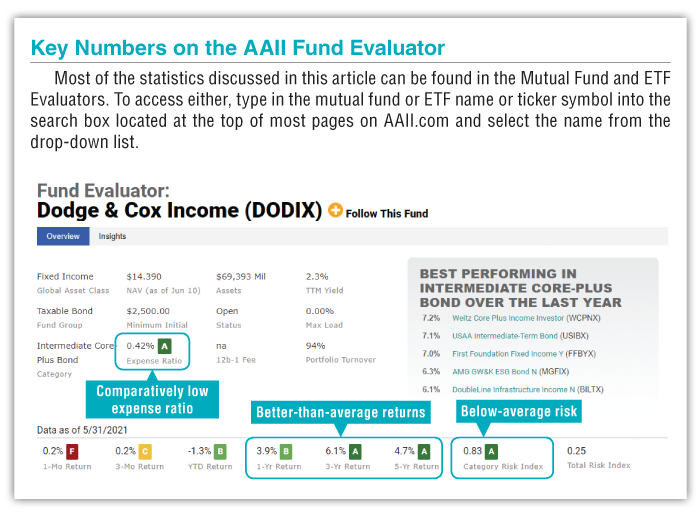
Category Risk: Higher scores indicate more volatile returns. Higher risk can be justified if the fund manager is targeting investments with higher potential returns. It may not be desired if big swings in returns would make you more likely to sell.
Expenses: Is the fund’s expense ratio below or above its category peers? High expense ratios raise the minimum return a fund has to realize just to match its lower-cost peers.
Fund Type: Does the fund match your allocation needs? A top-down approach to selecting funds uses your allocation and investment preferences (e.g., active or passive) to initially narrow down the list of mutual funds and/or ETFs you will consider.
Interest Rate Sensitivity: Bond funds with extensive levels of interest rate sensitivity are the most likely to react to interest rates. Combining this measure with the category risk index shows whether a manager is taking on more interest rate risk and potentially more credit risk in order to realize higher returns and/or yield.
R-Squared: This measure shows how much of a fund’s return is attributable to movements in the S&P 500 index. Be aware of funds with above-average expense ratios and high R-squared numbers. They are providing index-like return characteristics at a much higher cost.
Returns: How has the fund performed relative to its category peers over various time periods? Comparing returns against similar funds is important because a fund’s returns are primarily driven by the asset class group they invest in.
Once the list of potential fund candidates is narrowed by the top-down approach, the primary factors to consider are returns relative to peers (higher is better) and expense ratios (lower is better). R-squared is a consideration when looking at actively managed funds—particularly domestic stock funds—to ensure the manager is truly active.
Three other ratios can help guide your choice of which fund to use.
The first is the category risk index, which indicates how volatile a fund’s returns have been over the last three years relative to all other funds in its category. Higher ratios indicate greater volatility. Higher volatility is not a negative if a manager is targeting investments with higher potential returns. A high category risk would be a reason for caution if bigger swings in returns would prompt you to sell more frequently.
Interest rate sensitivity signals the likelihood of a bond fund’s underlying holdings moving in price in reaction to changes in interest rates. Bond funds with extensive levels of sensitivity can be expected to experience larger swings in returns than bond funds with moderate or limited levels of sensitivity.
Turnover reveals the trading activity of a fund. A value of 100% indicates complete turnover of a portfolio within one year. Low turnover ratios reflect a long-term investing focus by the fund manager. High turnover rates reflect a shorter-term approach. High turnover rates can result in higher tax costs and higher fund expenses.
Select a category under Expanded Fund Listings, sort on any column heading, then mark funds to check side-by-side using the Compare column.

Go to the Learn & Plan section of AAII.com to walk through the entire five-step Individual Investor Wealth-Building Process. To aid in building your plan, there are short videos to watch and fun challenges to work through.
We think you’d like this related webinar! Individual Investor Show: Deep-Value Screen, High-Yield Equity Funds, Using PRISM to Select Funds
AAII How-To AAII How-To Mutual Funds
Related
Understanding Mutual Fund Fees and Expenses
Related

Comparing Funds That Track the Same Index
Related

Top Considerations When Comparing Funds

FRED B from OR posted over 5 years ago:
You need to log in as a registered AAII user before commenting.
Log InCreate an account