

| 20+ Years: | Long Investment Horizon |
very risk tolerant
Discover the best asset allocation models to maximize your investment portfolio's returns while working within your risk appetite.
At first glance, many investors assume that the basic asset allocation decision is an easy one. After all, at this level you are focusing on only two choices—stocks and bonds.
While the choices are few, the way you allocate your portfolio among these two categories will have by far the greatest impact on your performance of any investment decision you make.
To see how real investors like you navigate this decision, check out the AAII Asset Allocation Survey, which offers monthly data on how individual investors currently position their portfolios.
We developed this Asset Allocation Models page to ensure that you receive the information and insights needed to find the best asset allocation for your investing goals and tolerance for risk.
If you think you are already an Asset Allocation Pro, then take our quiz to test your knowledge. If you're uncertain, the AAII Asset Allocation Mini Course is found on the right-hand side of this page. Our PRISM Wealth-Building Process can help you clarify your time horizon and tolerance for risk.
For those who simply want to dig into our investor profiles and the risk/return numbers of our three suggested allocations, use the models below.
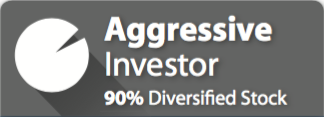
Time Horizon
very risk tolerant Characteristics
Allocations
10% Fixed Income
90% Diversified Stock
Portfolio Return
YTD: 10.3%
1 yr: 12.7% 5 yrs: 8.3% 10 yrs: 10.1% Transitions
25% Fixed Income
75% Diversified Stock
Investors, as they age, usually
transition their portfolios toward
less risky and less aggressive asset
allocations.
|

Time Horizon
Characteristics
Allocations
40% Fixed Income
60% Diversified Stock
Portfolio Return
YTD: 6.3%
1 yr: 8.4% 5 yrs: 6.1% 10 yrs: 7.6% Transitions
50% Fixed Income
50% Diversified Stock
Investors, as they get closer to retirement, usually transition their portfolios toward lower risk and more conservative allocations.
|

Time Horizon
not risk tolerant Characteristics
Allocations
60% Fixed Income
40% Diversified Stock
Portfolio Return
YTD: 3.8%
1 yr: 5.6% 5 yrs: 4.7% 10 yrs: 5.8% |

Once you've determined what Kind of investor you are (Conservative, Moderate or Aggressive) it is time to focus your energy on the nuts and bolts of the asset allocation process. In other words, it's time to slice up the stock and bond pies into allocations across specific investment categories: large, mid, small, and international stock holdings, plus determining how much intermediate or short-term bonds you want to own. The following suggested Asset Allocation breakdowns from AAII can serve as your guide.
We've read the research, talked to the pros and developed what we feel are solid, all weather asset allocation models for long-term investors. To get started, simply spend some time reflecting on the projected average annual returns as well as the possible bad year scenarios for each model and then look at the return data in the second chart to get a feel for how each actual asset class has performed over differing time periods. If you want to dig even deeper into why it pays to diversify, take our brief Asset Allocation Mini Course found in the right hand column. To create a personalized investing plan, see our Wealth-Building Process.
|
Suggested Allocation Breakdowns
Characteristics
Allocations
10% Fixed Income
90% Diversified Stock
Portfolio Return
YTD: 10.3%
1 yr: 12.7% 5 yrs: 8.3% 10 yrs: 10.1% Transitions
25% Fixed Income
75% Diversified Stock
Investors, as they age, usually
transition their portfolios toward
less risky and less aggressive asset
allocations.
|
Suggested Allocation Breakdowns
Characteristics
Allocations
40% Fixed Income
60% Diversified Stock
Portfolio Return
YTD: 6.3%
1 yr: 8.4% 5 yrs: 6.1% 10 yrs: 7.6% Transitions
50% Fixed Income
50% Diversified Stock
Investors, as they get closer to
retirement, usually transition their
portfolios toward lower risk and
more conservative allocations.
|
Suggested Allocation Breakdowns
Characteristics
Allocations
60% Fixed Income
40% Diversified Stock
Portfolio Return
YTD: 3.8%
1 yr: 5.6% 5 yrs: 4.7% 10 yrs: 5.8% |
Mutual funds used as proxies for calculating the historical performance for the allocation models starting in December 2025 are:
Large-cap stocks: Vanguard 500 Index Admiral Shares (VFIAX)
Mid-cap stocks: Vanguard Mid-Cap Index Fund Admiral Shares (VIMAX)
Small-cap stocks: Vanguard Small Cap Index Admiral Shares (VSMAX)
International stocks: Vanguard Developed Markets Index Fund Admiral Shares (VTMGX)
Emerging market stocks: Vanguard Emerging Markets Stock Index Admiral Shares (VEMAX)
Intermediate-term bonds: Vanguard Intermediate-Term Treasury Index Admiral Shares (VSIGX)
Short-term bonds: Vanguard Short-Term Treasury Index Admiral (VSBSX)
More fund options for implementing the allocation models in a portfolio can be found in our Funds page.
Exchange-traded funds (ETFs) that can serve as proxies for the above allocation models include, but are not limited to:
Large-cap stocks: Vanguard 500 Index Admiral Shares (VOO)
Mid-cap stocks: Vanguard Admiral Mid-Cap Index ETF (VO)
Small-cap stocks: Vanguard Small Cap Index ETF (VB)
International stocks: Vanguard Developed Markets Index ETF (VEA)
Emerging market stocks: Vanguard Emerging Markets Stock ETF (VWO)
Intermediate-term bonds: Vanguard Intermediate-Term Treasury ETF (VGIT)
Short-term bonds: Vanguard Short-Term Treasury ETF (VGSH)
More exchange-traded fund options for implementing the allocation models in a portfolio can be found on our ETFs page
Prior to December 2020, the following mutual funds were used as proxies for calculating historical performance: Vanguard 500 Index Investor Class (VFINX), BNY Melon Mid Cap Index Investor Class (PESPX), Vanguard Small Cap Index Investor Class (NAESX), Schwab International Index, Schwab International Index (SWISX) and Vanguard Emerging Markets, Stock Index Investor Class (VEIEX), Vanguard Intermediate-Term Treasury Investor Class (VFITX) and Vanguard Short-Term Treasury Index Admiral ((VSBSX)
Asset allocation involves assigning a proportion of investment dollars to specific asset classes. An asset class is a broad category of related securities, such as equities, bonds, commodities (gold, oil, etc.), real estate and even alternative investments such as venture capital. Naturally, each asset class has various types of investments. Equities, for instance, include stocks, options, mutual funds and ETFs (exchange-traded funds).
These asset classes have different risk profiles and historical rates of return. The chosen blend significantly affects your expected growth, but also the likelihood of experiencing a given year with a substantial portfolio decrease. Investors diversify in this way (between and within asset classes) to protect gains while still gaining exposure to market price movements. There is no best asset allocation strategy because portfolio goals vary for each investor.
Asset Allocation Basics
Dividing capital among the various classes depends on risk appetite and investing timeline. Investors comfortable with risk typically place most of their capital—up to 90%—in stocks, while conservative investors place around 50% of their funds in fixed income. Because of their risk, stocks can offer higher rates of returns. Bonds, stable by their nature, generally offer modest returns, especially in today’s low-interest-rate environment.
Risk tolerance largely depends on the investing timeline. Young investors, not needing to draw down their portfolio for decades, should generally invest aggressively. Retired investors tend toward conservatism because they cannot risk a year with a 30% equity crash—they don’t have other income to supplement their portfolio. As the time to retirement decreases, investors tend to shift their asset allocation strategy to move funds from equities to bonds.
Wealth and cash flow also play a role. Those who will be spending a smaller proportion of their wealth or have guaranteed sources of cash flow (such as pension and Social Security benefits for retirees) can opt for a more aggressive allocation. Conversely, those who will be spending a large portion of their savings over a shorter period of time should consider a more conservative allocation.
Asset Allocation by Age
Again, these are general patterns; asset allocation by age varies by individuals’ needs. New investors may need money to buy a home and therefore might opt for a conservative asset allocation model. Those who retire early need their portfolios to last 35+ years, and thus will keep a larger exposure to the stock market.
A simple asset allocation rule to follow is to subtract your age from 100 and invest that amount in stocks. As bond yields have fallen, some retirement planners now argue that the rule should be modified to 110 or even 120. Regardless of which you choose, it gives a good indication of where to invest your funds.
Tactical asset allocation involves taking an active approach to the percent of a portfolio in any particular asset class based on expected market conditions. For example, a 45 year old may have 60% of her funds invested in equities. However, she expects that stocks will rise in the next five years because of a current recession. Therefore, she chooses to increase her stock asset allocation to 70%.
While this may sound obvious—buy low, sell high—it delves into market timing, which few experts endorse as investors generally overestimate their ability to identify market lows and highs. Instead, financial advisors generally recommend spending time and energy on successfully diversifying holdings within asset classes, not shifting the holding percentage between them in response to market conditions.
This diversification helps maximize returns within asset classes and ensures safe access to money when needed. On the equities side, investors should have exposure to large-cap, mid-cap, small-cap and international stocks (from emerging and established markets). Aggressive investors tend to have a higher percentage of funds in mid- and small-cap stocks and emerging markets than more conservative counterparts because of risk.
Bond diversification means choosing between short- and medium-term bonds. The longer the term, the higher the yield, but also the higher the risk that the issuer defaults or goes bankrupt. Until investors have a regular need to draw from their portfolio, bond allocation should be entirely in intermediate-term bonds. Generally, only conservative investors should park money in short-term bonds.
Recently, new target-date funds have emerged to simplify the asset allocation process. These funds have a target payout date and automatically adjust exposure to stocks and bonds as the years pass. For instance, someone who buys shares of a 2045 target-date fund (expecting to retire in year 2045) would automatically have their funds diversified appropriately. This benefits individuals who want a more passive approach to investing, but obviously comes with increased expenses and loss of control.
Asset allocation is the most important part of investing. It determines risk and expected return—both more so than the individual securities selected within each asset class. Figuring out the right asset allocation model for your goals is the first step to achieving them. Below, you’ll find AAII’s asset allocation examples for structuring your portfolio to maximize your returns.