

Related

Portfolio Strategies
AAII’s PRISM Wealth-Building Process helps you think through the considerations for creating the optimal allocation for you.

Charles Rotblut leads a class in AAII's new Essential Investing Video Course. Go to https://www.aaii.com/ves for more information and to subscribe.
The conventional wisdom about allocation is to gradually become more conservative as you age. This means having most of your portfolio in stocks when you are young and most in bonds and cash equivalents when you are older.
We believe individual investors can do better. AAII’s PRISM Wealth-Building Process helps you think through the considerations that will enable you to create a more optimal allocation based on your goals and risk tolerance.
In this AAII How-To column, I explain the logic behind the conventional wisdom on age-based allocation strategies. I then show you how to create a customized approach that will work better for you.
The conventional wisdom approach to allocation is to use a glide path. A glide path gradually reduces a portfolio’s exposure to stocks over time.
The best-known glide path is 100 minus your age (Figure 1). It is a true age-based allocation strategy. The percentage of your portfolio allocated to stocks is equal to 100 minus your age. A 25-year-old investor will have 75% of their portfolio in stocks (100 – 25). A 75-year-old investor will have 25% of their portfolio in stocks (100 – 75).
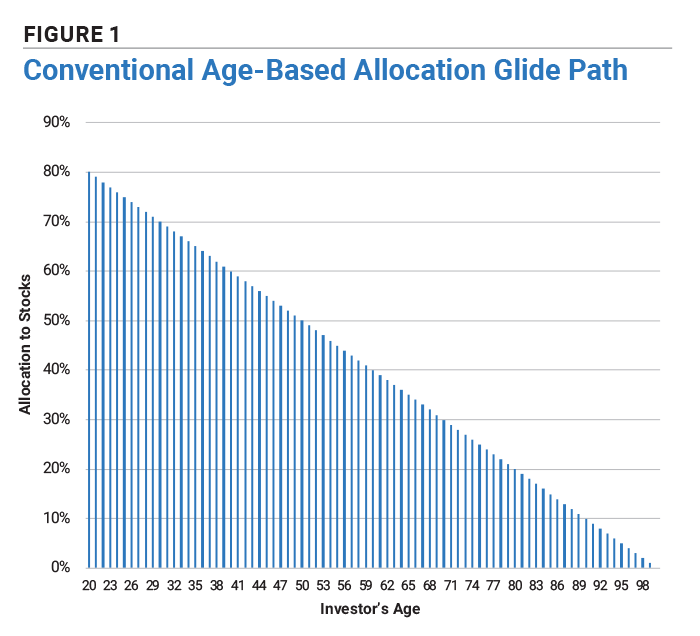
Young investors allocate the largest percentage of their portfolio to stocks since they have many years before retirement and require growth of capital. Investors in retirement are taking withdrawals and are assumed to need more preservation of capital.
Target-date funds follow glide path strategies that also evolve from a large stock allocation to a significantly reduced stock allocation over a long period of years.
These age-based allocation strategies work well for investors who are unfamiliar with how to properly allocate or otherwise don’t want to make such decisions. Glide paths are much better than attempting to time the market or simply allocating to whatever is working well at the time an allocation decision is made.
Age-based allocations assume that everyone has the same psychological and financial tolerance for risk, specifically volatility. This is far from the truth. Tolerances vary by person.
Shorter-term spending needs are not considered by glide paths. Investors in the earlier stages of their career may be attempting to build up emergency savings, pay off student loans and/or start a family. Mid-career adults may be trying to catch up on their retirement savings after having earned lower salaries earlier in their careers.
Wealth and guaranteed sources of income are ignored by age-based allocations. Retirees who are able to live on their Social Security and pension benefits do not need the significant allocation to bonds that a glide path calls for.
Wishes to leave a financial legacy are also completely ignored by glide paths. Investors who feel confident about their portfolios outlasting them can continue to emphasize growth of capital.
The PRISM Wealth-Building Process customizes allocation strategies based on your personal goals and risk tolerance (Figure 2). It then ties your allocation to when you will need to start taking withdrawals.
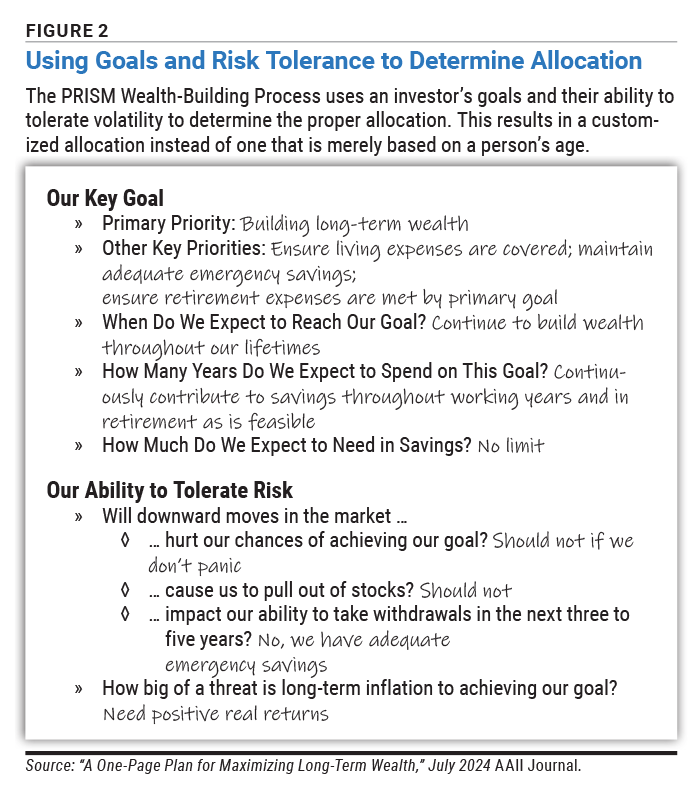
Customization is the key difference. PRISM is not a one-size-fits-all approach. It can easily be modified to target shorter-term spending such as buying a first (or second) house. It can also be used to plan out a future inheritance or other goals.
Let’s assume you have a general date range for when you will retire, and you anticipate enjoying a long retirement. Target-date funds are established in five-year increments, which can already lead to a mismatch. You will have to choose between a 2030 and 2035 target-date fund if you plan to retire in 2033.
In 2030 (or 2035), the target-date fund will evolve to an increasingly significant retirement allocation to bond funds. (Some are starting to incorporate annuities or similar types of investment products.) You, on the other hand, may want to maintain a large allocation to stocks well into retirement. Establishing and following your own personal allocation strategy allows you to do this. PRISM provides the framework to help you plan it out.
The PRISM Wealth-Building Process asks you to define and prioritize your goals. It also asks you to determine your personal risk tolerance. Based on these two considerations, an allocation is determined.
Let’s say your primary goal is having enough in savings to fund your retirement. Key considerations are when you expect to reach this goal, how many years you expect to spend on the goal and how much you need to fund it.
In terms of risk, PRISM asks whether downward moves in the market will hurt your chances of achieving your goal and/or impact your ability to take withdrawals within the next three to five years. Both are designed to take your wealth and sources of cash flow into consideration.
PRISM also asks you whether downward moves in the market will cause you to pull out of stocks. This question prompts you to consider your psychological tolerance for risk. Some people are unfazed by downward market volatility, while others get very nervous. The optimal allocation strategy is always the one you can stick with no matter what the market is doing.
The appropriate allocation is then determined by these factors. An investor whose combined wealth and sources of income (Social Security benefits, pensions, annuities, etc.) exceeds their projected spending in retirement can maintain a high allocation to stocks regardless of their age. Conversely, an investor who barely has enough to fund their goal and gets unnerved by downward moves will need a conservative allocation.
Notice that in both instances, the allocations are not tied to age. Rather, they are customized based on individual goals and risk tolerance.
Glide path allocation strategies that reduce volatility based on your age are a simplistic approach. While traditional glide paths provide a useful starting point, they do not account for your specific goals, sources of income, wealth level or ability to handle market volatility. A truly effective allocation strategy adapts to your goals and risk tolerance. By following the PRISM Wealth-Building Process, you will create a more proper and personalized allocation strategy.
Download a PRISM Wealth-Building Plan Worksheet PDF that you can fill out and save.
Portfolio Strategies

PRISM Wealth-Building Process

PRISM Wealth-Building Process

ROBERT A from NC posted over 1 year ago:
ROBERT A from NC posted over 1 year ago:
JOHN L from NJ posted over 1 year ago:
PATTI R from AZ posted over 1 year ago:
BARRY J from TX posted over 1 year ago:
ROBERT A from NC posted over 1 year ago:
You need to log in as a registered AAII user before commenting.
Log InCreate an account