



Related

Portfolio Strategies
Even if you are limited to choosing among Fidelity funds, you can still build a portfolio based on one of AAII’s allocation models.

Charles Rotblut leads a class in AAII's new Essential Investing Video Course. Go to https://www.aaii.com/ves for more information and to subscribe.
In this article, we highlight no-load Fidelity funds with low expense ratios and above-category returns that can be used to create diversified portfolios based on the AAII Asset Allocation Models.
In discussing the AAII Asset Allocation Models over the past several months, we have provided ideas for using index funds, such as tilting them toward specific styles like growth and value, and shown options for using equal-weighted funds. In all cases, we have considered mutual funds and exchange-traded funds (ETFs) from a variety of fund families. All mutual funds and ETFs discussed so far in this series are potential options for someone who is not constrained to a specific fund family.
This is not universally the case. Some individual investors are constrained in their investment choices. Many defined-contribution plans, like a 401(k) or 403(b), are tied to a specific fund family. Those using a 529 plan to save for a child’s or grandchild’s college expenses may be limited. Others may have accounts set up with a specific fund family or otherwise be incentivized to use funds from a particular fund company. There can also be individual preferences for a specific fund family. To account for this, we’re going to start looking at the offerings from specific mutual fund and ETF providers to highlight options that can be used to implement the AAII Asset Allocation Models in your portfolio.
We chose Fidelity to start with because it is one of the largest mutual fund companies and it is one of the largest 401(k) managers. The combined assets of the Fidelity Investments mutual funds that are included in our database exceeded $5.8 trillion as of July 2023.
The AAII Asset Allocation Models provide individual investors with guidance on reasonable asset allocations that take into account their time horizon and ability to withstand short-term market volatility. The models incorporate three key building blocks to a successful allocation strategy: stocks, bonds and cash.
Our process for narrowing down the 1,435 Fidelity funds listed in our mutual fund screener as of July 2023 was based on a few key criteria. The mutual funds had to be from categories matching the AAII Asset Allocation Models. This meant no target-date funds, no sector equity funds, etc. All mutual funds had to be no-load and directly accessible to individual investors.
Expense ratio grades were required to be A or B. These grades are assigned to funds whose expense ratios are below average for their categories. This was a key criterion since expense ratios are the one component investors can control. The higher the expense ratio, the higher the return a fund needs to realize just to match the returns of a fund with a lower expense ratio.
Returns were required to be above average relative to a fund’s category peers for most annualized periods when possible. Return grades of A or B are assigned to funds whose returns for a given period rank in the top 20% and 40%, respectively, for their categories.
When screening for mutual funds offered by Fidelity, we found 938 were identified as true no-load funds by Morningstar. Requiring funds to be open to new investors; excluding institutional, adviser, retirement and S class shares; and setting a maximum minimum purchase amount of $50,000 cut the number of fund candidates to 371.
This may still seem like a large number, but when you drill down to find candidates for following a basic, diversified allocation strategy, the options quickly get smaller. A big reason is the restrictions placed on several mutual funds offered by Fidelity.
Let’s start with the funds classified as no-load class shares by Morningstar. This classification for noninstitutional and non-retirement, non-adviser and non-S share class funds commonly covers funds that are available for purchase by individual investors. This is not universally the case. For instance, the Fidelity Strategic Advisers Large Cap fund (FALCX) is only available to investors enrolled in the company’s Wealth Services program.
We also noticed different access levels, with mutual funds classified by Morningstar as “other” share class funds. This group includes mutual funds like Fidelity SAI Small-Mid Cap 500 Index fund  (FZFLX) and Fidelity Strategic Advisers International fund (FILFX). Both are limited to Wealth Services clients.
We sorted through the other share class of Fidelity funds to identify those available for purchase through a regular Fidelity brokerage account. Our hunch is that the other share class includes mutual funds only available directly through Fidelity as opposed to via third-party platforms (e.g., via a broker that isn’t Fidelity). In Table 1, we designated which funds are other share class funds.
Download the Excel spreadsheet of Table 1.
Among the no-load large-cap blend funds, Fidelity Total Market Index (FSKAX) is market-capitalization-weighted fund that can serve either as a large-cap holding or a broader holding covering all U.S. equities. Tracking the Dow Jones U.S. Total Stock Market index, it holds nearly 4,000 stocks. The index includes all U.S. companies with readily available prices across all market-cap sizes. Fidelity Total Market has bested the majority of its peers year to date and over the past five years. It also has a very low expense ratio at 0.015% (truncated in the table).
Fidelity ZERO Total Market Index (FZROX) is one of the firm’s zero-expense-ratio funds. These funds do not charge an expense ratio but may not be available for purchase by non-Fidelity clients. Like Fidelity Total Market, it holds large-, mid- and small-cap stocks. It differs by tracking a Fidelity float-adjusted market-cap-weighted index. Float-adjusted indexes factor in the number of shares available for trading for each company. Fidelity ZERO Total Market holds fewer stocks at just under 2,700 while having similar sector exposure as Fidelity Total Market.
[We excluded zero-expense-ratio funds Fidelity Series Total Market Index (FCFMX) and Fidelity ZERO Large Cap Index (FNILX) because each has an Grade of C for the three-year period ending July 2023 and no five-year return history.]
The Fidelity 500 Index fund (FXAIX) is a true large-cap fund. With an expense ratio of 0.015%, it is competitive with other S&P 500 funds. It is classified as “other.” This may make it difficult to purchase in non-Fidelity accounts.
The best-performing large-cap blend fund in the group is Fidelity U.S. Sustainability Index (FITLX). As the name implies, it is a socially responsible fund. Its underlying benchmark, the MSCI USA ESG Select Index, comprises large and midsize companies with strong environmental, social and governance (ESG) ratings. Though the fund bleeds across asset allocation categories, it is tilted toward large caps.
We include both growth and value funds for investors who wish to tilt their portfolios toward either style.
On the growth side, the Fidelity Blue Chip Growth fund (FBGRX) has the highest year-to-date and five-year performance. Even at three years, it ranks in the top quintile of its category with an A+ Investor Grade of A. Started in 1987 and managed by Sonu Kalra since 2009, this fund seeks stocks with above-average earnings growth potential and a business catalyst that could add to a stock’s true value. Though cheaper than the majority of its peers with an A+ Investor Grade of B for expense ratio, its 0.76% ratio reflects its active management approach.
Those who prefer an index approach toward growth could look at the Fidelity Large Cap Growth Index fund (FSPGX). The fund charges an expense ratio of just 0.035%. It tracks the Russell 1000 Growth index. The index comprises the companies in the Russell 1000 that have higher price-to-book-value (P/B) ratios, higher historical sales growth and higher projected earnings growth.
Though the Fidelity New Millennium fund (FMILX) follows more of a growth approach, it is classified by Morningstar as a large-value fund. The actively managed fund seeks to invest in emerging growth stocks whose earnings outlooks are viewed as being misperceived by the market. This growth focus helps to explain why its performance has been in the top quintile of large-cap value funds for the year-to-date, three-year and five-year periods. Its expense ratio of 0.61% is low for the category, earning the fund an A+ Investor Grade of A.
The Fidelity Mid Cap Index fund (FSMDX) tracks the Russell Midcap index. This market-cap-weighted index comprises the 800 smallest companies in the Russell 1000. As such, it includes larger companies than the S&P MidCap 400 index. The fund’s disappointing three-year performance (and A+ Investor Grade of D) is attributable to this mid-cap index’s returns. The fund has a very low expense ratio of 0.025%.
Fidelity Growth Strategies (FDEGX) was the only mid-cap growth fund to come close to meeting our criteria. Its year-to-date return of 17.7% is slightly better than the category average, equivalent to an A+ Investor Grade of C. This is an actively managed fund that seeks to identify quality mid-cap funds exhibiting persistent growth.
Of the three mid-cap value funds displayed, Fidelity Value Strategies (FSLSX) is the only to have A+ Investor Grades of A for the year-to-date, three-year and five-year periods. It also has the highest expense ratio of this group at 0.88%, though this is not significantly higher than the other two. The actively managed fund’s strategy finds companies with “superior” returns on invested capital that are trading at discounts relative to their earnings and cash flow.
The Fidelity Stock Selector Small Cap fund (FDSCX) has five comanagers who seek mispriced companies with “a more modest active risk profile.” Despite this objective, the fund’s category risk index is very much average at 1.00. Nonetheless, Fidelity Stock Selector Small Cap has outperformed its peers while maintaining a below-average expense ratio.
The Fidelity Small Cap Enhanced Index fund (FCPEX) will be converting to an ETF in November 2023. We excluded it from Table 1 because of this upcoming conversion even though it has A+ Investor Grades of A, B and B for its year-to-date, three-year and five-year returns, respectively. Though its investment process will not change, we cannot predict how well its price returns will match its net asset value (NAV) returns after the conversion.
The only foreign blend mutual fund to meet our criteria was Fidelity International Index (FSPSX). It tracks the widely followed MSCI EAFE index. This market-cap-weighted index includes both large- and mid-cap stocks from 21 developed markets, excluding the U.S. and Canada. Because Fidelity International is an index fund, its expense ratio is 0.035%.
We excluded the Fidelity International Enhanced Index fund (FIENX) because it too is converting to an ETF in November. The actively managed fund has an A+ Investor Grade of B for its year-to-date return and a grade of A for its three-year return, but C for its five-year return.
Those who prefer foreign small-cap funds could consider Fidelity International Small Cap (FISMX). The actively managed fund follows a value approach. Though currently open to new investors, Fidelity has previously closed it to new investors.
Fidelity’s no-load international growth funds have performed well against their category peers, but have average expense ratios compared to their peers (A+ Investor Grades of C).
The Fidelity Emerging Markets fund (FEMKX) has been among the best-performing emerging markets funds this year and has an A+ Investor Grade of A for its five-year annualized return. Its three-year return is close to the category average, however. The fund’s managers seek growth companies with free cash flow and strong business models.
The Fidelity Total Bond fund (FTBFX) invests primarily in U.S. government bonds (30.1% of the portfolio) and corporate bonds (37.6%). It is managed by a team of six comanagers. Investment-grade bonds account for 85% of its portfolio. It has been a top performer in its category this year as well as over the past three and five years. Its expense ratio grade of A has contributed to this outperformance. The fund had a yield of 4.1% at the end of July.
The Fidelity Investment Grade Bond fund (FBNDX) has a higher allocation to government bonds than Fidelity Total Bond at 42.7% and a lower exposure to corporate bonds at 30.0%. Its yield is also lower at 3.3% while its category risk index is slightly higher (1.03 versus 0.96).
Fidelity did not have any no-load short-term bond funds available to individual investors that met all of our criteria. The two that came closest were the Fidelity Short-Term Treasury Bond Index fund (FUMBX) and the Fidelity Short-Term Bond fund (FSHBX). Both have A+ Investor Grades of A for their expense ratios of 0.03% and 0.30%, respectively. Fidelity Short-Term Bond has nearly half its portfolio allocated to corporate bonds while Fidelity Short-Term Treasury has nearly all of its portfolio in Treasury bonds. Morningstar classifies Fidelity Short-Term Treasury as an “other” share class fund.
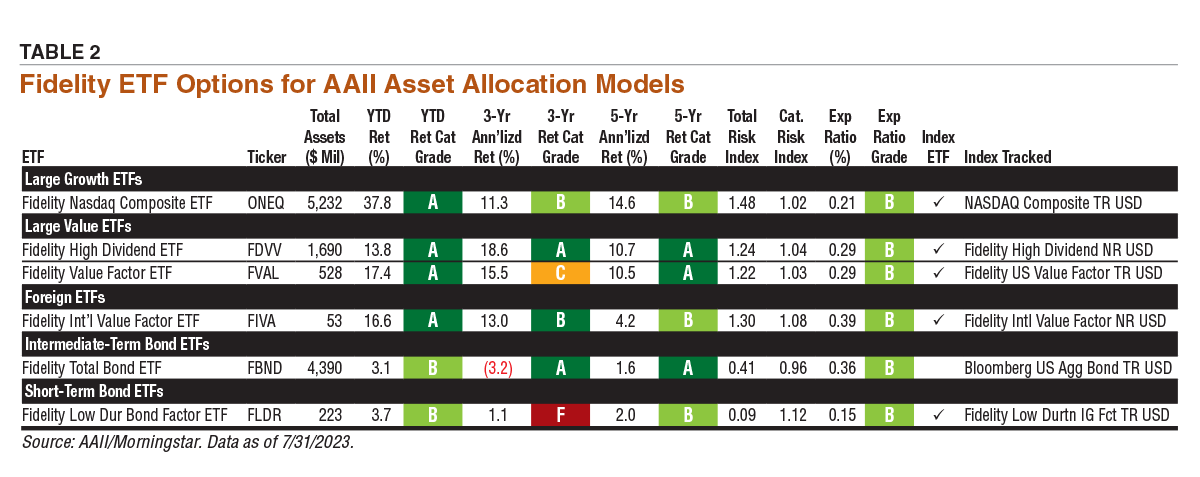
There were fewer than 60 Fidelity exchange-traded funds as of the end of July. The list of ETFs quickly narrowed once we limited the group to the AAII Asset Allocation Model categories and applied our expense ratio and performance criteria. The passing ETFs are shown in Table 2.
Download the Excel spreadsheet of Table 2.
On the stock side, none of Fidelity’s large-blend ETFs qualified. The Fidelity Nasdaq Composite ETF (ONEQ) would be a consideration for someone who is seeking growth. On the value side, the Fidelity High Dividend ETF (FDVV) has realized top-quintile returns for its category. The Fidelity International Value Factor ETF (FIVA) tracks a proprietary Fidelity index, targeting value-oriented stocks in developed foreign countries.
The Fidelity Small-Mid Multifactor ETF (FSMD) and the Fidelity Small-Mid Cap Opportunities ETF (FSMO) did not meet our criteria. Fidelity does not offer its own emerging markets ETF.
The Fidelity Total Bond ETF (FBND) is an actively managed fund. It allocates 35% of its portfolio to U.S. government bonds and 38% to corporate bonds. The Fidelity Low Duration Bond Factor ETF (FLDR) is a short-term index fund. Though it realized above-category-average returns on a year-to-date and five-year basis, it lagged its peers on a three-year basis.
Portfolio Strategies

ETFs and Mutual Funds

AAII How-To

NEIL S from TX posted over 3 years ago:
CHARLES R from IL posted over 3 years ago:
Kevin J from TX posted over 3 years ago:
CHARLES R from IL posted over 3 years ago:
BARRY J from TX posted over 3 years ago:
Kevin C from DE posted over 3 years ago:
CHARLES R from IL posted over 3 years ago:
KENNETH S from NC posted over 3 years ago:
RAINER F from MA posted over 3 years ago:
CHARLES R from IL posted over 3 years ago:
WILLIAM B from GA posted over 3 years ago:
You need to log in as a registered AAII user before commenting.
Log InCreate an account