


Related

Portfolio Strategies
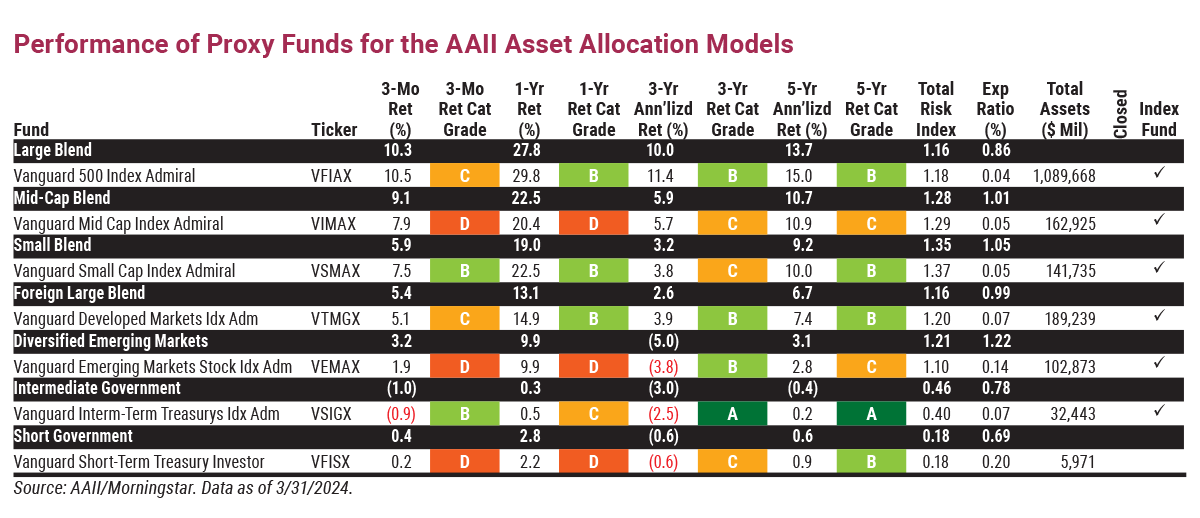
A cursory glance at the performance of the individual mutual funds used to track the AAII Asset Allocation Models reveals the story of what happened during the first quarter of 2024.
by Charles Rotblut | May 2024

Charles Rotblut leads a class in AAII's new Essential Investing Video Course. Go to https://www.aaii.com/ves for more information and to subscribe.
A cursory glance at the performance of the individual mutual funds used to track the AAII Asset Allocation Models reveals the story of what happened during the first quarter of 2024. The big drivers of returns were the Magnificent Seven technology-related stocks and falling expectations about the prospects for several interest rate cuts.
Concentration within the S&P 500 index—and thereby the Vanguard 500 Index Admiral fund  (VFIAX)—increased throughout the quarter. The large-cap fund ended the first quarter with its 10 largest holdings accounting for nearly one-third (32.2%) of its overall portfolio. This was due to the outperformance of the Magnificent Seven stocks.
Meanwhile, bond yields rose throughout the quarter as inflation proved more resilient than traders had hoped. This led to a resetting of expectations about how many interest rate cuts the Federal Reserve will make this year. The net effect was a slightly negative return for the Vanguard Intermediate-Term Treasury Index Admiral fund (VSIGX).
Notably, asset class leadership during the first quarter is a continuation of what we saw last year. Domestic large-cap stocks outperformed mid- and small-cap stocks as well as foreign stocks. Growth outperformed value among large-, mid- and small-cap stocks.
On the bond side, intermediate-term bonds once again struggled and underperformed their short-term counterparts. The yield curve itself remains inverted, with short-term Treasury yields above their intermediate- and long-term counterparts.
These performance trends will not continue forever. At some point, small stocks will outperform their larger counterparts, international stocks will take the performance lead over domestic stocks and intermediate-term bonds will deliver higher returns and yields than short-term bonds.
The timing of when this will happen is, of course, unknown. One of the big benefits of diversification is the increased odds of having exposure to the right asset class at the right time.
The Vanguard mutual funds listed below are proxies for tracking the AAII Asset Allocation Models. Exchange-traded funds (ETFs) can be substituted for them. In this month’s issue, Cynthia McLaughlin presents options from BlackRock that can also be used.
Portfolio Strategies

Investor Professor

JOHN L from NJ posted over 2 years ago:
BARRY J from TX posted over 2 years ago:
You need to log in as a registered AAII user before commenting.
Log InCreate an account