


- Investors who prefer Vanguard funds or ETFs can find options that fit AAII Asset Allocation Models
- Comparison of performance, strategies and expense ratios across the select Vanguard funds
- Guidance on using Vanguard funds for diversified portfolio allocation
Seven broad-based Vanguard mutual funds are used to track the performance of the AAII Asset Allocation Models. Exchange-traded fund (ETF) versions are also listed for most asset categories. But these funds are not the only options for investors who want to use Vanguard funds. Vanguard offers a variety of mutual funds and ETFs for those interested in exploring other choices or who wish to tilt their portfolios toward a particular style.
In previous articles on the AAII Asset Allocation Models, we have explored mutual funds and ETFs from various fund families. The rationale for exploring funds from several fund families that can be used to follow the AAII Asset Allocation Models is to provide options for those who face investment choice limitations. We are adding Vanguard to this analysis. Vanguard’s widely held mutual funds and ETFs are known for low expense ratios, diversification, and depth and breadth of choices.
Vanguard Mutual Funds
We required mutual funds to be identified by Morningstar as true no-load funds and open to new investors. Institutional, advisor, retirement and S class shares were excluded, and a minimum purchase amount no higher than $50,000 was set. Vanguard has institutional funds and many funds with high investment minimums, but no advisor or S class shares.
The year-to-date and three-year and five-year annualized returns were required to rank in the 40% to 100% range for the fund’s category. Returns in this range might seem below what we would advocate for inclusion in the AAII Asset Allocation Models, but relaxing this restriction allowed us to consider a larger group of mutual funds.
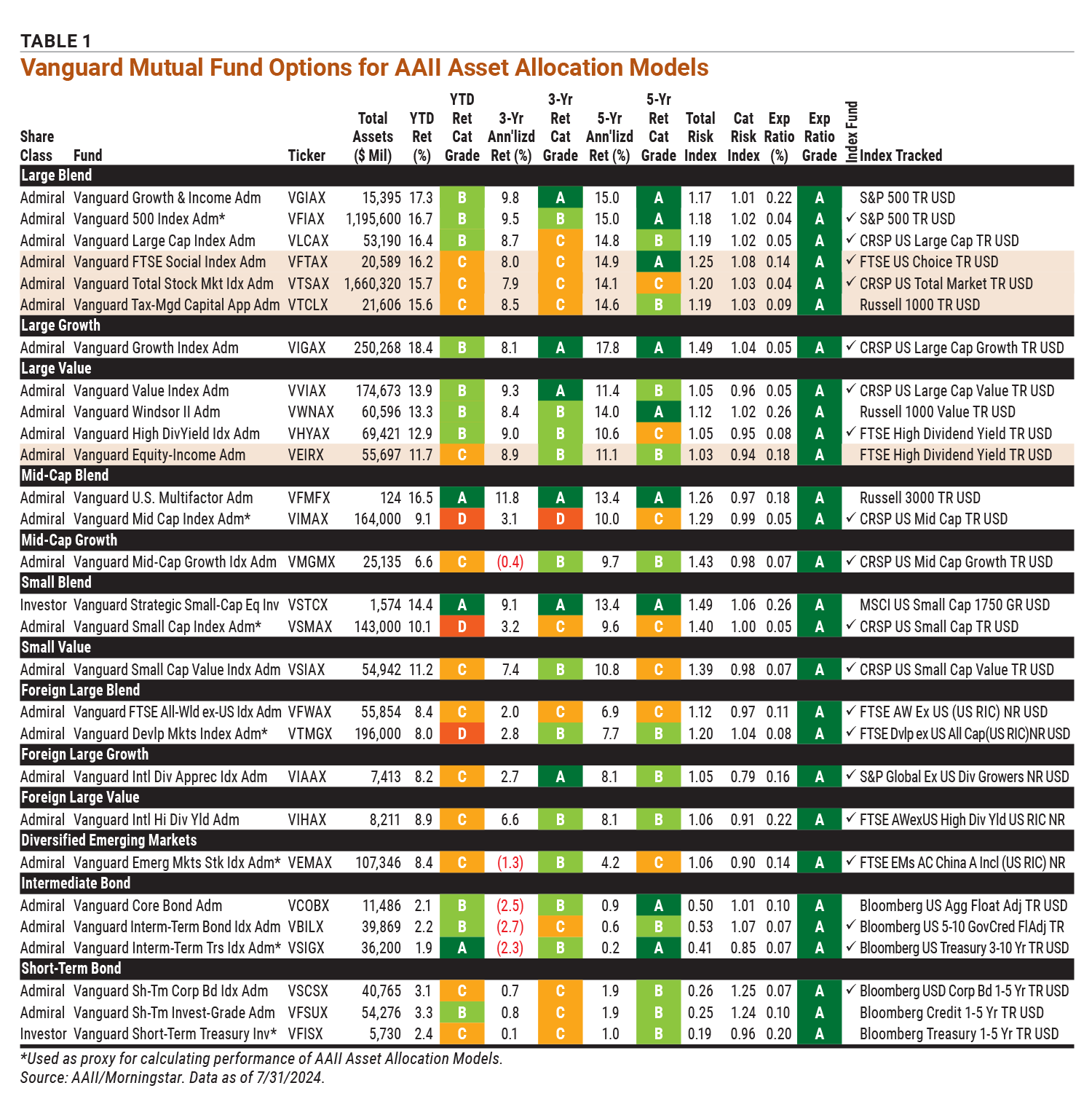
The seven index mutual funds used to track the AAII Asset Allocation Models are noted by asterisks in Table 1. Only two of those funds actually met the criteria for inclusion: the Vanguard 500 Index Admiral fund  (VFIAX) and the Vanguard Emerging Markets Stock Index Admiral fund (VEMAX).
Equity categories include blend, growth and value mutual funds. Fixed-income categories include intermediate and short-term bonds.
Admiral class funds in Table 1 passed our screens and are available for individual investors to purchase in their brokerage accounts. While Vanguard only makes Admiral class shares available to new investors for many of its funds, some of its mutual funds are still investor class. This was the case for the small blend funds that passed the criteria.
Funds are ranked by year-to-date return within each category.
Download the Excel spreadsheet for Table 1.
Large Blend Funds
The Vanguard Total Stock Market Index Admiral fund (VTSAX) is the most widely held Vanguard mutual fund in terms of total assets. It is followed by the Vanguard 500 Index Admiral, which ranks second in terms of total assets.
The funds employ slightly different strategies. The Vanguard 500 Index Admiral tracks the S&P 500 index, whereas the Vanguard Total Stock Market Index Admiral tracks the overall stock market, including large-, mid-, small- and micro-cap stocks. Both have expense ratios of 0.04%, which equate to AAII A+ Investor Grades of A.
The Vanguard 500 Index Admiral has performed better than the Vanguard Total Stock Market Index Admiral over the year-to-date, three-year and five-year periods with above-average performance. The performance of the Vanguard Total Stock Market Index Admiral has been average. Large-cap performance has positively affected the S&P 500 over these periods, whereas small-, mid- and micro-caps have suffered periods of underperformance.
The Vanguard Growth and Income Admiral fund (VGIAX) is actively managed and captures both the capital appreciation and dividend income of the S&P 500. At 0.22%, its expense ratio is comparatively high, though still low for its category. The fund has delivered above-average returns for the time frames shown.
Large Growth Funds
One choice exists from this category: the Vanguard Growth Index Admiral fund (VIGAX). It tracks the CRSP U.S. Large Cap Growth index. The index comprises 183 companies selected primarily based on their historical and projected earnings growth. The Vanguard Growth Index Admiral has above-average returns and a comparatively low expense ratio for its category. The total risk index value of 1.49 is among the highest of the funds shown in Table 1. The total risk index compares the standard deviation of returns for a given fund with that of all funds in the universe. The average value is 1.00. Values above and below indicate higher and lower risk, respectively, relative to the overall universe.
Large Value Funds
One of the highest-performing large-cap value funds included in Table 1 is the Vanguard Value Index Admiral fund (VVIAX). It tracks the CRSP U.S. Large Cap Value index. The index selects stocks based on their price-earnings (P/E), price-to-book-value (P/B) and price-to-sales (P/S) ratios and their dividend yields. Of the four choices in this category, the Vanguard Value Index Admiral also has the lowest expense ratio of 0.05%. It has the best performance year to date and over the last three years. The actively managed Vanguard Windsor II Admiral fund (VWNAX) performed better over the five-year period (14.0% vs. 11.4%).
Mid-Cap Funds
The Vanguard U.S. Multifactor Admiral fund (VFMFX) is an actively managed fund. It is categorized as a mid-cap blend, but it employs a proprietary screening model that ranks stocks on factors such as momentum, quality and value. It has top quintile (top 20%) returns for its category on a year-to-date and three-year and five-year annualized basis. Investors will pay 0.18% for this performance.
The Vanguard Mid Cap Index Admiral fund (VIMAX) is passively managed. It tracks the CRSP U.S. Mid Cap index and is utilized in AAII’s Asset Allocation Models.
Small-Cap Funds
The investor class Vanguard Strategic Small-Cap Equity Investor fund (VSTCX) was included to provide a small blend choice with above-average historical performance. This actively managed fund attempts to balance growth with reasonable valuation.
Its strategy contrasts with that of the broader and passively managed Vanguard Small Cap Index Admiral fund (VSMAX). The latter is used in the AAII Asset Allocation Models. This fund has below-average performance year to date and average performance over the three- and five-year periods.
Small-cap stocks have underperformed large caps for the past 13 years, according to Wellington Management Co., in large part due to the dominance of large-cap technology stocks.
Fixed-Income Funds
Fixed-income choices include intermediate- and short-term bond funds. The Vanguard Intermediate-Term Treasury Index Admiral fund (VSIGX) offers passive exposure and has above-average category performance for the periods depicted.
The Vanguard Short-Term Treasury Investor fund (VFISX) is actively managed with average performance for the year-to-date and three-year periods. Its performance is above average over the last five years.
Both funds are used to track the AAII Asset Allocation Models and have below-average expense ratios.
Vanguard ETFs
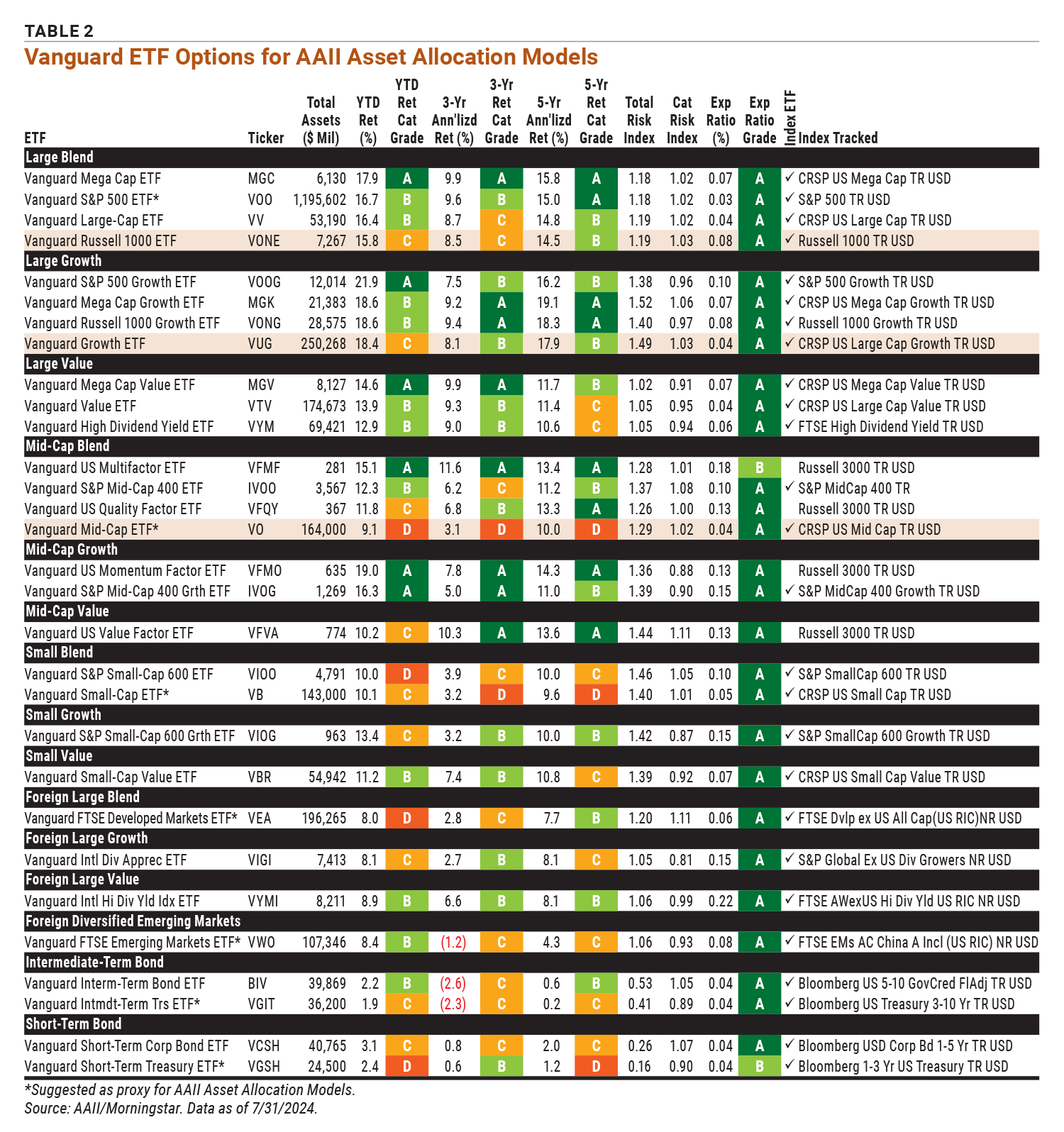
Vanguard ETFs were selected for inclusion in Table 2 using the same criteria implemented for Table 1. Most are passively managed. All but two of the expense ratios equate to A+ Investor Grades of A. The remaining two are B grades.
We generally suggest avoiding ETFs with A+ Investor Grades of D for returns. Exceptions can be made when the number of ETFs in a category is small, the absolute difference in returns is not large and/or an ETF is tracking a broad-based index. A handful of the ETFs suggested as proxies for the AAII Asset Allocation Models have this grade. They include the Vanguard Mid-Cap ETF (VO), the Vanguard Small-Cap ETF (VB), the Vanguard FTSE Developed Markets ETF (VEA) and the Vanguard Short-Term Treasury ETF (VGSH).
Download the Excel spreadsheet for Table 2.
Large Blend ETFs
The widely held Vanguard S&P 500 ETF (VOO) has the lowest expense ratio (0.03%) of all the ETFs in Table 2. It is the ETF version of the Vanguard 500 Index Admiral. It also has above-average returns but a slightly lower expense ratio than its mutual fund counterpart.
The Vanguard Mega Cap ETF (MGC) measures the return of U.S. stocks with market capitalizations over $200 billion. The Vanguard Mega Cap has higher returns than the Vanguard S&P 500, but also a higher expense ratio of 0.07%.
Mid-Cap ETFs
The Vanguard U.S. Multifactor ETF (VFMF) and the Vanguard U.S. Momentum Factor ETF (VFMO) are mid-cap blend and mid-cap growth options, respectively. The two have year-to-date and three-year and five-year annualized returns equating to A+ Investor Grades of A. These are actively managed funds that invest in U.S.-listed stocks with strong recent performance.
The Vanguard U.S. Multifactor considers value and quality factors in addition to momentum. It has the smallest level of assets in Table 2 at $281 million.
Other Categories
Vanguard’s extensive offerings include ETF options to fill your foreign, emerging market, intermediate-term bond and short-term bond allocation needs.
Where to Do More Research
AAII members have access to portfolio and performance data through the Fund and ETF Evaluators. Type the fund’s name or ticker in the search box at AAII.com and then choose the fund from the drop-down list. Those interested in learning more about asset allocation and the AAII Asset Allocation Models can visit www.aaii.com/asset-allocation.
Other articles in this series found on AAII.com:
-
Using Fidelity Funds to Fill Your Asset Allocation Needs, September 2023
-
Index Fund Options for AAII’s Asset Allocation Models, November 2022
Discussion
FREE REPORT

BARRY J from TX posted over 2 years ago:
ROBERT A from NC posted over 2 years ago:
BOB KAPICKA & B from IL posted over 2 years ago:
Cynthia M from IL posted over 2 years ago:
You need to log in as a registered AAII user before commenting.
Log InCreate an account