


- Explains tax advantages of municipal bonds and details risks like interest rate, credit and call risk
- Compares investing in munis via individual bonds, mutual funds, closed-end funds and ETFs
- Shows how to evaluate muni bond funds using factors like credit quality, duration, expenses and leverage
If your combined federal, state and local tax bracket is high and you’re looking for a way to earn tax-free interest, consider municipal securities (aka munis). Munis are issued by state or local governments to fund operating and capital project needs.
In most cases, interest earned on muni bonds is exempt from federal taxes and may be exempt from state and local taxes. Municipalities need a way to compete for investor capital, and keeping the interest tax-free (in most cases) accomplishes that.
Why Consider Muni Bonds Now?
Tax rates are unlikely to come down soon, as most governments need to keep them high to fund operating and capital requirements. Many municipalities are issuing more bonds to cover budget shortfalls, giving investors a wide selection of tax-advantaged securities.
The tax-adjusted yields are attractive too. As of July 2026, the 10-year Treasury bond yields about 4.5%. The 10-year muni bond yield is approximately 3.25% for A-rated national issuers. If you’re in the 37% maximum federal tax bracket, your taxable equivalent yield on the 10-year A-rated muni bond is around 5.16%, which makes it competitive relative to taxable Treasurys. (The taxable equivalent yield is also advantageous for those in the 32% and 35% tax brackets.)
There are many options available to tailor a muni bond portfolio to your specific circumstances. Besides actual bonds with different credit ratings and maturities, there are closed-end and open-end muni bond funds and muni bond exchange-traded funds (ETFs).
Municipal Bond Risks
While the benefits of muni bond ownership are clear, there are risks to be aware of.
Interest rate risk means that an uptick in interest rates will cause a bond’s value to fall. Duration measures how a bond’s price will react to changes in interest rates. Longer-duration bonds will fall more, while shorter-duration bonds will fall less. If you hold a bond until maturity, you will normally get your principal back, barring any credit issues. Interest rates fell for almost 40 years before starting to climb in the autumn of 2020. Whether rates will climb higher remains to be seen, so it may make sense to stay with shorter-duration securities for now.
Credit risk is the risk of default and the possibility that interest or principal may not be paid according to schedule. With some municipalities facing budget woes, this could happen, although default rates among muni bond issuers are historically low. You can reduce the risk of default by staying with general obligation or revenue bonds from mainstream issuers—not private purpose entities like sports stadiums—with solid credit ratings.
Early call risk is the risk that the issuer can call or redeem your bond before maturity. This may occur if interest rates fall after the initial issuance, allowing the municipality to call the older issue and replace it with a new one at a lower interest rate. The bondholder is faced with getting principal back early and scrambling to invest it at similar rates and maturities—which may no longer be available in the market. If you buy individual bonds, make sure the bond is not callable at a price below what you paid. If it is, make sure the interest rate justifies the risk of an early call.
Finally, for interest to be exempt from all taxes, you’ll need a bond issued by your state of residence. Residents of high-tax states like California and New York benefit most from this exemption. Muni bond interest may also subject you to the alternative minimum tax (AMT).
Although muni bond interest is not subject to federal taxes, the Internal Revenue Service (IRS) does include it in your combined income when determining how much of your Social Security benefit is taxable. Muni bond interest is also included in modified adjusted gross income (MAGI) for determining your Medicare premiums two years out (e.g., 2028 premium is based on 2026 MAGI).
Consult a tax professional if you have questions.
Differences Between the Three Types of Muni Bond Funds
Once you’ve decided that muni bonds have a place in your portfolio, which vehicle do you choose: individual bonds, open-end mutual funds, closed-end funds or ETFs?
If your portfolio is large enough to accommodate several issues for diversification and you know your way around the municipal market, individual bonds can make sense. For most other investors, open-end mutual funds, closed-end funds or ETFs may be better choices. Let’s review the latter three.
Open-End Mutual Funds
Most investors are familiar with the structure of an open-end mutual fund. The fund is registered with the U.S. Securities and Exchange Commission (SEC) under the Investment Company Act of 1940 and issues or redeems shares at net asset value (NAV) at the end of any day the markets are open. The share price reflects the NAV with no premium or discount. There are no limits on how many shares may be issued, though a fund can close itself to new investors or investment.
Most mutual funds are actively managed. Shareholders pay a percentage of assets (expense ratio) to cover the expenses of managing the fund. Distributions of realized net capital gains and net investment income (NII) must be made by the fund at least annually, although many mutual funds pay quarterly or monthly. [Editor’s note: A listing of no-load muni mutual funds can be found in AAII’s Guide to the Top Mutual Funds.]
Closed-End Funds
Closed-end funds are slightly different. A finite pool of capital is raised, and there is no continued offering of shares. (Some closed-end funds may conduct secondary or follow-on offerings, though these are infrequent and limited in size.)
Shares are traded on a stock exchange at a market price determined by supply and demand. Excess demand sometimes causes a closed-end fund to trade at a premium to its NAV, while excess supply may cause the market price to trade at a discount.
Like open-end funds, most closed-end funds are actively managed, charge an expense ratio and make regular distributions.
Exchange-Traded Funds
ETFs represent a hybrid of the open- and closed-end structures. Like both, an ETF is a pool of securities with a dedicated purpose: to mimic a particular index or invest in a specific industry or country.
ETFs are often passively managed and have lower expense ratios. Like open-end mutual funds, ETFs can issue an unlimited number of shares. Like closed-end funds, ETFs trade on an exchange.
Mechanisms exist to keep ETF prices at or near their NAV, but ETFs with lower volume or following specialized strategies may trade at a premium or discount to their NAV. [Editor’s note: A full listing of muni ETFs can be found in the Guide to the Top ETFs.]
Evaluating Closed-End Muni Bond Funds
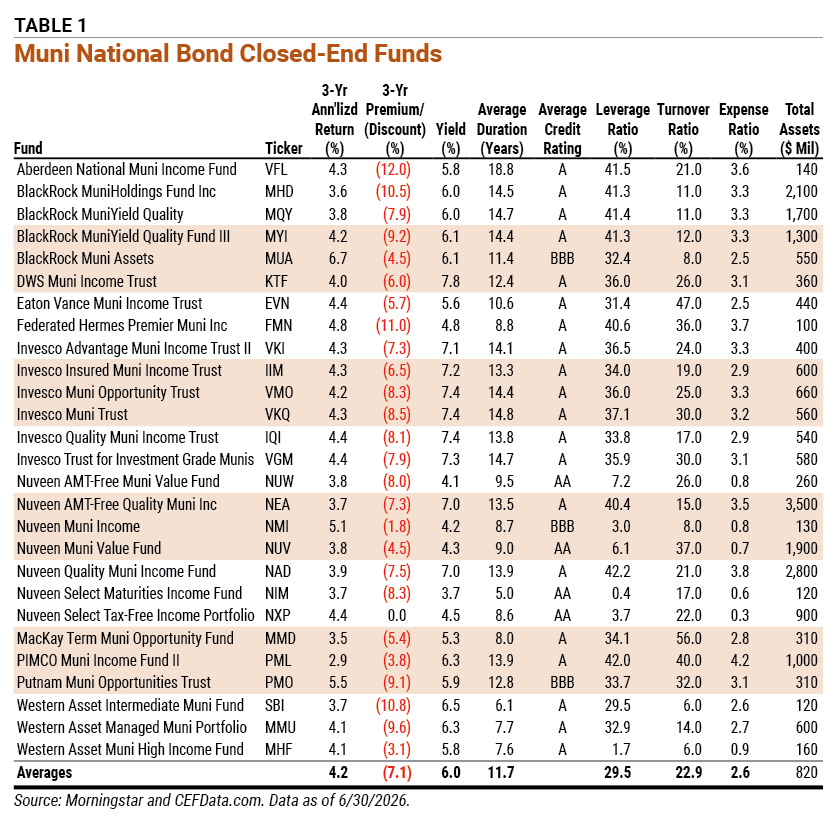
Table 1 lists 27 closed-end national muni bond funds that have been around for at least 10 years and have investment-grade portfolios. Let’s review some of the important features.
Solid Credit Rating
While one of the attractions of a fund is diversification across many different issues, it’s always good to see a high average credit rating of at least BBB or better. This is considered investment grade and reduces, but doesn’t eliminate, the risk of an individual bond defaulting.
10-Year Record or Better
This is long enough to see how a fund does through a market cycle. Examine how the NAV performance compares to that of its benchmark. The share price results are less important since the portfolio manager can’t control the premium or discount. However, closed-end fund managers can impact the NAV via astute security analysis, portfolio management and share buybacks.
Premium/Discount History
Evaluate how the premium or discount to NAV moves over a multiyear period. A significant discount alone is no reason to buy a closed-end fund, but if all else is acceptable, it’s better to buy when the discount is widest. Likewise, when selling, try to sell when the premium is widest. Knowing the historical fluctuations of discounts and premiums will help you do this.
Low Turnover
High turnover generates taxes. We at Pinnacle generally prefer low turnover and longer holding periods to capture the true potential of a security. The average turnover of the funds in Table 1 is 22.9%, meaning that the average holding period is about 4.3 years.
Constant or Declining Shares Outstanding
Generally, we don’t favor closed-end funds that raise capital via rights or secondary offerings. We normally prefer smaller asset bases to larger ones, which can sometimes lead to a lowering of standards to keep the portfolio fully invested. We like funds that repurchase shares at prices below NAV, which is accretive to NAV. This information may be found in a fund’s annual report.
No Returns of Capital
Many funds attempt to attract investors by maintaining an above-average yield funded by a return of capital or principal. Essentially, this means giving investors their money back, which results in a declining NAV and share price over time. This information is disclosed in a fund’s annual report.
Low Expense Ratio
Since the expense ratio directly reduces shareholder returns, we prefer lower ratios. The expense ratios shown in Table 1 include both operating and interest expenses. You’ll notice that the six funds with minimal leverage have low expense ratios since there are minimal interest costs.
Leverage
Virtually all the funds shown in Table 1 employ some leverage to enhance returns. The leverage may occur by issuing some type of floating rate security (often preferred shares) with dividends tied to short-term interest rates. Proceeds from the preferred issuance are invested in higher-yielding, longer-maturity muni bonds. The higher interest earned on the long bonds more than offsets the preferred dividends, and common shareholders pocket the difference.
However, if the yield curve becomes inverted—that is, short-term rates become higher than long-term rates—trouble ensues. The cost of the preferred dividends becomes greater than the interest earned on the longer-term bonds. Since preferred shareholders are always paid before common shareholders, there may be little left over to pay the common shareholder, which may cause the common share price to fall.
Duration
The duration of a closed-end muni bond fund indicates how much interest rate risk is embedded in the portfolio. As mentioned previously, interest rates and bond values move in opposite directions, with the longest durations fluctuating the most, up or down.
For example, if a fund has a duration of eight years and interest rates rise by one percentage point (100 basis points), the fund’s value will fall by 8%. Conversely, if interest rates fall by one percentage point, the fund’s value will rise by 8%.
Short- vs. Long-Duration Funds
Which is better, a short- or long-duration portfolio? It depends on where you think interest rates are headed. If you expect interest rates to rise, you’re better off with a short-duration portfolio that will fall less. If you expect interest rates to fall, you’re better off with a long-duration portfolio, which will rise in value more than a short-duration portfolio.
Fund investors should assess this carefully. Holders of individual bonds will normally be paid off at maturity regardless of duration even if rates go against them in the interim. However, bond fund owners are more vulnerable to interest rate risks since there is no moment at which all bonds mature simultaneously. Bonds are constantly maturing, with the proceeds being reinvested to maintain a maturity and duration consistent with the prospectus. The NAV will fluctuate with interest rates, and the proceeds from selling a fund may be more or less than the cost.
At this point in the interest rate cycle (mid-July 2026), we suggest considering short-duration funds. In our opinion, investors are not compensated with enough additional yield to justify the risk of longer durations. The average duration shown in Table 1 is 11.7 years. However, there are several shorter-duration funds that generate only slightly lower yields with comparable expense ratios.
Are Muni Bond ETFs a Better Alternative?
Table 2 shows 12 national (not state specific) ETFs. You’ll notice a couple of differences from the national closed-end funds table. First, since ETFs normally trade at or close to NAV, there is no Premium/(Discount) column. Next, since these ETFs employ no leverage, the Leverage Ratio column is not required.
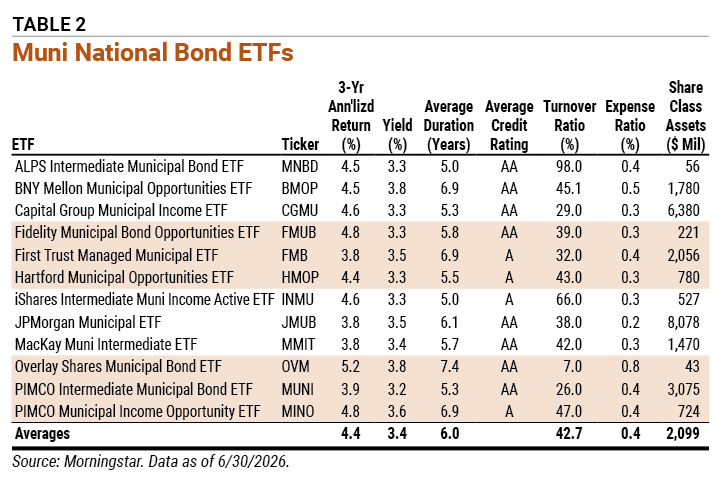
As in the case of the muni bond closed-end funds in Table 1, Table 2 shows the averages for muni bond ETFs. The average current yield for the closed-end funds is higher (6.0%, versus 3.4% for the ETFs), likely because the closed-end funds have a much longer average duration. The average expense ratio for the closed-end funds is higher (2.6%, versus 0.4% for the ETFs) and reflects the leverage employed by the closed-end funds. The average ETF turnover is almost twice that of the closed-end funds (42.7%, versus 22.9% for the closed-end funds). This may occur because the ETFs are subject to an ever-changing capital base. The average three-year returns are comparable, although the ETFs have a shorter average duration (6.0 years, versus 11.7 years for the closed-end funds).
Conclusion
For many individual investors in high tax brackets in search of tax-free income from a diversified portfolio, closed-end muni bond funds and muni bond ETFs make sense as alternatives to individual bonds. They are fairly liquid and may be purchased through most brokerage firms. Each provides a wide array of choices, including duration, credit rating and leverage.
Closed-end funds can often be purchased at a discount to their NAV during periods of market turmoil, providing the opportunity for additional gains if the discount narrows. While ETFs rarely trade at a discount, they are very liquid and often have lower expense ratios. The muni bond ETFs shown here offer a lower yield but have a shorter duration, making them less exposed to rising long-term interest rates. Both ETFs and closed-end funds are exposed to credit risk. Even if a default happens outside of your portfolio, the negative psychology could impact the value of your fund. While investing in closed-end funds and ETFs is very convenient, make sure you know the risks.

Related

PRISM Wealth-Building Process
Guidelines for Selecting Bonds and Cash-Like Instruments
Related
Discussion
FREE REPORT

Get your free copy of our special
report analyzing the tech stocks
most likely to outperform the
market.
No comments have been added yet. Add your thoughts to the discussion!
You need to log in as a registered AAII user before commenting.
Log InCreate an account