

Related


PRISM Wealth-Building Process
How composite rates for Series I bonds issued within the last five years have evolved.
by Charles Rotblut | June 2023

Charles Rotblut leads a class in AAII's new Essential Investing Video Course. Go to https://www.aaii.com/ves for more information and to subscribe.
Last year, we featured Series I bonds when they could be purchased with a juicy yield of 9.62% (“Why I Bonds Have Appeal When Inflation Is Rising,” June 2022 AAII Journal.) Fast forward 12 months and the yields are now significantly lower.
The composite rate on new I bonds is 4.30%. For I bonds purchased between May and October 2022—when they surged in popularity—the current composite rate is 3.38%. The difference between the two yields is attributable to the fixed rate portion of the composite rate. Newly issued I bonds have a fixed rate of 0.90%, whereas as I bonds issued between May and October 2022 have a 0% fixed rate of interest.
The composite rate is calculated as [fixed rate + (2 × semiannual inflation rate) + (fixed rate × semiannual inflation rate)]. The fixed rate is set at issuance. The inflation rate is reset every six months. The inflation rate can be revised upward (as it was in May 2022) or it can be revised downward, as it was in November 2022 and in May 2023.
The table below shows how composite rates for I bonds issued within the last five years have evolved.
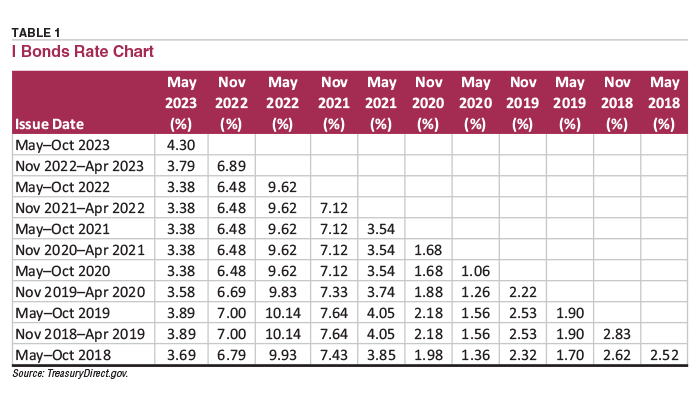
Those of you who, like me, bought I bonds last year when the composite rate was 9.62% now face the decision of whether to continue holding them. I bonds can be sold after one year but if redeemed within five years of purchase, the previous three months of interest will be forfeited. So, if you now redeem an I bond purchased in May 2022, you’ll forfeit three months of interest that was paid at a 6.48% composite rate.
If you intend to sell the I bonds within five years of purchase, then you will have to decide which three months of interest you are willing to forfeit. I view this as the choice between what interest you will receive by continuing to hold I bonds and what you might gain from redeeming them and putting the proceeds into something else. (Interest paid by Treasury bonds, including I bonds, is taxed at the federal level but not the state level. So, your tax-equivalent yield should be considered if you live in one of the many states that tax income.)
The goal in such a situation is to make sure the interest rate (or return) of what you are switching to is high enough to warrant the change. The realization of taxes on I bonds may play a role in the decision—particularly for those who expect to be near a threshold for higher tax rates or higher Medicare premiums.
PRISM Wealth-Building Process

DAVE G from TX posted over 3 years ago:
You need to log in as a registered AAII user before commenting.
Log InCreate an account