Why I Bonds Have Appeal When Inflation Is Rising

With part of its interest rate based on the rate of inflation, Series I savings bonds might be worth a look in the current environment.

In October 1985, I told my clients that “there is probably no other investment on the market today that offers as high a return/risk ratio” in making the case for U.S. savings bonds. [The AAII Journal published an article by Meyer in August 1986 stating his case.]

At the time, I was discussing EE savings bonds (which are no longer available with a variable interest rate) available at your local bank. Beginning in 1982—around the time I started my investment advisory firm—this updated version of the U.S. savings bond (even going back as far as war bonds)—had been made more attractive by guaranteeing a minimum return of 7.5% when held for at least five years. (Higher yields were possible if the bonds were held longer than five years.)

Regardless of the fact that U.S. savings bonds were backed by the “full faith and credit of the U.S. government,” they remained something of a “snoozer” because they were complicated to own and manage: During the period of May 1941 through October 1982, in which non-market-based interest E and EE bonds were issued, the guaranteed minimum interest rate was adjusted 19 times. It was complicated to understand the redemption rates/tables, and the bonds were issued only in paper form and thus liable to loss or theft.

Unlike just about every other investment product, EE bonds were “authorized” by Uncle Sam—not sold by securities and insurance firms and their commissioned brokers. Salespeople didn’t get rich recommending savings bonds, even though they were quite a good deal.

Though the EE bonds that are issued now earn a fixed rate of return, a different savings bond is available that offers an excellent current yield and semiannual adjustments for inflation. Through October 2022 these bonds can be purchased to yield 9.62%. This rate applies for the first six months you own the bond, and could possibly be higher there-after, depending on changes to the consumer price index (CPI)—meaning if inflation continues to rise.

This instrument is the U.S. Treasury Series I bond. Individuals may buy $10,000 of I bonds per year (spouses can purchase $10,000 each year if they have separate accounts). That’s a lot more than couples are earning now on their cash and it’s about as safe a place as you’ll find for cash.

The interest structure is somewhat complicated: It’s a combination of a fixed rate that does not vary over the life of the bond and an inflation rate that is set twice a year. For bonds issued from May 2022 through October 2022, the rate is 9.62%, up from 7.12% paid during the prior six-month period.

You must open an electronic account at the Treasury to purchase I bonds. It shouldn’t take more than 10 minutes to set up an account and transfer the money electronically from a savings or checking account. You can find details here.

A Few Facts About I Bonds

You may convert a paper bond issued before 2008 to an I bond regardless of the amount.

Unlike with the older EE bonds, you can determine the current value of I bonds simply by visiting your Treasury account.

I bonds may be cashed at any time after 12 months. You receive the original purchase price plus interest earned. I bonds are meant to be longer-term investments; if you redeem one within the first five years, you’ll lose the previous three months’ interest (e.g., if you redeem an I bond after 18 months, you’ll receive the first 15 months of interest).

The interest rate on I bonds each six-month period cannot fall below zero and the redemption value cannot decline.

I bonds increase in value on the first day of each month, and interest is compounded semiannually based on the issue date (the month and year in which full payment for the bond was received). Table 1 shows the dates that new rates take effect for I bonds depending on the month of issue.

TABLE 1. When I Bonds Change Rates

It probably makes sense to allocate the amount of I bonds purchased among several denominations in case there is a need to raise cash during the holding period.

I bond interest is not taxed at the state or local levels. I bond interest is taxed at the federal level as ordinary income. Taxes on the interest paid can be deferred until redeemed so there may be some tax advantages to enjoy.

An I bond account can only be opened by an entity with either a Social Security number or taxpayer identification number (TIN). I’m afraid this means cash transferred from tax-deferred retirement accounts such as individual retirement accounts [e.g., IRA, SEP IRA, 401(k)]—along with other employer-sponsored retirement accounts—does not qualify. Individuals with tax-deferred retirement accounts holding substantial cash would have to take a taxable distribution from the retirement account to purchase I bonds.

Trusts can hold I bonds and other savings bonds. (See the TreasuryDirect website for more information.) Legal businesses (sole proprietorships, partnerships, LLCs and corporations) may utilize I bonds. Judging the tax implications of this type of withdrawal to fund I bonds will be a function of each person’s situation.

How to Buy I Bonds

There are two ways to buy I bonds: in electronic form at www.treasurydirect.gov or in paper form by using any federal income tax refund you are eligible for.

I bonds are purchased at the face value. For example, you pay $50 for a $50 bond. (The bond increases in value as it earns interest.)

I bonds come in any amount to the penny for $25 or more (e.g., you could buy a $50.23 bond). Paper bonds are sold in $50, $100, $200, $500 and $1,000 denominations.

In a calendar year, you may purchase up to $10,000 in electronic I bonds at TreasuryDirect.gov and up to $5,000 in paper I bonds by applying your federal income tax refund. Bonds you buy for yourself and bonds you receive as gifts or via transfers count toward the limit. However, if a bond is transferred to you upon the death of the original owner, the amount doesn’t count toward your limit.

You may buy I bonds as gifts for any TreasuryDirect account holder, including children. The dollar amount of the gifts counts toward the annual limit of the recipient, not the giver. So, in any calendar year, you can buy up to $10,000 in electronic bonds and up to $5,000 in paper bonds for each person to whom you gift.

Understanding I Bond Interest Rates

In my opinion, the Treasury website—and reporting about I bonds in general—is somewhat confusing. The wording used to describe the “initial interest rate” only quotes the yield of 9.62% that is paid on new bonds purchased between May and October 2022. However, the detail of how I bond interest is calculated is quite complicated.

Unlike the EE bonds previously referenced, which guaranteed a minimum interest rate of 7.5% for the life of the bond and which could be higher after an inflation adjustment, I bonds essentially only guarantee that your six-month yield on bonds held will not be less than zero (when, during deflationary periods, real yields can be negative after adjusting for inflation) and that your six-month yield will rise and fall with inflation.

I bonds have an annual interest rate derived from a fixed rate and a semiannual inflation rate. Interest, if any, is added to the bond monthly and is paid when you cash it.

The Fixed Rate Component of I Bonds

You will know the fixed rate of interest used to help calculate interest on your bond when you buy it. That fixed rate does not change during the life of the bond. In my opinion, the Treasury should be more forthcoming about the fixed rate, which is currently 0.0%, but which was much higher 20+ years ago. This was during a period of high inflation when the fixed interest rate ranged between 3.4% and 3.6% during the first three years they were issued.

The fixed rate can become a multiplier in calculating the actual six-month rate, but certainly not now since it is zero. Between 1998 and 2008, the fixed rate declined from a high of 3.6% to a low of zero. It has since remained at or close to zero—only reaching 0.50% and 0.70% each during one six-month period. The Treasury announces the fixed rate for I bonds every six months. That fixed rate then applies to all I bonds issued during the next six months. The fixed rate is an annual rate. Compounding is semiannual. (The fixed rate announced in May 2022 was 0.0%.)

The Inflation Rate Component of I Bonds

Unlike the fixed-rate component—which does not change for the life of the bond—the inflation rate can and usually does change. The inflation rate is set every six months in May and November, based on changes in the non-seasonally adjusted CPI for all urban consumers (CPI-U) for all items, including food and energy. The change is applied to a bond every six months from the bond’s issue date.

The Composite I Bond Rate

To get the actual rate of interest (sometimes referred to as the composite or earnings rate), the fixed rate and the inflation rate are combined using the following equation:

Composite rate = [Fixed rate + (2 × Semiannual inflation rate) + (Fixed rate × Semiannual inflation rate)]

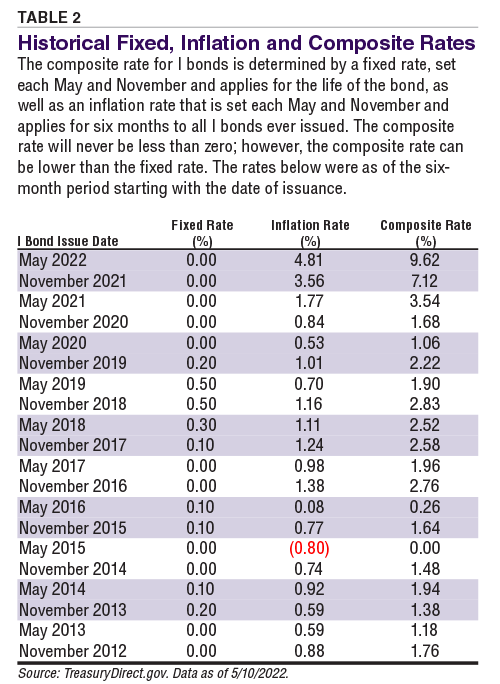
The composite rate will never be less than zero. However, the composite rate can be lower than the fixed rate. If the inflation rate is negative (due to deflation), it can offset some of the fixed rate. If the inflation rate is so negative that it would take away more than the fixed rate, the composite rate is capped at zero. Since 1998, the composite rate has only been negative twice, when it was capped at zero for all bonds sold prior to 2009 (–2.78%) and again in 2015 (–0.80%) for bonds purchased between 2003 and 2015. Table 2 shows the historical fixed, inflation and composite rates since 2012.

TABLE 2. Historical Fixed, Inflation and Composite Rates

Keep in mind that this 0.0% composite rate was only for one six-month period over the life of any bond held at the time. Those bonds purchased prior to 2003 were able to escape the 0.0% yield during 2015 because the fixed-rate multipliers ranging between 2.0% and 3.60% offset the –0.80% negative variable rate. They were not able to offset the –2.78% variable rate that occurred during 2009.

While I take issue with the way the Treasury describes the “guaranteed fixed rate” of this product, I don’t think it is currently particularly important, or even the strongest selling point. For the last five rate periods, the fixed rate has been 0.0%. Since 2008, it has been 0.0% in 16 of 29 periods, varying only three times (between 0.50% and 0.70%) with the balance being 0.30% or less.

The fixed rate can become a useful factor once it goes above 1%, and a significantly useful one when higher. For example, since 2008 the fixed rate has never been above 0.70%, and the current composite rates for all I bonds issued since then have averaged very close to the recent 7.12%. Bonds issued prior to 2008, with fixed rates between 1.0% and 3.6% (during a period generally of much higher inflation, until recently), are currently earning between 9.62% and as high as 13.39% during the current six-month period as of publication. Remember, at about the time bonds with high fixed rates were issued, purchasing a 30-year Treasury bond would have locked in a guaranteed 8%+ rate for the entire 30-year term. Even I bonds purchased with high fixed rates have never paid close to an 8% composite rate for any length of time.

The Appeal of I Bonds

If you made it through the previous section, you probably understand why such detail is not provided in the front-end description of I bonds on the Treasury.gov website.

You can find all this detail if you look for it, but we’re not talking about a simple money market account or certificate of deposit (CD) here. There will be a decision to make every six months on whether to cash in a bond for a better alternative or to buy more to lock in another favorable six-month rate. The fact that the current fixed rate is zero and can’t go any lower places the primary emphasis on the semiannual inflation rate component.

I bonds have appeal as a place to park cash for at least the next 12 months, and potentially longer, since the pace of inflation has accelerated, interest rates remain at historically low levels even though the Federal Reserve is raising rates and the interest rates paid by banks and money markets are minimal.

In my opinion, there is an argument to be made for using I bonds for cash yielding little or nothing in the interest rate and inflation environment that exists as I write this in May 2022, so long as you plan to hold them for at least 12 months. Regardless of how I bond rates will be revised again in November 2022, it’s very unlikely that you’ll find a better yield during 2022 on CDs and money markets.

Any time between now and October 2022, an I bond purchased will be guaranteed a 9.62% yield for a six-month term, after which it will earn interest at the new rate established in November 2022. If the rise in inflation persists, the November rate could be even higher for another six-month period. Conversely, should inflation subside by November, the new rate could be lower, even substantially lower.

But even if the November 2022 interest rate were to become zero, the 12-month average interest rate on the I bond would be 4.81%, which is much higher than the average interest rate cash is likely to yield on average over the next 12 months.

I bonds might also serve as surrogates to traditional bonds in a diversified stock and bond portfolio—in addition to serving as its cash component—since Treasury bonds across nearly all maturities are yielding nowhere near 9.62%. Once cash and bond yields begin to approach historically normal interest rates and maturities, it might then be prudent to redeem I bonds with their variable rates and build a ladder of Treasuries with varied maturities to lock in higher, considered risk-free, yields.

Discussion

Roger A from NV posted over 4 years ago:

Yes, I-Bonds are a good idea. But the TreasuryDirect website is one of the most user unfriendly sites I know. To get paper bonds, you must accept nearly a dozen pieces of paper to get a $1K bond.


Louise M from NV posted over 4 years ago:

I bought one in April and one in May but I am confused about how the interest accrues. Does it compound or is it just an accrued amount due on liquidation? I understand there is a 3 month penalty if you liquidate before one year and no penalty if held 3 years?


CHARLES R from IL posted over 4 years ago:

Hi Louise,

The TreasuryDirect website says "interest is compounded semi-annually" on I bonds. The penalty is waived after you have held the bonds for at least five years.

-Charles


THOMAS W from AZ posted over 4 years ago:

Since my wife and I are retired and in our 70s, we are buying US I Savings Bonds for long term health care needs if we need it. We max out our yearly purchases at $30k (both SS + trust). It’s currently a VG bond substitute, for one’s equity portfolio, too. The Fed tax deferral, being state and local tax free, along with compounding helps as an inflation hedge for ever increasing healthcare costs. Health can deteriorate quickly so we don’t feel at risk equity investments are appropriate. Thomas W


PAUL C from VA posted over 4 years ago:

The article says: "You may convert a paper bond issued before 2008 to an I bond regardless of the amount" but I am wondering whether that is a typo. I have not been able to confirm this, either on TreasuryDirect or anywhere else. TreasuryDirect says "If you own a paper bond issued before 2008, you can convert it to an ELECTRONIC bond in your account in TreasuryDirect regardless of the amount of the bond."


LIHONG Q from NY posted over 4 years ago:

Hi Charles, your article says, "Remember, at about the time bonds with high fixed rates were issued, purchasing a 30-year Treasury bond would have locked in a guaranteed 8%+ rate for the entire 30-year term. Even I bonds purchased with high fixed rates have never paid close to an 8% composite rate for any length of time." After checking, I found out that 30-year Treasury bond rate is about 3%, not 8%. Am I wrong? Please correct me and clearify the rate. Many thanks.


BRAD H from AK posted over 4 years ago:

I recently decided this is a good investment vehicle for me so this week I pursued setting up Treasury Direct accounts for my spouse and myself. The online registration went smoothly. The rub for me was that they send you an account number via email, and in that email they state that a form is required to be printed and have a signature certified, and then the paper form mailed in. The process can easily take two weeks to three weeks, not 10 minutes as they claim. This time difference is not a deal breaker for me but I would appreciate truth in their advertising.


PETER L from CA posted over 4 years ago:

Thomas W. It is my understanding that the purchase limit is $10K per SS# or $2K for a couple. You wrote that you are able to purchase $30K by purchasing $10K in the name of a trust. Is this a revocable trust with your SS# or is it an irrevocable trust with its own EIN?


PETER L from CA posted over 4 years ago:

I found the following at boglehead.org. I hope that Thomas W can confirm. by SnowBog » Sun Apr 11, 2021 9:24 pm One can have an individual account and an entity account using the same SSN. It is allowed because they are different types of accounts. Correct, one is an "individual" account, the other is a "trust" account. Same SSN (since it's "my" living trust), but it's a different account type. In the individual account, the bonds are titled for co-owners of "SnowBog" and "spouse". In the trust account, bonds are titled for "snowbog, or successor trustees of snowbog living trust dated XYZ". Spouse is setup as successor trustee. (And vice versa in spouse accounts.)


CLAUDE B from FL posted over 4 years ago:

My wife and I purchased $40k in December ($10k each in our names and another $10k each in our respective revocable trusts) and another $40k in January.


JULIAN B from TX posted over 4 years ago:

I agree with commenters lamenting the dismal treasurydirect.gov web site. My bigger concern is with the inscrutability of interest accruals in the account. I log in to check my account every couple of months since my first purchase in January this year. So far, their "system" has added interest in strange amounts twice, with no explanation or dates or time periods regarding the additions. I wish they could handle transactions in the account more like a bank does.


DAVE G from TX posted over 4 years ago:

I believe a correction is needed to the comment that implies you need to buy different amounts of I-bonds to make withdrawals easy. I use to think that but it just isn't so. After the first year, you can withdraw any amount you desire from an I-bond and you will just be left with a partial I-bond.


DAVE G from TX posted over 4 years ago:

Julian B., Yes, the way the treasury calculates the interest may seem strange but it is completely predictable if you have the correct formula. I have built a spreadsheet that tracks my payments and it comes out to the penny every month. It is not a trivial task and took me months to sort out both the correct number of significant digits to use to convert the CPI-U to interest rates and then to understand that each of your bond's interest rate payments is built from a $25 bond that is compounded every six months in a rolling fashion based on the start date of your bond. Also, what you see on the website is always 3 months behind if your bond is less than 5 years old. For example, if you bought a $2000 I-bond in Dec 2021 the first six interest payments are $12, $11.20, $12, $12, $12, and $12, giving you a total compounded amount of $2071.20 at the end of six months. This would be the total "on paper" which you would have as of 6/1/2022. However, what you would see in your account in June would be $36 less because of the 3-month penalty.


ALLEN P from TX posted over 4 years ago:

I am going to make an assumption from reading the comments above that although each individual US Treasury account holder can only purchase $10k/year of iBonds, the funding can come from the same joint bank account? I am about to find out! Thanks for a very informative article!


JIM C from AZ posted over 4 years ago:

I believe the formula “Composite rate = [Fixed rate + (2 × Semiannual inflation rate) + (Fixed rate × Semiannual inflation rate)]” is incorrect!! I believe the correct formula is “Composite rate = [Fixed rate + (2 × Semiannual inflation rate)]” . Otherwise, a great article


Larry Y from CA posted over 4 years ago:

Ordering online was almost enough to make me forget about it. After a few days I finally was able to purchase my $10,000 worth. Now, I'm wondering what the process is going to be like when I sell...


DAVE G from TX posted over 4 years ago:

Jim C, The article is correct, but in my spreadsheet, I state it a little differently: FR+VR+(FR*VR)/2 where FR is the fixed-rate and VR is the annual inflation rate for the six-month period you are working with. The whole formula is also rounded to 4 decimal places in Excel.


DAVE G from TX posted over 4 years ago:

Jim C, as an example in Nov 2018 the rates were fixed=.5% and variable 2.32%. Your formula would indicate 2.82% composite, yet the real calculation shows it is 2.83%


BRUCE F from IL posted over 4 years ago:

In addition to purchasing $10,000 in I bonds for yourself, people who expect to get a federal tax refund can elect to get up to $5,000 in paper I bonds. Families with kids can also invest up to the annual limit on behalf of each child. To do so, the parent has to create a Treasury Direct custodial account for the child and then make the purchase. People who run businesses or have a living trust can also extend the I bond purchasing limit by buying the assets on behalf of the entity. That means that even if you’re self-employed and file taxes on an IRS Schedule C as a small business, you can purchase up to $10,000 I bonds annually for that business. This purchasing power also applies to living trusts, through which people can purchase an additional $10,000 in I bonds per year. So, a married couple, each of whom own a business and have living trusts, could buy up to $60,000 in I bonds annually, as well as buying $5,000 per person in paper bonds, bringing their yearly total to $70,000. If that couple had two children, they could purchase an additional $20,000 of I bonds on their behalf.


DAVID H from MT posted over 4 years ago:

Could Dave G from TX list the numbers for each of the 3 terms in the equation before any multiplications? That is CR = FI + 2*SI + FI*SI and for his equation CR =FI + VR + (FR*VR)/2 Is the term in table 2 labeled inflation rate, the semi-annual term referred to in the article or an annual rate that we need to adjust? I do not get the results in Table 2 either. I get the results Jim C got.


Dennis S from NJ posted over 4 years ago:

I have a couple of questions. 1. If I buy an I bond on the last day of the month, will I receive interest as though I held the bond for the entire month? 2. If I buy an I bond today, will I receive the current rate of interest for the next 6 months or will the interest rate change when the Treasury resets in November? Many thanks.


CHARLES K from WI posted over 4 years ago:

Very good insights from Bruce F on how to maximize the returns from this program. $10,000 a year just won't do it for many of us.


DAVE G from TX posted over 4 years ago:

David H. First you have to realize the semi-annual rate is nothing more than the annual rate /2. So the term 2*SI is the same as my term VR. I think labeling Table 2 the way the author does makes it a little confusing, but either method works fine. Let's take the line labeled Nov 2018 which Jim C says is 2.82%. Using the numbers in table 2 and your formula CR= .5 +2*1.16 +.5*1.16 = .005+.0232+(.005*.0116). It is easy to see the first two terms (.005+.0232) = .0282. Now simply add the result of the last term which is .000058 and before rounding you get .028258, which when rounded to 4 places gives .0283 or 2.83%


DAVE G from TX posted over 4 years ago:

Dennis S from WI. 1. If you wait until the very last day to buy the bond you most likely will buy it in the following month and lose that month's interest because the buy is not usually posted to your account until the next business day, so depending on where the weekend falls or any Holiday the next business day could be the next month. Also, I do not believe TD guarantees the buy will be posted the next day, so don't be greedy and pull back 2 or 3 business days from the end of the month and you will usually be fine. But to be clear the answer to your question is yes you get the whole month's interest no matter what day the buy is posted to your account as long as you realize that the day it is posted is not the same as the day you request it 2. When you buy the bond you get 6 months of interest that was in effect in the month of the transaction. Say you wait until June 30th to request a buy. That buy then occurs in July and thus the first 6 months of interest you get are at July's rate which is 9.62%, at which point it resets to a new rate in Jan.


Patricia D from MI posted over 4 years ago:

Ive had laddered I-bonds since the 90s. Some have a fixed 4% interest. Add to that the new 9% interest and they're doing quite well. I got them from my local bank.


STEVEN R from KY posted over 4 years ago:

Can a non-profit 501c3 corp buy an I-bond? We have the required TIN number you said in your article


ROBERT A from NC posted over 4 years ago:

Looks to me like I-Bonds are taxed sort of like traditional IRAs. That is, you pay taxes at ordinary rates when you cash them in. For me, that's a significant detriment in that it would probably knock my after-tax return down below the current inflation rate. The FIRST DOLLAR over deductions is taxed at ordinary rates, whereas I can bring in more than $100,000 in qualified dividends with NO tax and still have the potential for long-term appreciation of the underlying assets. Trying to use I-Bonds for short-term cash storage is even worse, as you can get hit with penalties for not holding them long enough. No thank you!


RYAN O from NC posted over 4 years ago:

"Once cash and bond yields begin to approach historically normal interest rates and maturities, it might then be prudent to redeem I bonds with their variable rates and build a ladder of Treasuries with varied maturities to lock in a higher, considered risk-free, yields." Could someone please define the above in practical quantifiable terms. I am too young to have a grasp of what constitutes historically normal interest rates and maturities. Is it fair to assume that it is unlikely such a situation will be occurring anytime soon? Thank you!


DAVE G from TX posted over 4 years ago:

Steven R, your non-profit can purchase investments like stocks or i-bonds. There are just rules on how you use any profits from these purchases. I believe the income has to be used in pursuit of your non-profit charter.


DAVE G from TX posted over 4 years ago:

Robert A, "Looks to me like I-Bonds are taxed sort of like traditional IRAs." The operative word there is "sort of" in that money in an after-tax account is almost always worth less per dollar of your earnings on the front end, so the IRA will always win in these cases on a similar tax rate of earnings compared to retirement withdrawals. The plus of the I-bond is you can control when or if you withdraw the funds. In the case of the IRA, you can only control some of the withdrawals, others are forced by your age. Of course, it is possible to bring in $100k of qualified dividends and not be taxed if you are married and have no other income at all such as from Social Security, or IRA RMDs. Also, dividends and Long term capital gains are taxed the same, except in the case of LTCG you can pick or choose when you want the income. In the early years before retirement dividends that aren't needed for spending can create an unnecessary extra tax burden on top of your salary.


SHARON P from MD posted over 4 years ago:

I am reiterating the comment from "Paul C from Virginia": The article says: "You may convert a paper bond issued before 2008 to an I bond regardless of the amount" but I am wondering whether that is a typo. I have not been able to confirm this, either on TreasuryDirect or anywhere else. TreasuryDirect says "If you own a paper bond issued before 2008, you can convert it to an ELECTRONIC bond in your account in TreasuryDirect regardless of the amount of the bond." Has Charles Meyer or someone from the editorial staff sought to confirm or correct this? I also have not been able to confirm this anywhere.


James O from NH posted over 4 years ago:

I am curious as to what happens with the interest - - I know it accumulates. Does the interest also earn interest at the current rate? Do the interest payments rollover to an ibond and earn additional interest. Thanks


DAVE G from TX posted over 3 years ago:

James O, the answer to your two questions is essentially 1)no, 2)yes. To explain think of a 6-month bond with a coupon rate that changes every 6 months. Also, note that the base for all TD calculations is a $25 i bond. So say you bought a $25 i bond in Dec 2021 @7.12%. The first total shows on Jan 1 as $25.15, followed by 25.29, 25.44, 25.59, 25.74, 25.89. These numbers are all generated based on the initial value of $25 and an interest rate of 7.12/2 or 3.56%. That is why at the end of six months you have only simple interest of 25*(1+.0356)=$25.89. Now for the second part of your question -- yes the $25.89 is now used for the next 6 months of simple interest, which in this case was 9.62/2 or 4.81% and 25.89 *1.0481 =$27.14 when rounded to two digits. Now that you have the basics of the math you can apply this to any i bond you purchase. Say you put $10,000 into the i bond last Dec instead of $25. Your total at the beginning of Dec 2022 would be 27.14*10,000/25 or $10,856.


DAVID D from NH posted over 3 years ago:

Treasury representative, Jennifer, on 10/3/2022 at 1:50 PM said that : "No, you cannot exchange a Series EE bond issued prior to 2008 for an iBond in excess of the $10,000.00 annual limit". This was in my question: "How do I exchange my series EE Bond of $10,000.00 issued in 1992 for a i bond with accumulated interest." Jennifer went on further: "You must cash your series EE bond and then purchase an i bond subject to the $10,000.00 annual limit". A. D. D.


DAVID D from NH posted over 3 years ago:

I rec'd the following from Treasury Direct today: Hello, There is no option to exchange savings bonds to new bonds, or to another series of bonds. You can cash the bonds and report the taxable interest. Then you can purchase new bonds—up to the $10,000 annual limit—within your account if you wish. Sincerely, Treasury Services


JOHN H from TN posted over 3 years ago:

Naming a beneficiary for the I-Bond is particularly confusing. If you plan on spending probate fees, then purchasing an I-bond is pretty easy. But if you want it to transfer on death, there will be many minutes of head scratching as you attempt to enter your beneficiary information. In fact, I am still scratching my head.


DAVE G from TX posted over 3 years ago:

John H, I think the key to making it simple is get the beneficiary right when you purchase the bond initially. Say you want to register the bond in your name and make Mrs. H the beneficiary. The step is to create a registration for the bond that ends up saying in essence John H POD Mrs. H. If I remember it was sort of trial and error to put the names in the right order and check the proper box, but once you do that you can use the same registration box every time and don't have to redo it. I know you can also change the beneficiary I just haven't tried it, but I know there are plenty of help videos out there.


You need to log in as a registered AAII user before commenting.
Create an account

Log In

Get your free copy of our special report analyzing the tech stocks most likely to outperform the market.

Download the FREE Report Here: