


Related

First Cut Stocks
Investors, particularly retirees, can leverage the benefits of dividends to combat the deleterious effects of inflation and market volatility.
by Aaron Brask | July 2020

When designing portfolios to provide for retirement, conventional wisdom holds that allocations to stocks generally facilitate growth that helps hedge against inflation. We agree with this notion but try to make it more concrete by highlighting the fundamental and market-based mechanics behind this relationship.
We look at empirical data to investigate how inflation relates to market prices, earnings and dividends. We measure results over 25-year time periods—fairly typical horizons for retirement planning. Our findings reveal impressively strong relationships between fundamental performance and inflation, but an unsurprisingly weaker linkage between market returns and inflation.
Relative to chiseling away from a portfolio, we believe dividends provide a more direct tool to combat inflation as they avoid the layer of noise imposed by often-volatile market prices. This can be especially important when inflation surfaces, as asset prices may react negatively—thereby requiring higher withdrawals when asset prices are depressed. This situation can impose permanent damage on retirement security and is why retirement researchers identify inflation as such a critical risk.
When it comes to investing for retirement, conventional wisdom holds that allocations to stocks generally facilitate growth that helps hedge against inflation. The following highlights what we believe are the key fundamental and market-based mechanics that drive this relationship.
At the root level, shares of stock represent profit-seeking enterprises and these businesses require capital to acquire resources [e.g., property, plant and equipment (PP&E), raw materials and labor], alter or assemble them and turn them into something they can sell to their customers. This capital naturally demands a return. Thus, as inflation increases input costs, maintaining the required return on this capital will increase the absolute level of profit. Put simply, profits should rise with inflation under these assumptions.
Of course, economic forces do not follow a set schedule or formula. Innovation and competition involve much trial and error. Moreover, companies ultimately rely on humans to make decisions. On an individual basis, this introduces some subjectivity into their fundamentals. However, the level of entropy (randomness) is increased as they interact and create feedback loops. The bottom line is that the inflation-profit model described above will naturally involve significant noise.
Notwithstanding this randomness, as long as survival instincts, profit motives and competition exist, the above logic regarding returns on capital will apply and help explain why profits—and thus stock prices—should be positively correlated with inflation over the longer term.
While the relationship between inflation and profits is already noisy, market-based forces make the relationship between inflation and stock prices more tenuous. We firmly believe prices follow fundamental performance over the long term. However, investor sentiment can influence prices over shorter periods. This notion is particularly relevant in the context of inflation. Historically, we have witnessed periods where investors reacted negatively to significant bouts of inflation and we suspect that is due to them assuming (implicitly or explicitly) a higher interest rate is warranted for discounting future cash flows. However, this reaction ignores the phenomenon we highlighted previously and will illustrate with historical data: Inflation appears to give rise to increasing profits over the longer term.
In the context of retirement, inflation can require one to withdraw more money to maintain the same standard of living. Moreover, the threat is magnified to the extent that a sustained uptick in inflation can increase prices for the remainder of one’s retirement. Even worse, negative market reactions during inflationary periods can add further risk to this situation. On the one hand, inflation may force an increase to the dollar amount of portfolio withdrawals. On the other hand, each dollar of withdrawal may require selling more shares or bonds in an environment where their prices are depressed. This is why academics and practitioners view inflation as such a significant threat to retirement security.
The goal of this section is to illustrate the historical relationship inflation has had with corporate fundamentals (i.e., earnings and dividends) and stock prices. We use Nobel laureate Robert Shiller’s data (www.econ.yale.edu/~shiller/data.htm) for S&P 500 index prices, earnings and dividends. We start out by investigating these relationships over 25-year time periods, as we believe this can help us address some of the noise and identify longer-term trends. Moreover, 25 years is a reasonable period to consider in the context of retirement planning.
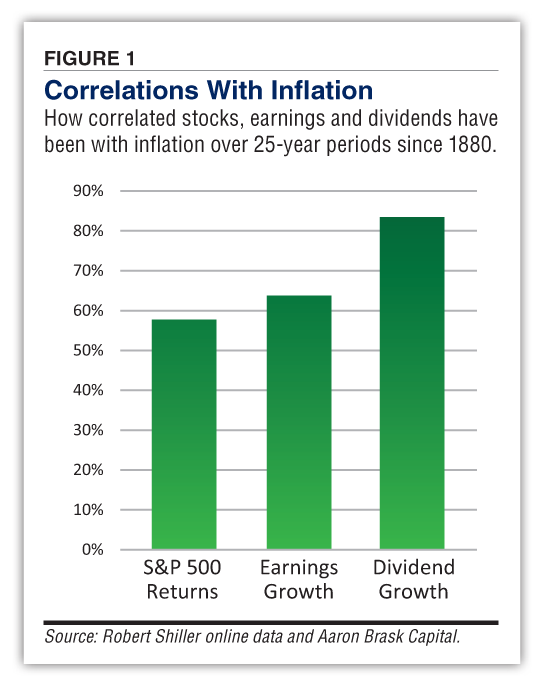
Figure 1 shows how stock prices, earnings and dividends were correlated with inflation over 25-year periods. It shows impressively strong relationships between fundamental performance and inflation, but an unsurprisingly weaker linkage between market returns and inflation. S&P 500 returns were 58% correlated with inflation while earnings and dividends exhibited correlations of 64% and 83%, respectively.
We also calculated how volatile these quantities were by measuring the standard deviation of their growth rates. Specifically, we calculated intra-period standard deviations for each 25-year window and took an average. Standard deviations calculated over the entire 1872–2019 period show similar results, but we chose to present the average of intra-period standard deviations to account for potentially changing inflation regimes (i.e., the mean used to calculate each standard deviation was more specific to that particular period—not a universal average).
The consumer price index (CPI) exhibited the least volatility, with a standard deviation of 4.6%. We suspect this is primarily due to the slow-moving forces of supply and demand, but hedonic adjustments to CPI figures and central bank mandates for price stability may also be factors. The standard deviations for dividends, earnings and S&P 500 prices were all higher at 10.7%, 27.5% and 17.9%, respectively. (Hedonic adjustments attempt to remove price changes due to the changing quality of the underlying goods. Those who are interested can read more about hedonic adjustments on the Bureau of Labor Statistics’ website: www.bls.gov/cpi/quality-adjustment/home.htm.)
Interestingly, earnings showed the highest volatility. We believe this is due to the apples to oranges nature of the comparison. For example, each earnings figure represents the profits that the underlying companies reported over a particular period. However, market prices represent an average of expected earnings over many different periods. Moreover, earnings figures can be arbitrarily small over some periods (there were no negative readings in the data we used). Thus, percentage-based growth figures calculated from lower levels may accelerate rapidly. It is also worth noting that dividend volatility might also be lower due to the discretion CEOs and CFOs have in declaring dividends. Indeed, they have the ability to dig into retained earnings and pursue what they expect will be sustainable dividend policies despite fluctuations in their earnings.
Even if they exhibited the highest correlations with CPI or the lowest level of volatility, earnings are not accessible, except to the extent they are paid out as dividends. That is, only share prices and dividends represent tangible, liquid money investors can use for spending.
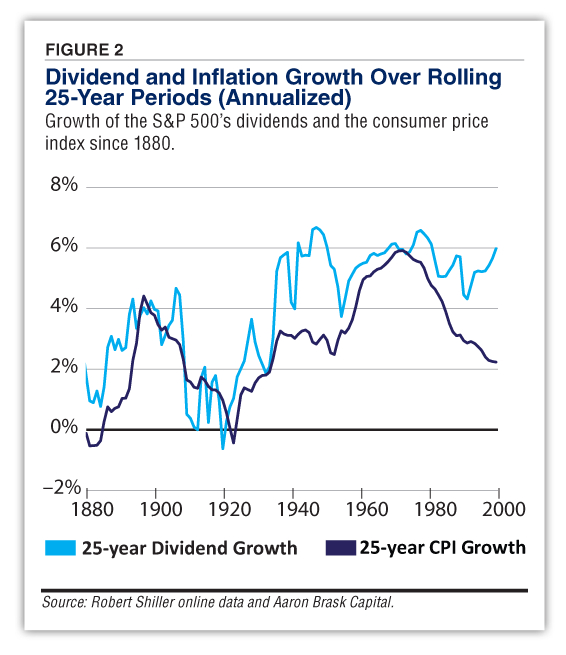
Figure 2 provides a visualization of the 25-year growth rates for S&P 500 dividends and the consumer price index. The chart shows how the 25-year growth rates for dividends and CPI evolve through time. While they broadly followed each other, the most recent data show inflation trending lower while dividend growth rates have sustained their near-peak levels. In periods where CPI grew the most, dividends also grew at a significant rate. This would have been particularly important to those relying on dividends for retirement income, since the growth in dividends would have been there when it was needed most.
The calculations utilized growth rates from 122 overlapping 25-year windows spanning the 1872–2019 period. In particular, each growth rate depended only upon its starting and ending value. Thus, even if the dividend/inflation correlation of 25-year windows was high, the intra-period trajectories of these quantities could be divergent.
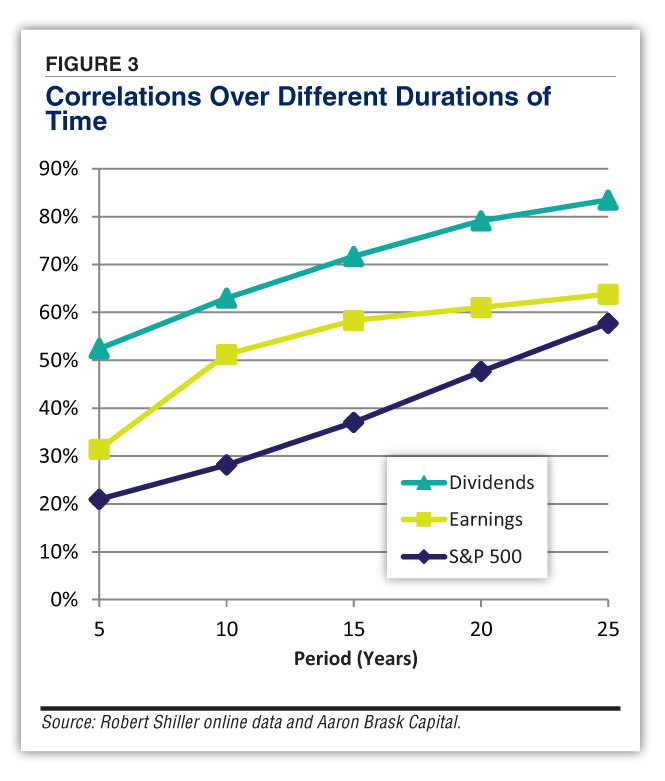
In order to assess the relationship between dividends and inflation at a higher resolution (i.e., within the 25-year periods), we made similar observations over smaller periods. Figure 3 shows the correlations calculated for rolling time periods ranging from five years to 25 years. To be clear, the 25-year correlations in Figure 3 are the same as those presented in Figure 1. As expected, correlations increase with longer time periods. We attribute this to the noise we mentioned while discussing the theoretical underpinnings of this relationship (e.g., companies might temporarily absorb price increases before passing them on to their customers). Dividends show the highest correlations regardless of the time period chosen. Moreover, while not shown here, correlations between CPI and dividends fell to 34% for one-year time periods but increased to 95% with 50-year periods. On balance, we believe this indicates a strong relationship between dividends and inflation.
To summarize, we highlight a few key points related to inflation:
In the previous sections, we shared our conceptual model and data indicating how inflation relates to corporate fundamentals and stock prices. This section highlights two roles dividends can play in mitigating risks related to market volatility.
The first context focuses on using dividends as a source of income versus having to chisel away at a portfolio’s principal and thus being at the mercy of the market. Dividends depend on underlying operating performance of the company but are not at the mercy of fickle investors’ buying and selling. So, this can reduce one’s dependence on market performance (as we discussed in our “Dividends Are Different” article, available at www.aaronbraskcapital.com/dividends-are-different).
The second context focuses on reducing rather than avoiding market volatility. Indeed, we believe dividends can be used to identify companies with higher-quality fundamentals and less market volatility. However, not all dividend strategies are the same. There are two primary types of dividend strategies and they are effectively polar opposite in nature. Given the proliferation of indexes, exchange-traded funds (ETFs) and dividend-related products, it is easy to get confused. So, here are descriptions.
High-dividend-yield strategies: Many dividend-based products and strategies target stocks that are paying high dividend yields. These are usually stocks that pay dividends but have run into troubles, thereby sending their share price lower and pushing their dividend yield higher. Investors generally take notice of successful companies that consistently increase their earnings and dividends. This can keep their prices elevated and push their dividend yields lower. Accordingly, we find that high-dividend-yield strategies often result in portfolios comprising lower-quality companies.
Rising-dividend strategies: The second type of dividend strategy we highlight targets stocks that have consistently paid and raised dividends for an extended period. While these companies may have lower dividend yields, the quality of the underlying companies is typically much higher—as evidenced by their ability to pay and increase dividends. Accordingly, this approach is very different than pursuing higher dividend yields.
For our purpose of investigating how dividend strategies can impact market performance, we focus on the latter dividend strategy. Our hypothesis is that companies that have consistently paid and raised their dividends, on average, are higher quality and exhibit lower market volatility. For this purpose, we consider the Vanguard Dividend Appreciation ETF  (VIG). As the name indicates, this fund invests in companies that have records of growing their dividends. Moreover, it has a live track record going back to April 2006. Therefore, we can observe performance over at least one complete market cycle.
Of course, this is just one fund, so the evidence may appear anecdotal in nature. However, our research reflects similar trends whereby portfolios of higher-quality companies tend to exhibit lower market volatility and reduced drawdowns—regardless of whether or not they pay dividends.
We now investigate how this is related to market performance. We are particularly interested in how these types of stocks held up during turbulent periods. Since its inception in 2006, the Vanguard Dividend Appreciation ETF returned 8.92% on an annualized basis. This was almost identical to the SPDR S&P 500 ETF Trust (SPY) which returned 8.65%. However, the volatility and drawdown of the Vanguard Dividend Appreciation ETF were both significantly lower than for the SPDR S&P 500 ETF. The standard deviations of their returns were 12.75% for Vanguard Dividend Appreciation and 14.52% for SPDR S&P 500 and their drawdowns were –41% and –51%, respectively. This drawdown data is anecdotal, since it only represents one particular event. So, we investigated the data for the benchmark index that the Vanguard Dividend Appreciation fund targets, the Nasdaq U.S. Dividend Achievers, and found similar results. While these results were actually stronger, it is worth noting that they were based on an index backtest rather than a live track record.
While some refuse to accept any role for dividends in portfolio construction or management, our intuition and historical data lead us to believe such views are dogmatic. We believe dividends possess important attributes with regard to inflation and market volatility that allow them to play a unique and critical role, especially in the context of retirement income planning.
This article first presented our theoretical model for how inflation relates to both corporate fundamentals and share prices. We then shared empirical results showing how dividend growth has been more strongly correlated with inflation than stock market returns or earnings growth. We also discussed and presented data describing how dividends could be used to bypass and possibly reduce stock market volatility.
We believe the empirical results regarding inflation corroborate the ideas behind our economic model as well as the notions we discussed in “Dividends Are Different.” For example, dividends are fundamental in nature and represent an economic phenomenon that is distinct from market prices and share buybacks.
At this point, refusing to acknowledge these unique attributes of dividends is effectively alleging the correlations we calculated were just a coincidence or manipulated by corporate managements. Given that these trends occurred over multiple time periods, we think the possibility of coincidence is de minimis. Moreover, that would be quite a conspiracy. Executives of companies from all sectors and across many time periods would have had to collaborate so that their dividend policies would aggregate in such a way to conform to inflation trends over multi-decade periods.
We do not subscribe to any such conspiracies. We believe the dividend-inflation trends we highlighted represent a visible hand of capitalism at work, as required returns on capital effectively push inflation through the economy’s profit mechanism. Since dividends are taken out of profits and paid directly to investors, they are not subject to the sentiment of often-fickle investors. This is especially important since investors can react negatively to inflation and send market prices lower at a time when liabilities may be rising. As such, we believe dividends provide a better source of income for investors who have liabilities that will likely grow with inflation.
We believe retirees, in particular, can leverage the benefits of dividends highlighted in this article to combat the deleterious effects of inflation and market volatility. ?
First Cut Stocks
AAII Stock Ideas

Investor Professor

Unknown from unknown posted over 6 years ago:
MORT A from MI posted over 6 years ago:
Aaron Brask from Florida posted over 6 years ago:
TIMOTHY H from CA posted over 6 years ago:
AARON B from FL posted over 6 years ago:
DAVE G from WA posted over 6 years ago:
AARON B from FL posted over 6 years ago:
You need to log in as a registered AAII user before commenting.
Log InCreate an account