

Related

Value Investing
AAII’s screen based on Miller’s Single Best Investment (SBI) approach seeks out high-quality stocks trading with high current dividend yields that offer high growth of the dividend.
by John Bajkowski | April 2020

The severe and sudden coronavirus-related market drop has many investors seeking out quality companies trading at attractive valuation levels. Many investors are turning toward dividend-paying stocks as a means of capturing current income while waiting for a market turnaround. Lowell Miller is an investing guru known for his disciplined, dividend-focused strategies. He founded Miller/Howard Investments Inc. in 1984 (www.mhinvest.com) and manages a number of portfolios constructed of financially strong firms with the ability to pay and consistently raise dividends.
Lowell Miller lays out his strategy in his book “The Single Best Investment: Creating Wealth with Dividend Growth” (Second Edition, Independent Publishers Group, 2006). Miller argues that too many investors have a hodgepodge of holdings that lack any overall strategy or philosophy behind their strategy. Miller feels that individuals should stop “playing the market” and instead become investors—like Warren Buffett, we should consider our stock investment as a partnership interest in a real and ongoing business. The ownership perspective frees investors from trying to guess the next hot sector or investment style, provided they invest in financially sound companies with reasonable long-term growth prospects.
A long-term perspective does not free a portfolio from market up- and downswings, but confidence in one’s approach provides a vision and understanding of why the market is down and its ability to rebound. An investor must stick with a plan.
Miller advocates that investors establish a strategy that relies on common sense, with reasonable achievable goals—noting that the strategy needs to be supported by evidence that the approach works over the long run. Investors will not succeed in the long term if they try to get higher returns than the market normally allows for a given level of risk.
Miller argues that stock dividends have an advantage over bond interest income because of the potential for the stock dividend payment to increase over time. Equity income offers long-term growth of principal and income. A good stock investment must overcome inflation and justify its risks.
Miller reminds us that investments such as stocks do not have the same rate of return each year. To compare investments, you must also consider the potential volatility of the return from period to period and seek out the highest level of return for a given level of risk. The stock dividend payment helps to smooth out the return over time, so you do not have to swing for the fences to build wealth from just capital gains. An investment with a 10% average annual return will grow 600% in 20 years. Investors just need to find businesses with reliable growth willing to share their profit with their owners. A long-term viewpoint is important; an obsession with monthly and even quarterly returns may “gum up the gears.”
Stock dividends make it easier to hold onto investments through price fluctuations of individual stocks and the market as a whole. The compounding principle of equity-income success remains in play whatever the market is doing. Miller looks for high-dividend-paying stocks with increasing dividends because investors will get the rising stream of income and the higher income level should eventually result in higher price valuations as well. Of course, this assumes relatively normal price-earnings ratios and interest rates.
Miller points out that dividends tell the truth. A meaningful dividend and a growing dividend payment are signals that the company has the wherewithal to pay its dividend. With a rising dividend, investors have some evidence that they are partnering with a real company that is doing well enough to pay and increase its dividend on a regular basis.
Dividends have a signaling attribute of the state of the firm’s business to investors. Boards of directors never want to cut the dividend and they will only raise the payout after considering the business strength and capital needs of the firm. Miller highlights a study published in the Journal of Finance by Adam Koch and Amy Sun, which revealed that investors buy dividend growth stocks to confirm the quality of reported earnings.
It is important to identify companies that not only have the financial strength to pay their dividends, but are also doing well enough to increase their dividends on a regular basis.
Miller acknowledges that dividend strategies fall out of favor at times, but he reminds us that investors will continue to be rewarded with the income portion of the approach until the market comes around to appreciating the strategy again. Over the long term, Miller feels that you should see the stock price rise by an equal percentage to the dividend increase for stocks trading with above-average dividend yields. If you purchase stocks with low current dividend yields, the market is looking at other factors to value the stocks.
Miller seeks out high-quality stocks trading with high current dividend yields that offer high growth of the dividend. He refers to a company with these qualities as a Single Best Investment (SBI) stock. Miller lays out 12 rules to follow in buying and holding an SBI stock and cautions that investors need to be somewhat adaptable rather than rigid when following the rules. However, for all but the most sophisticated investors, the rules should be treated as rules and not guidelines. Under normal market conditions, if a stock does not meet one of the 12 rules, there should be another stock that manages to meet all of the requirements.
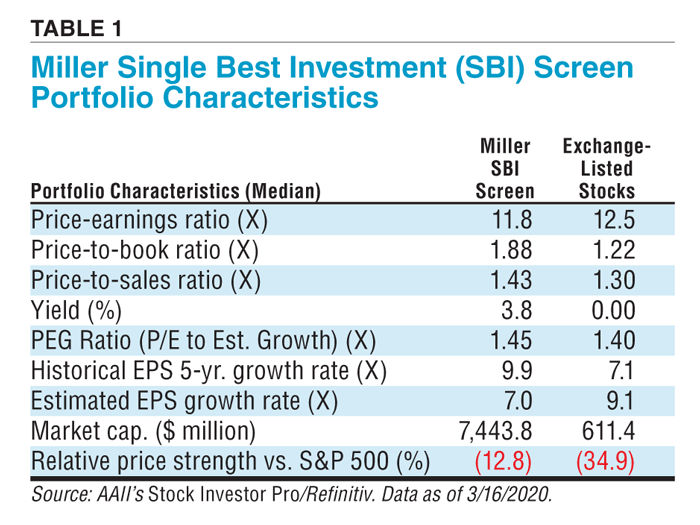
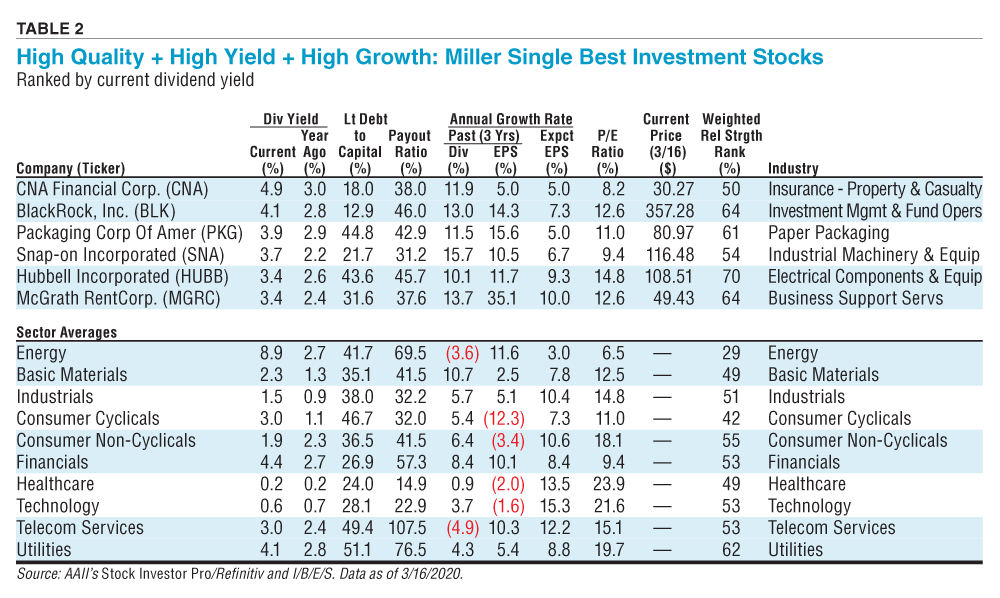
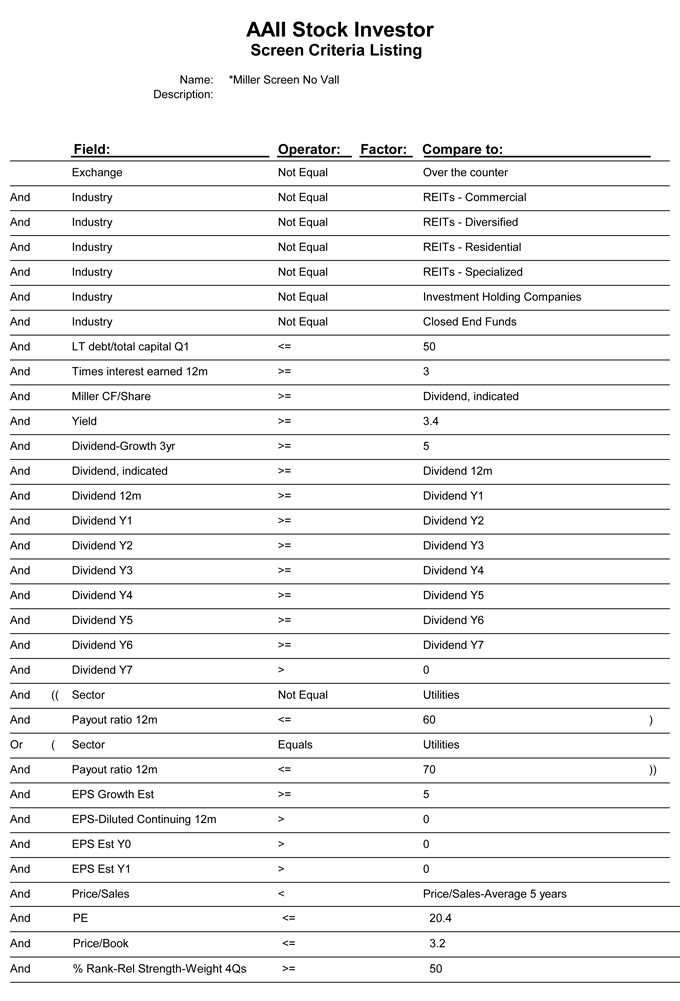
We used AAII’s fundamental screening and stock database program Stock Investor Pro to construct a screen that follows the Miller Single Best Investment strategy laid out in his book. Table 1 shows the characteristics of the stocks that match the Miller SBI screening strategy. Table 2 reveals the firms passing the strategy on March 16, along with industry averages for many of the key factors.
High-quality stocks have superior financial strength: low debt, strong cash flow and good overall creditworthiness. While some debt is good, too much debt puts the company at risk during an economic slowdown.
While companies with very stable and predictable cash flow may be able to take on higher levels of debt, Miller indicates that investors should avoid companies that have a debt-to-capital ratio greater than 50%. Capital is the long-term source of funding for the firm and consists of the sum of long-term debt and owner’s equity (book value). Debt to equity is calculated by dividing long-term debt by capital. Half debt and half equity results in a ratio of 50%. The higher the ratio, the greater the proportion of debt.
Stock Investor Pro’s dataset covered 6,096 companies as of March 16, 2020. Just over 4,000 companies had a debt-to-capital ratio less than or equal to 50%, eliminating around 2,500 companies from consideration.
Beyond the level of debt carried on the company’s books, investors should also examine the ability to pay its interest obligations from the company’s cash flow. The times interest earned, sometimes referred to as the interest coverage ratio, is a traditional measure of a company’s ability to meet its interest payment obligations. It indicates how many times over a company’s earnings before dividends can pay interest on its debt. The larger and more stable the ratio, the lower the risk of the company defaulting. A ratio of less than one indicates that the company’s current earnings are not high enough to meet its current debt payments. Miller looks for a coverage ratio of at least three to one. Just over 1,490 companies in the Stock Investor Pro universe have a times interest earned ratio of three or better. Adding this filter to the debt-to-capital filter left us with 1,156 passing stocks.
Miller looks for overall cash flow to be strong for his SBI candidates. High cash flow provides financial flexibility for companies in good times and bad. Miller wants cash flow to be strong enough to fund the dividend and the investment need to keep the company growing. We created a custom field in Stock Investor Pro that took the cash flow from operations and subtracted the capital expenditure and divided the total by the number of shares outstanding to create a pre-dividend free-cash-flow per share figure. We then required that this free-cash-flow per share figure be greater than the indicated dividend. Around 3,150 firms passed this filter independently. Adding the filter to our Miller SBI screen reduced the cumulative number of passing companies to 930.
As a final quality check, we exclude stocks that were not listed on the New York, American or Nasdaq stock exchanges. We also excluded real estate investment trusts (REITs), closed-end funds and investment holding companies. This reduced the cumulative number of passing companies to 830.
Miller requires that the dividend yield (indicated annual dividend divided by stock price) be high enough at the time of investment to be meaningful, even if high dividend growth is anticipated. The goal is to locate stocks with high current yields and high expected growth. It is important for the yield to be high enough to be a “compounding machine.” High-yielding stocks attract income-seeking investors who will put pressure on management and the board of directors to continue paying an attractive dividend.
A rising-dividend payment for a stock may be a good signaling device from management, but alone it does not present the type of dividend-compounding machine that Miller is seeking.
Miller compares the current stock yield to the market yield (S&P 500 index) and requires that the yield be at least 1.5 times the market. Two times the market yield is even better. Screening for a dividend yield relative to a market benchmark automatically adjusts to the market valuation levels.
The current yield of the S&P 500 is 2.27%. This is up from the 2.00% yield one year ago. The yield has increased due to the recent market weakness as well as the 9.0% dividend growth over the last year. Our Miller screen is looking for companies with a dividend yield of 3.4% or higher. We multiplied the S&P 500 yield of 2.27 by 1.5 to come up with this figure. Only 1,358 stocks out of a universe of 6,096 companies currently trade with a yield of 3.4% or greater. Adding this requirement to our screens for financial strength reduces the number of passing companies to 269.
Dividend growth is a sign of financial strength. The dividend growth should at least keep pace with inflation. Examining the past pattern and records of dividend increases should help to gain an understanding of dividend growth patterns. Miller looks for expected dividend growth of 5% or greater to assure growth in excess of inflation. Stock Investor Pro does not have consensus estimates for dividend growth.
Our Miller screen required a compound annual growth rate of 5% or greater over the past three years. Around 1,000 stocks have a historical compound annual growth rate of 5% or higher, and adding this requirement to our Miller SBI screen reduced the number of passing companies from 269 to 165. We then required several years of consecutive dividend payments without reductions. There are 885 companies that pass this filter independently, and it reduced our overall number of passing companies to 111.
Many investors look at the dividend payout ratio to measure the flexibility of the firm to continue paying and increasing its dividend payout. The payout ratio is the annual dividend divided by annual earnings per share. The lower the ratio, the more secure the dividend and the greater the chance for a dividend increase. The acceptable payout ratio varies by industry, with companies in more stable industries often having higher payout ratios. Our Miller SBI screen looks for utilities to have a payout ratio of 70% or lower and all other firms to have a payout ratio of 60% or below. Around 2,400 firms pass this filter. Adding this requirement to our Miller SBI screen reduced the number of passing companies to 97.
Miller looks for stocks in which earnings are expanding on a steady uptrend since dividends are paid from the income stream. The earnings growth does not need to be humongous, but it should be at least as strong as the dividend growth you are expecting. Annual earnings growth that is consistent and in the 5% to 10% range is required.
Our Miller screen looks for companies with an expected compound annual growth rate of 5% or greater over the next three to five years. We also added simple filters that required positive expected earnings per share for the current and next fiscal year. While these earnings estimates are likely to come down, it represents a good starting point. Just 825 companies currently have these characteristics. Adding the positive earnings requirements along with the minimum expected long-term growth rate of 5% reduced the number of passing companies to 26.
Miller considers a long record of success as one measure of good management. A record of market share expansion during economic or industry slowdown is a good sign. Ownership of shares by management is another good sign. Share ownership reflecting one year’s worth of salary is a reasonable requirement.
Miller examines how well management has been able to absorb and integrate acquisitions. Miller recommends management with integrity by examining if public statements turn out to be true. These are primarily qualitative measures that should be reflected in good quantitative results.
It is natural to seek out bargains when selecting stocks, but investors should remember the old maxim that “quality is always a bargain.” Even Warren Buffett is quoted as saying that it is far better to buy a wonderful company at a fair price than a fair company at a wonderful price. However, Miller acknowledges that many studies have shown that stocks priced lower based on traditional valuation measures outperform more expensive stocks in the long run. Many investors overpay for high expected growth and underpay for assets.
Miller highlights the use of price-to-sales ratios, price-earnings ratios and price-to-book-value ratios in his book.
When a stock trades with a low price-to-sales ratio, the multiple likely reflects investor pessimism about the company’s ability to maintain or improve its profit margins. A low price-to-sales ratio is attractive, especially if you notice an improving trend in profit margins. When screening for valuation factors, you can use fixed values or relative values. Miller notes that the price-to-sales ratio can be refined to look at the norm for the industry, as the price-to-sales average varies by the general profitability and growth within industries. It is also beneficial to screen against a firm’s own norm. Our Miller SBI screen looks for companies with a price-to-sales ratio below their historical average over the last five years. Around 3,400 stocks pass this filter independently.
Much research also supports the benefit of seeking stocks with low price-earnings ratios. It provides a quick measure of how expensive or cheap a given stock is currently priced at. Higher growth stocks deserve to trade with higher price-earnings multiples, but the other factors such as interest rates also impact the earnings multiple. Lower market interest rates can support higher price-earnings ratios. Miller recommends stocks with a price-earnings ratio less than the market price-earnings ratio. The S&P 500 has a current price-earnings ratio of 20.4, so our Miller SBI screen looks for stocks with price-earnings ratios of 20.4 or lower. Around 2,200 stocks have a price-earnings ratio of 20.4 or lower.
Book value is a very rough measure of the accounting value of the company. It represents the assets of the company less all liabilities. Comparing the price of the stock to its book value per share highlights how closely the market value of the company is trading to its accounting value. Unfortunately, many intangibles will not show up on the company’s books, so book value will often understate the true economic value of the firm. Nevertheless, stocks with low price-to-book values have historically outperformed the market. The lower the ratio the better. Miller prefers to compare the company value to the market level. The S&P 500 is currently trading with a price-to-book-value ratio of 3.2. We added a third valuation to our Miller SBI screen that required a price-to-book ratio of 3.2 or lower. Just under 4,000 stocks have price-to-book ratio of 3.2. The combination of value filters reduced our list of passing companies to 24.
In many ways, Miller feels the story or belief behind the company is as important as the valuation of the stock. An undervalued stock has some proposed story or expectation, and the investor needs to believe that the story will come true when they buy the stock. The story must be about the future of the stock, the market or even the economy. It might be a simple story that projects a rebound in earnings over the next few years and a stock’s return to its normal valuation level. A tailwind of favorable industry growth is good. Optimally, there is a “growth kicker” built on a base of reliable earnings and cash flow.
While technical analysis can be complex and difficult to interpret, there is a great deal of support in the use of relative strength to highlight stocks on the upswing. Miller indicates that underperformance followed by notably rising relative price strength is positive. A high-volume selling climax may point to a stock ready for an upturn. Miller states that technicals are not too useful for selling but can help investors select among their candidates and trim some positions.
Our Miller screen simply looks for stocks that have outperformed 50% of all stocks over the last year using a weighted relative strength index that places higher emphasis on performance over the last quarter. With the weighted relative strength calculation, the most recent quarterly price change is given a weight of 40% and each of the three previous quarters are given a weighting of 20%. The filter reduced the number of passing companies from 24 to six.
[For more on using relative strength to measure a stock’s momentum, see the AAII How-To column in this issue.]
Miller is trying to build a long-term compounding machine by investing in businesses with long-term prospects. When performing their qualitative analysis, investors should ask if the company provides items that are a necessity of life. Will the goods produced by the company be required years from now? Are profit margins improving? How has the company responded to competition in the past? Is it a dominant market player and is the size of the market for its goods or services growing?
Miller feels that successful investing requires a long-term perspective for an investor. We should focus on the unfolding story of the company, its industry and the marketplace. We should do everything possible to keep ourselves from “holding anxiety.” The ownership perspective is a long-term perspective. Emotions and unnecessary decisions are the undoing of most investors.
Dividends are the key to the SBI strategy, so investors need to be alert to the state of the dividend. Stocks should be sold if the dividend is in jeopardy. A rise in the payout ratio may highlight a risk to the dividend payment. In many ways, the reverse of the factors used to select SBI stocks are concerns—declining cash flow, growing levels of debt and earnings declines are issues that should be explored. A change in the company dividend policy may signal a change in the payout philosophy of the firm. Unless there is a reasonable excuse, failure to raise the annual dividend is a red flag. Once the financial strength, high current dividend and high dividend growth story changes, the stock should be sold.
Miller states that if your account is large enough you should hold around 30 stocks, with equal-dollar investments in each holding. If you hold fewer stocks, it is better to focus on the more conservative stocks of the universe. The high-income stocks of the SBI universe should be able to produce long-term income and growth of capital.
Only six securities passed our interpretation of the Miller Single Best Investment strategy and they are ranked by dividend yield in Table 2. Our screen focuses on the quantitative elements of the strategy, the first step in the process. Miller lays out helpful framework in building and managing an equity-income portfolio. The next step would be to examine the qualitative factors of the company, its management and the industry.
Individual investors have the advantage of time on their side. Investing in dividend-paying stocks with growing dividends represents a great way for investors to harness the power of time and the compound growth of dividend reinvestment.
([Cash from operations 12m]-[Capital expenditures 12m])/[Shares Average Q1]
Value Investing

Investor Professor

Stock Strategies

Brent from CA posted over 6 years ago:
Dave G from WA posted over 6 years ago:
KevinAS from Ca posted over 6 years ago:
jeffrey sonshine from connecticut posted over 6 years ago:
Jean from AAII posted over 6 years ago:
JOHN W from WA posted over 6 years ago:
DAVID P from AL posted over 6 years ago:
You need to log in as a registered AAII user before commenting.
Log InCreate an account