


Related

Investor Professor
Online Exclusive: Market Breadth's Meaning for Individual Investors

Dispatches
The eight so-called MegaCap-8 companies accounted for 26.4% of the S&P 500 index’s total market capitalization as of June 9, 2023.
by Charles Rotblut | July 2023

Charles Rotblut leads a class in AAII's new Essential Investing Video Course. Go to https://www.aaii.com/ves for more information and to subscribe.
The S&P 500 index entered into a new bull market on June 8, 2023. The index’s ascent to more than 20% above its low on October 12, 2022, has not reflected the performance of all stocks, however. As of mid-June, the Russell 2000 index remained in a bear market—yet to rebound by 20% from last year’s lows.
The divergence is being driven by the performance of the so-called MegaCap-8. The MegCap-8 stocks as identified by Yardeni Research are Alphabet Inc.  (GOOGL), Amazon.com Inc. (AMZN), Apple Inc. (AAPL), Meta Platforms Inc. (META), Microsoft Corp. (MSFT), Netflix Inc. (NFLX), Nvidia Corp. (NVDA) and Tesla Inc. (TSLA). These eight companies accounted for 26.4% of the S&P 500’s total market capitalization as of June 9, 2023, according to Yardeni. The “worst” performer of the MegaCap-8, Alphabet, had a year-to-date gain of 40.0% as of June 16. Meta Platforms, Nvidia and Tesla have more than doubled in price.
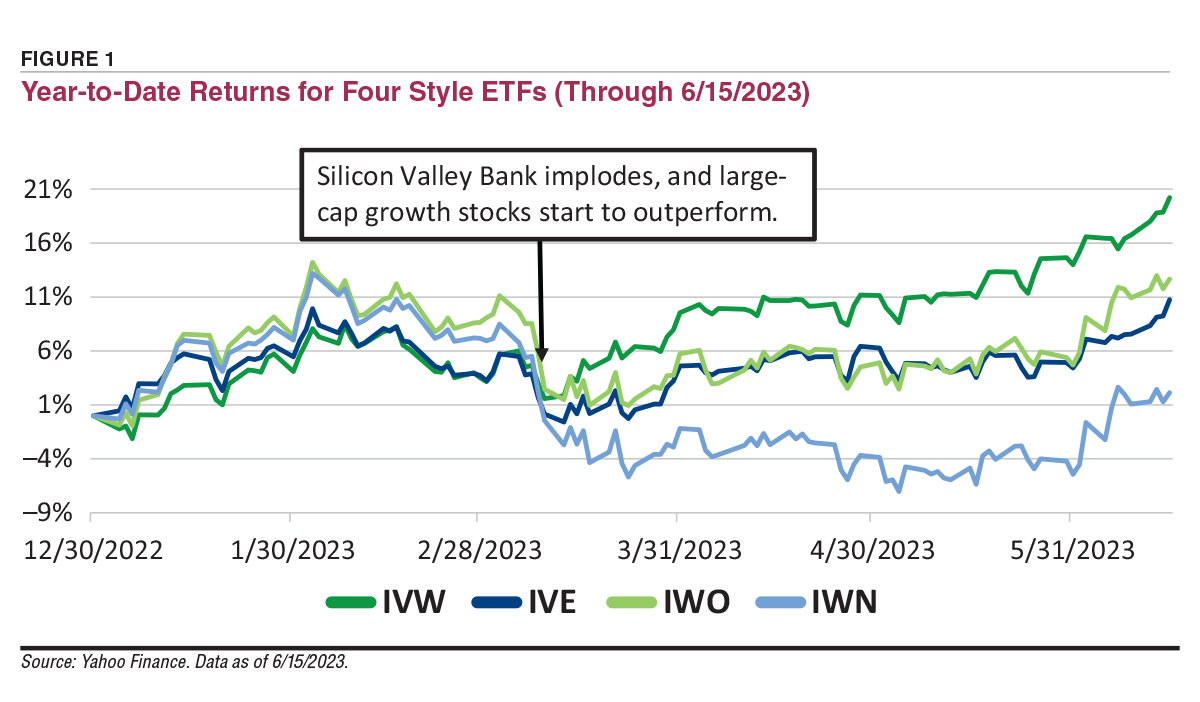
This year’s rally in stocks hasn’t always been driven by the MegaCap-8. Prior to the March 9 run on Silicon Valley Bank, small-cap stocks were outperforming. As you can see in Figure 1 below, both the iShares Russell 2000 Growth ETF (IWO) and the iShares Russell 2000 Value ETF (IWN) were outperforming their large-cap peers on a year-to-date basis. These two ETFs are plotted in light green and light blue, respectively.
Once Silicon Valley Bank collapsed, preferences changed. Large-cap growth took off, as you can see with the big ascent experienced by the iShares S&P 500 Growth ETF (IVW) in dark green. Even the large-cap iShares S&P 500 Value ETF (IVE) closed its performance gap against small-cap iShares Russell 2000 Growth during the second quarter.
The returns of Alphabet, Amazon, Microsoft and Netflix demonstrate the shift. The four stocks gained 6.8%, 11.8%, 5.8% and 5.7%, respectively, between the start of 2023 and March 8. Between March 9—when Silicon Valley Bank collapsed—and June 16, 2023, those same stocks jumped by 31.1%, 33.6%, 34.9% and 38.5%, respectively.
The difference in returns highlights the lack of breadth experienced so far by the new bull market. Breadth refers to the participation rate of stocks in a market move. When breadth is narrow, as it is now, only a relatively small number of stocks are participating in the move. Wide breadth is generally preferred since the participation of many stocks implies greater conviction in the move. Narrow breadth can be an early sign of a new market move or a warning sign that the new trend is not sustainable. Let’s hope that it is the former.
Investor Professor
Dispatches


BARRY J from TX posted over 3 years ago:
You need to log in as a registered AAII user before commenting.
Log InCreate an account