Reasons That Investors Part Ways With Their Financial Adviser

There are several common, but multi-dimensional, reasons that advisers are terminated by their clients according to research by Morningstar.

There are several common, but multi-dimensional, reasons that advisers are terminated by their clients according to research by Morningstar.

The issues have their basis in three underlying factors: insufficient focus on the person side of personal finance, advisers’ inability to communicate their value and a mismatch of expectations early in the relationship. Most of the reasons for firing advisers are not related to performance or portfolio returns but instead indicate a need for enhanced soft skills.

One hundred and eighty-five respondents out of 3,003 surveyed said they had parted company with their adviser in the past. Answers to the question “Why did you choose to stop working with [an] advisor?” were categorized into six areas thought to be the most common answers. Topping the list at 32% is the quality of financial advice and services. Clients believed that their values did not align with those of their adviser or that advisers were risking more money than they were comfortable with. The second-most-common category is the quality of the relationship. Clients felt that advisers were not giving their full effort or were not as available as clients expected. These two reasons represent more than 50% of the six most common issue areas.
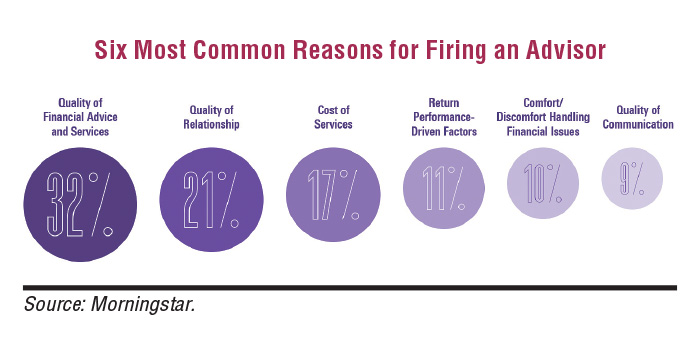
Six Most Common Reasons for Firing an Advisor

When an investor cited a specific reason related to one of these categories, the issue often stemmed from the adviser not dedicating enough time to understanding who their client is as a person and not understanding their client’s personal financial goals.

Morningstar concludes that their findings point to old-fashioned communication as the key to retaining clients. A prime example of a communication snafu is when clients associate advisers with generating abnormal returns but are quick to assign blame during unfavorable market conditions. While an adviser may be diligently monitoring a client’s account, their work may go unrecognized if they are not effectively communicating with that client. In addition, minimal communication can create a misunderstanding about what an adviser brings to the table. Both issues can be prevented by setting expectations early in the relationship and assuring the client that their needs are understood.

Source: “Why Do Investors Fire Their Advisor?,” by Danielle Labotka and Samantha Lamas; Morningstar Behavioral Research, April 2023.

Discussion

DAVE G from TX posted over 3 years ago:

"Morningstar concludes that their findings point to old-fashioned communication as the key to retaining clients." I think communication is part of it but that is not the whole story. I was a financial consultant for 11 years and recently retired from consulting with a very good track record. I think the key to not being "fired" is two-fold. First is setting proper expectations of what you can do for the client and letting them know what they can expect from the market. Before I suggested any equity portfolio, I asked them how they dealt with the last recession in 2008 and had them fill out my own version of a risk profile to gain some perspective. Next, I put together a list of between 3 to 10 Mutual Funds depending on my perceived needs of the client and the funds available to me from either their 401k, IRA, or Roth accounts and that is what they invested in. In all cases I tried to discourage individual stock investing as in my opinion it adds nothing to an investor's return and is just a source of continual worry for them since most stocks will fall at some point while you own them and in most cases you won't know exactly why. When a diversified mutual fund (mostly index funds) falls you know exactly why and if you are working and accumulating you know you are buying "stocks on sale." I rarely suggested anyone adjust their portfolio even in 2020. Only a couple of clients suggested in 2020 that they felt a little too aggressive so in that case we made a small adjustment with a little higher allocation to some bond funds. In retrospect it was probably the wrong thing to do, but as an advisor I feel it is your job to adjust if a client is having trouble sleeping, so to speak. Most people call that not investing beyond your "sleep factor." Beyond giving your clients a portfolio that is easy to put under their pillow the other thing is to charge them a reasonable price. My price was $100 for 6 months and I always gave them the option of not paying me if they didn't think my advice was worth it. For that I would track their portfolios on Morningstar and send them a report every quarter showing them their progress and of course respond to any questions by email or phone. In my opinion the mistake many advisor's make is setting up portfolios that require constant monitoring in the first place because most of those are doomed to trail the market eventually and no amount of communication will help that when the client understands they could easily have invested in 3 mutual funds and done much better.


BARRY J from TX posted over 3 years ago:

Dave, don’t be so hard on yourself. A passive-aggressive posture only depreciates your professional skill set. The issues listed in this article (and the original survey article) parallel the issues you hear on EVERY cheesy daytime “divorce court” TV show -- “We don’t communicate.” “The other party is engaging in risky behavior.” “This is not what I expected.” The shallowness and triteness of these statements say a lot more about the depth of the deficiencies in client planning and their ability to conduct honest reflection than they do about the performance of the financial advisors. Consider this evidence. #1 A 0.6% [185/3,003] advisor “divorce” rate is over 800 times better than the matrimonial divorce rate. Using the 50% divorce base rate as the most likely data, over the period of time covered, we can estimate that about 1,500 of these clients were divorced. #2 The bad news is that the other party gets 100% of the AUM after the breakup. Ouch! By comparison, you usually have to die to lose all your assets. Bigger ouch! This is just another cheesy survey that produced a set of shallow, trite outcomes. I downloaded and read the original article. @ https://assets.contentstack.io/v3/assets/blt4eb669caa7dc65b2/blt8ac67a0c1e9209c7/64371e4937ecbf10cadcf2ed/Why_Investors_Fire_Their_Financial_Advisor.pdf Morningstar's advice is equally cheesy. “To understand how to ameliorate these issues, advisors should focus on the underlying drivers, three of which we identified in this research: 1) insufficient focus on the person [sic] side of personal finance; 2) advisors’ inability to communicate their value; and 3) a mismatch of expectations early in the relationship.” As an independent investor, Dave, I thank you for the wisdom of your conclusion that “no amount of communication will help that when the client understands they could easily have invested in 3 mutual funds and done much better.” Why does the depth of this level of “help” remind me of the hand-painted, homemade cardboard sign above Lucy Brown’s sidewalk office, “Psychiatric Help. 5 cents”? Morningstar, thanks for the giggles.


DAVE G from TX posted over 3 years ago:

Barry, thanks for the comments. I think about a third of my clients came to me after "being sold" annuity products that they should have never bought. Once you unwind what was promised vs what they can realistically do, it is easier to see there are other ways to accomplish the same thing for less. I never advertised at all my services, so it was a good omen that another third came from recommendations.


BARRY J from TX posted over 3 years ago:

Good on ya, Davey. Here's some anecdotal comparative data. I read several articles in WSJ today about (1) the travails of investors who tried to become DIY bond investors because they saw higher returns over 2023, (2) the DIY experiences U. S. investors over 65 disserting fixed income for nearly 100% equity portfolios, (2) over 800 life experiences from WSJ readers to an article about how people regret their past decisions as they age. The comments seemed to split out as 50% I am happy with my life, 40% c'est le vie, and 10% I regret X, Y Z. It seems to be a matter of personal integrity and maturity of outlook, but we all encounter this "regretful" 10%. and have to deal with them. It's the relatives that test me the most. My anecdote? I just outlive 'em.


DAVID D from TX posted over 3 years ago:

Nice artickle. Like most AAII artickles long on words short on actionable information. For an example one of the top reasons for parting ways is unreasonable expectations. But no examples on what a "reasonable expectation" should be. Most Financial Advisor's would say 6-8%. Should a reasonable return from a Financial Advisor be the S&P 500 "benchmark" plus the rate of inflation and management fees over a 5yr or 10yr period? Say at minimum 11-12% ROI. Assuming by AAII standards being 100% in the market, 100% of the time.


DAVE G from TX posted over 3 years ago:

David D from TX I don't think an advisor should promise anything. If they do, I wouldn't trust them to begin with and look elsewhere. That being said as a financial consultant I didn't manage money directly but advised on how to invest. The number I used was typically 6-7% in my projections of future growth and that was overall a conservative number. That is a generalization based on accounts that were typically 75-90% equity mutual funds. Financial Advisors cannot just from reasonable math claim "benchmark plus fees" when 80% of professionals can't beat their benchmark consistently. You yourself can get "benchmark" yourself just with buy and hold of the benchmark, since trading costs are now essentially zero to buy the benchmark.


You need to log in as a registered AAII user before commenting.
Create an account

Log In

Get your free copy of our special report analyzing the tech stocks most likely to outperform the market.

Download the FREE Report Here: