



After a strong start to the year, investor sentiment turned negative as cracks in the solidity of regional banks were revealed. Regional banks are critical to the funding of smaller companies, so any pullback in lending especially hurts these firms. It was feared that if the tightening of the Federal Reserve did not push the economy into a recession, then a pullback in bank lending would. Eventually, stock investors turned their focus (and their funds) to larger growth companies perceived to benefit from the impact of artificial intelligence (AI), specifically large language models behind services such as ChatGPT. Throw in some uncertainty in potential fallout from failing to reach a compromise deal to extend our nation’s debt ceiling and you have a recipe for a relatively narrow stock market favoring large growth stocks for the first five months of this year.
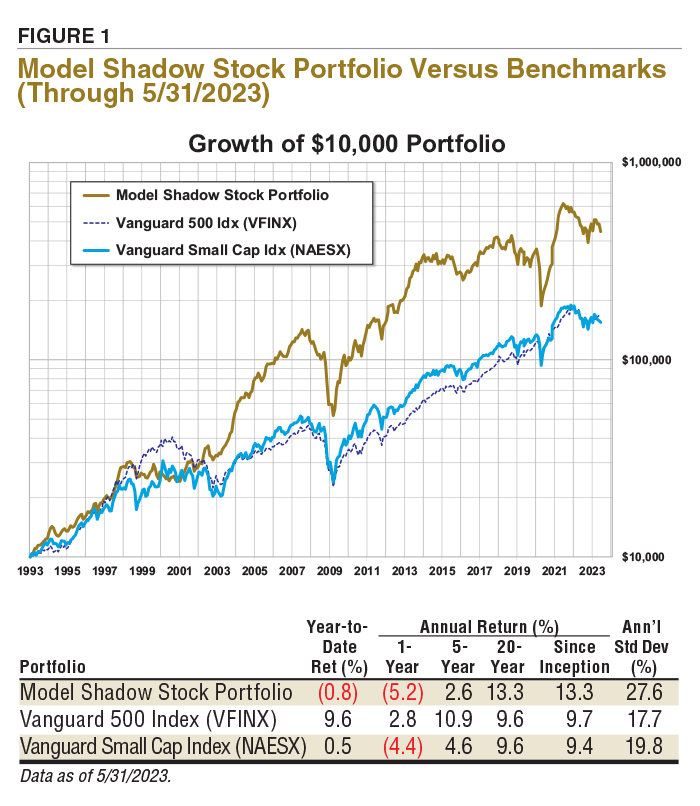
The S&P 500 index as measured through the Vanguard 500 Index fund  (VFINX) is up 9.6% year to date, while the Vanguard Small Cap Index fund (NAESX) is up 0.5% for the year. The DFA U.S. Micro Cap fund (DFSCX) is down 1.7% during the first five months of the year, while the Model Shadow Stock Portfolio is down 0.8% year to date.
Growth segments performed better than value-oriented stocks. In the large-cap segment, growth stocks are now up 14.0% for the year, while large-cap value stocks are up 4.9% year to date. In the mid-cap segment, mid-cap growth stocks are up 1.6% for the year, while value stocks are down 2.3% year to date. Small-cap growth stocks are down 0.9% year to date, while small-cap value stocks are down 3.2% for the year based on the performance of the respective S&P indexes.
Under the current uncertain economic environment, investors were more comfortable investing in larger companies until the start of June.
Since its inception in 1993, the AAII Model Shadow Stock Portfolio has a compound annual average return of 13.3% versus the Vanguard 500 Index fund’s gain of 9.7% per year on average over the same period. Over the same period, the Vanguard Small Cap Index fund posted an average annual gain of 9.4%. Figure 1 compares performance over other time periods.
Quarterly Review and Changes
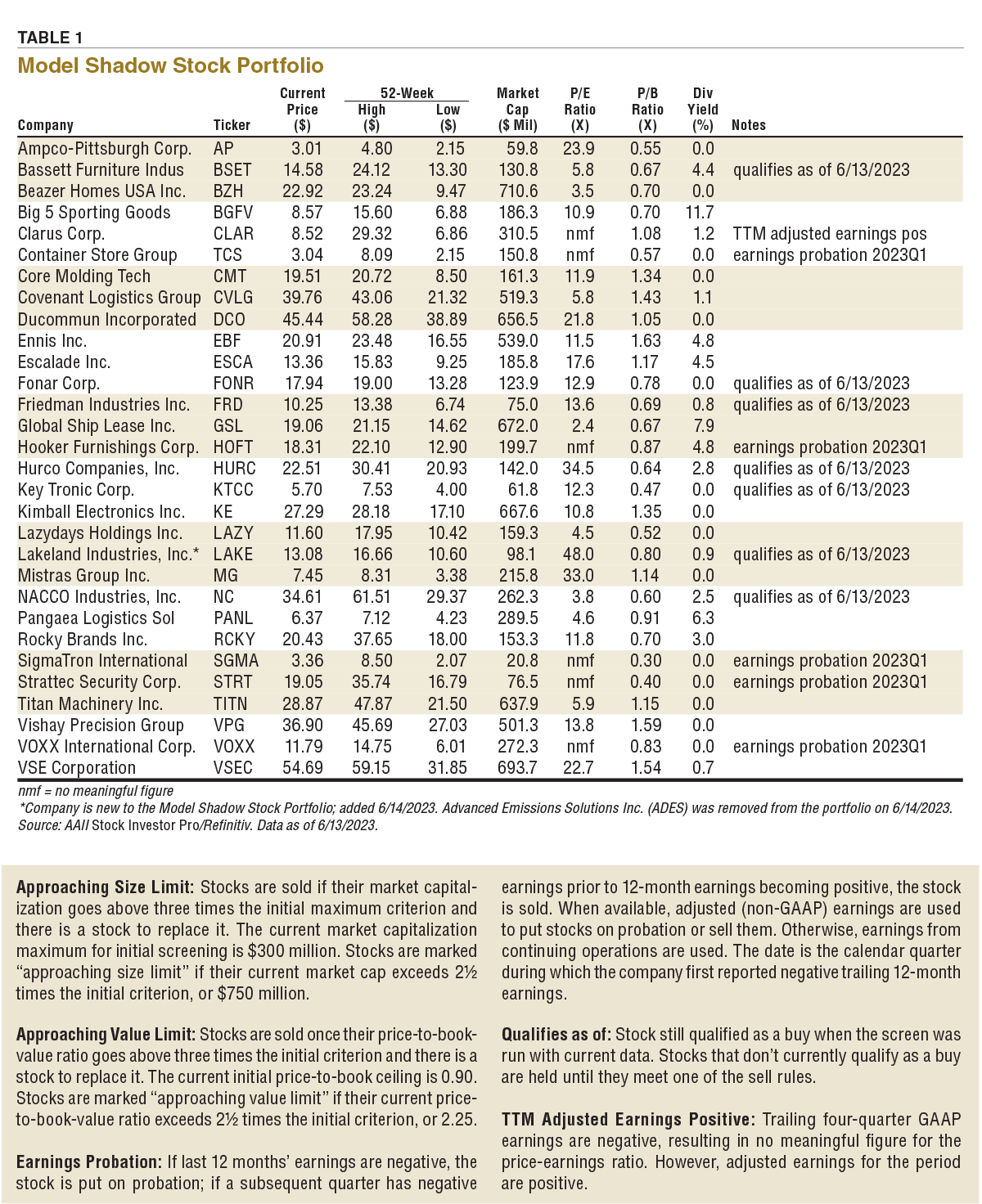
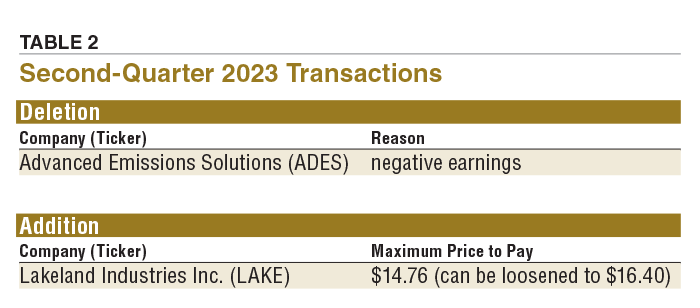
Table 1 shows the stocks currently making up the model portfolio. After conducting the quarterly review, there is one deletion and one addition to the Model Shadow Stock Portfolio, as summarized in Table 2.
The quarterly review was conducted with a strong uptick in the market during early June. The model portfolio rules guided the actions. The quarterly portfolio review is tied to the quarterly earnings reporting cycle of domestic companies. Companies are normally removed from the model portfolio if earnings turn negative or if strong growth and positive expectations push the size of the company and its valuation above desired levels.
The review begins with an examination of the prevailing valuation segments of the marketplace. The Model Shadow Stock Portfolio selection criteria targets the “cheapest” 10% of domestic stocks as measured by the price-to-book-value (P/B) ratio. The decile breakpoint for value is determined by examining price-to-book levels of domestic companies listed on the New York Stock Exchange (NYSE) and then using the price-to-book breakpoint for stocks listed on all domestic exchanges.
We determined the maximum price-to-book value for the lowest decile (lowest 10%) value universe among NYSE-listed stocks using AAII’s Stock Investor Pro stock screening program. The price-to-book cutoff had decreased slightly from 0.88 in March to 0.85. With the current initial qualifying maximum price-to-book ratio at 0.90, we are leaving it unchanged. Qualifying stocks must have a price-to-book ratio of 0.90 or lower. Stocks in the model portfolio are removed for valuation if they exceed three times the minimum initial price-to-book ratio at the time of a quarterly portfolio review. In other words, for this quarter’s review we use a price-to-book cutoff of 0.90 to screen for stocks to add to the Model Shadow Stock Portfolio and 2.70 (0.90 (BZH) 3) as the maximum price-to-book ratio to keep stocks in the portfolio.
As of June 13, 2023, Ennis Inc. (EBF) had the highest price-to-book ratio in the Model Shadow Stock Portfolio. Ennis is engaged in manufacturing, designing and selling business forms and other printed business products, primarily to distributors located in the U.S. Its price-to-book ratio of 1.63 is well below the 2.70 value used to remove stocks from the model portfolio. Therefore, no stocks are being removed this quarter for exceeding the valuation limit of the model portfolio.
We then examined market-capitalization levels of the companies listed on the NYSE to determine the size cutoff for the lowest decile. Here the market-cap level maximum was $285 million, compared to $297 million in March 2023. The decline was not significant enough to warrant a change to the portfolio rules. The maximum market cap for inclusion in the Model Shadow Stock Portfolio is $300 million, and holdings are removed if their market cap goes above three times the initial criterion at the time of the quarterly review: $900 million.
Beazer Homes USA Inc. (BZH) had the highest market cap in the portfolio, with a value of $710.6 million as of June 13, 2023. Its market cap is well below the removal level of $900 million, so no stocks are being removed this quarter for exceeding the size limit of the model portfolio.
The other major factor that leads to portfolio turnover is tied to negative earnings. If a company reports trailing 12-month earnings from continuing operations that are negative, the stock is placed on probation; if a subsequent quarter has negative earnings prior to trailing 12-month earnings becoming positive, the stock is removed. When available, adjusted (non-GAAP) earnings are used to put stocks on probation or delete them. These are earnings that are reported in the media and have been adjusted to eliminate the impact of nonrecurring events such as markdown of inventory or goodwill. The I/B/E/S adjusted earnings reported in Stock Investor Pro are used for Model Shadow Stock Portfolio decisions when they are available. For companies in the Model Shadow Stock Portfolio that are not followed by analysts, we use the diluted normalized earnings per share as calculated by Refinitiv. Diluted normalized earnings per share represent the bottom-line earnings available to common stockholders, excluding the effects of all nonrecurring/unusual/one-off/extraordinary items, adjusted by the effects of dilution. This value is adjusted by minority interest, equity in affiliates, the U.S. GAAP adjustment, preferred distributions and all other adjustments to earnings per share.
Portfolio Deletion: Advanced Emissions Solutions, Inc.
Coming into the quarter, only Advanced Emissions Solutions Inc. (ADES) was on earnings probation. Advanced Emissions Solutions provides solutions to customers in coal-fired power generation, municipal water and other industries through the proprietary emissions control and water purification technologies. The company reported a loss of $0.32 per share for the quarter ending March 31, 2023, while still on earnings probation. Advanced Emissions Solutions was added to the Model Shadow Stock Portfolio on March 14, 2022, at an average cost of $5.78 per share. It was removed on June 14, 2023, for $1.56 per share, for a loss of 71.4%.
During the quarter, five holdings reported losses great enough to push their trailing 12-month earnings into negative territory—Container Store Group Inc. (TCS), Hooker Furnishings Corp. (HOFT), SigmaTron International Inc. (SGMA), Strattec Security Corp. (STRT) and VOXX International Corp. (VOXX). The firms are now on earnings probation.
A stock can also be removed if it has been held for over four years if it also no longer meets the initial rules for qualifying and has not gained at least 10% annually from its purchase price and there is a new qualifying stock to replace it. The four-year rule is normally enforced during the year-end review.
Quarterly Addition: Lakeland Industries Inc.
Running the numbers, 23 stocks met the initial selection criteria for the Model Shadow Stock Portfolio as of June 13, 2023, down from 27 one month ago. AAII members can see and research which companies are currently passing the initial selection criteria in the Shadow Stock Ideas table on AAII.com. The list of Shadow Stock Ideas is updated daily—Tuesday through Saturday.
Six qualifying stocks were already in the Model Shadow Stock Portfolio at the time of the review. The remaining 17 stocks were examined to ensure adequate liquidity, timely financial filings and appropriate industry and foreign considerations. The Shadow Stock Portfolio Rules on AAII.com provide guidance on factors to consider when selecting stocks for your portfolio.
With the proceeds from removing the stock, as well as the cash held in the portfolio, one stock was added at roughly the average position size for the existing holdings in the tracking portfolio.
Lakeland Industries Inc. (LAKE) manufactures and sells a line of protective clothing and accessories for the industrial and public protective clothing market. The company’s product categories include limited use/disposable protective clothing, high-end chemical protective suits, firefighting and heat protective apparel, durable woven garments, high visibility clothing, along with gloves and sleeves. Lakeland Industries has a book value per share of $16.40 as of April 30. If you wish to stay within the 0.90 price-to-book-value maximum, you would pay no more than $14.76 per share ($16.40 (BZH) 0.90). However, if the stock price has moved up after being added to the portfolio, you can still purchase the stock unless the price-to-book ratio goes above 1.00, which equates to a price of $16.40 per share. To calculate the maximum purchase price based on the maximum desired price-to-book ratio, multiply the current book value per share ($16.40 for Lakeland Industries) by the maximum price-to-book ratio to be considered for the Model Shadow Stock Portfolio (currently 0.90, or 1.00 for loosened consideration).
Next Portfolio Review
The next quarterly review of the AAII Model Shadow Stock Portfolio will take place around the beginning of September 2023, after most of the holdings have announced their quarterly earnings. Any changes to the portfolio will be announced at the time they are made in a special Model Shadow Stock Portfolio Update email (sign up at www.aaii.com/email).

Related

Related

AAII Model Portfolios
Influx of New Blood for Model Shadow Stock Portfolio
Discussion
FREE REPORT

Get your free copy of our special
report analyzing the tech stocks
most likely to outperform the
market.
BRENT T from TX posted over 3 years ago:
You need to log in as a registered AAII user before commenting.
Log InCreate an account