

Related

Trading Strategies
Members discuss options strategies as inflation challenges traditional paradigms, plus news from the chapters.

Inflation. It’s the whispered word that makes even seasoned investors reconsider their strategies. An erosion in purchasing power often drives the hunt for higher returns, which in turn sparks debates about the optimal strategies for the times. One such strategy under the spotlight is options investing.
There’s an intriguing proposition making rounds: Can options strategies, with their inherent leverage, offer better protection against inflation than traditional investing methods? On the face of it, options trading seems like an enticing play. The ability to capitalize on market movements with a fraction of the investment to reach for yields that potentially outstrip inflation.
However, the leverage that options provide is a double-edged sword. While they can amplify gains, they can equally magnify losses. Inflation’s unpredictability coupled with options can be a volatile mix. Another perspective advocates for the use of strategies like covered calls, which, despite capping gains, provide an income source, offering some relief during inflationary periods.
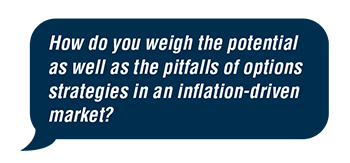
But here’s the million-dollar (adjusted for inflation, of course!) question: As inflation challenges traditional paradigms, should you lean more toward aggressive options strategies or tread cautiously, valuing capital preservation?
AAII members, it’s time to introspect.
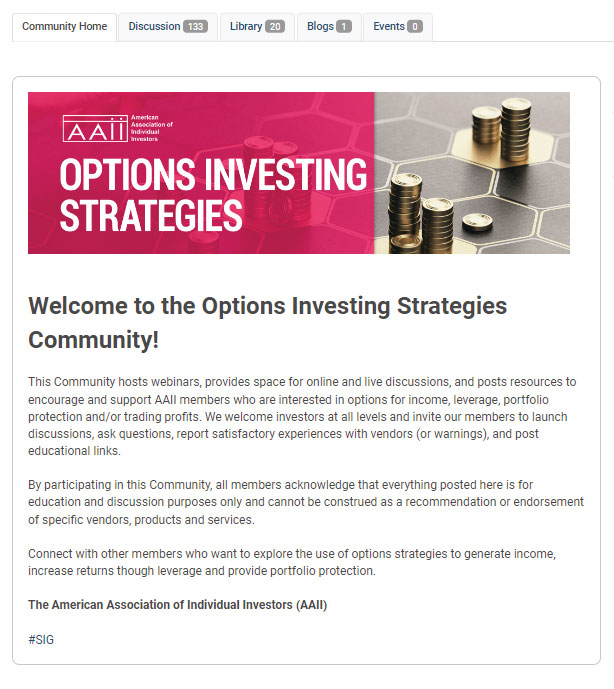
Interested in responding or curious to hear other investors’ strategies regarding inflation and options? Visit https://community.aaii.com with your AAII member credentials to join the Options Investing Strategies community today.
An elderly couple sat down for a Happy Meal at McDonald’s. The husband meticulously cut the burger in half and counted out the fries into two equal piles. Responding to a curious passerby the man declared, “My wife and I have always shared everything since the day we married.”
“So how come you’re eating, and she isn’t?”
The wife quickly sprang to his defense, “I’m waiting for the dentures.”
Ah, one more reason to embrace a lifetime of savvy AAII-style investing. (Indeed, our members should never find themselves in this predicament.) It also illustrates a speed bump in our efforts to map the trajectory of AAII member growth.
We know that some married couples share a single membership, which is A-OK with us, even though it confounds an exact head count. We also know some investors disengaged during the pandemic. We’re saddened to see renewals dip when the market dips—it should be the exact moment to redouble our commitment to learning and seek out opportunities to invest.
That said, our Chapter Communities and their audiences are growing, in large part due to collaborations. Most notable was our multichapter “Webinardigras” in June, where 170 attended live online and 981 have viewed the recording to date. Our fall lineup will feature more mega-events, such as a multichapter meeting with Paul Merriman in October and a Winter Webinardigras.
You can get in on the action at all our chapter online communities. Sharing makes it even better, but you’ll each need your own seat …
—Hollis Wagenstein-Hurturk, AAII Chapter liaison
Sign up for Chapters
www.aaii.com/ChapterEmail
See Upcoming Events
https://community.aaii.com/events/calendar
Trading Strategies

Robert R from TX posted over 3 years ago:
JOHN L from NJ posted over 3 years ago:
Hugh P from WA posted over 3 years ago:
You need to log in as a registered AAII user before commenting.
Log InCreate an account