


Related
AAII Community
A covered call strategy offers investors the chance to collect dividends, generate premium income, benefit from some price appreciation in bull markets and mitigate losses in a bear market.
by Brian Haughey, | March 2023

Investors seeking to earn modest returns in what they expect to be a relatively flat market can do so by writing calls against stock they already own. This “covered call” strategy, which also provides protection against small market declines, combines a long position in a stock with a short position in a call option and generates income in the form of a premium received for writing a call option.
As described in my article “Measuring Market Volatility Trends With the VIX” (June 2022 AAII Journal), a call option provides the owner with the right, but not the obligation, to purchase a firm’s shares at a fixed price known as the strike, or exercise, price. The writer, or creator, of the option has the obligation to deliver the stock at this price if the purchaser exercises the option. The option writer earns a premium for selling the option to the purchaser and, if the option is exercised, will also receive the strike price in return for delivering the stock. The option premium is a function of the current stock price, the strike price, interest rates, time to expiration and the stock’s implied, or expected future, volatility. Premiums tend to be greater in more volatile markets and increase the attractiveness of the covered call strategy.
Writing a call option without owning the stock (a “naked call” strategy) exposes the option writer to potentially unlimited risk because if the option were to be exercised, the writer would have to purchase the stock in the open market, possibly at a ruinous price, in order to deliver it to the owner of the option. However, the covered call strategy is no riskier than owning the stock outright, since the writer owns the stock prior to writing the option and can deliver it if called upon to do so. We should note, though, that in return for receiving the premium, the writer gives up the chance to benefit from any further stock price appreciation above the strike price.
A covered call strategy involves writing a call against shares you already own. A variant, the “buy-write” strategy, involves the simultaneous purchase of shares and writing of a call. The only difference between the two variants is that you may have unrealized gains or losses to consider with the covered call strategy.
A related strategy involves the naked writing of put options against a cash balance in a brokerage account. Whereas a call option conveys to the option owner the right to purchase stock at the specified strike price, a right that is attractive when prices are rising, a put option conveys the right to sell shares at a fixed price, which is attractive when prices are falling. Put writers are required to hold cash equal to the strike price for each option when writing an option contract. While it may sound dangerous, this “cash-secured put” or “put-write” strategy has essentially the same risk profile as that of the covered call strategy and appeals to investors who don’t yet own stock but are willing to purchase it at a lower price (the strike price) while generating premium income and earning some interest. In fact, a put-write strategy typically has slightly lower risk than a covered call strategy because at the time of writing the option call strikes are typically set above the current stock price while put strikes are generally set below the current price. Ignoring the premiums, the covered call writer, who already owns the stock, suffers a loss from a price decline from the current stock price, whereas the put writer, who is only required to purchase the stock if the price equals the strike price, will only suffer a loss if the stock declines further, below the put strike.
Suppose it is early November 2022, and you own shares of Microsoft Corp.  (MSFT). You don’t expect the share price to appreciate significantly over the next two months, so you decide to employ a covered call strategy.
On November 10, 2022, the price of Microsoft was $242. Since one option contract involves the purchase or sale of 100 shares, you buy 100 shares if you don’t already own them. At the same time, you write, or sell, one Microsoft call option contract (one contract consists of 100 options) with a strike of $250 and an expiration of January 20, 2023. You receive a premium of $10 for each of the 100 call options in the contract.
At expiration, if the stock price exceeds $250, you will have to deliver 100 shares. In exchange, you will receive $250 in cash for each share. You will have already received a $10 premium (on each of the 100 options in the contract) and the $0.68 dividend per share that was declared at the end of November 2022. Each of the shares, worth $242 in November, will be surrendered, leaving you with $260.68 ($250 + $0.68 + $10) in cash per share for a gain of $18.68 ($260.68 – $242). This is a 7.72% return in just over two months. It would result in an annual return in excess of 30% if you were able to replicate the strategy and outcome four times a year.
As it happens, at expiration on January 20, 2023, shares of Microsoft closed at $240. Because the option expired out of the money, meaning that the seller had no incentive to purchase the stock from you at $250, you keep your shares. Your position is therefore a net $250.68 per share ($240 + $10 + $0.68), a gain of $8.68 ($250.68 – $242). This is a return of 3.6% in less than three months, despite a $2 drop in the stock price during the period. If you were able to repeat this performance four times a year, your annual return would exceed 14%.
Remember that because options contracts require you to hold 100 shares for each contract you write, the strategy in this example would require an investment of $242 (MSFT) 100, or $24,200.
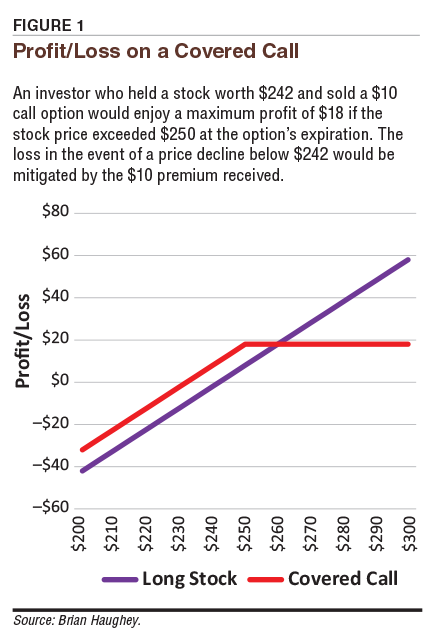
The covered call strategy allows an investor to benefit from price appreciation up to the strike price. In the Microsoft example, ignoring the dividend, the investor would benefit from price appreciation up to $250, while also earning $10 in premium. This means that they would surrender the stock for $260, $18 more than the $242 price when the strategy was initiated. The investor is also protected by the premium received against a price decline. In our example the stock could fall by $10, to $232, and the investor would not incur a loss, as illustrated in Figure 1.
An investor who owned stock worth $242 and sold a $10 option would enjoy a maximum profit of $18 if the stock price exceeded $250 at option expiration. The loss in the event of a price decline below $242 would be mitigated by the $10 premium received.
Since the investor using a covered call strategy holds a position in stock, high-quality blue-chip stocks such as those in the S&P 500 index are candidates to consider. A strike price higher than the current stock price is recommended. (If using a put-write strategy, however, a strike lower than the current stock price would be used.)
The premium earned by writing an option depends, in part, on the strike price and the time to expiration. The lower the strike price, the greater the premium, since it is more likely that the stock price will exceed the strike price at expiration and the option will be exercised. Since the stock must be delivered if the option is exercised, the option writer won’t gain from the stock’s price rising above the strike price. So, the writer must choose between maximizing premium income and setting the strike high enough to provide some potential for realizing a gain from an increase in stock price. If the stock is one that the writer would be reluctant to deliver, the strike price should be high enough so that the option is unlikely to be exercised.
The greater the time to expiration, the greater the premium since there is more time for the stock price to rise above the strike price. In general, expirations between one and three months in the future are typically chosen when using this strategy to allow the option writer to benefit from “time decay.” As time passes, it becomes increasingly less likely that the option writer will have to surrender the stock, if not already obliged to, so the option becomes less valuable. And since the passage of one day is more significant for a one-month option than, for instance, a one-year option, a shorter-dated option loses value more rapidly than a longer-dated option would.
The writer must choose between maximizing the premium and limiting the chance of the option being exercised, so the strike price and expiration date are typically considered together. Most option writers will look at an option’s implied volatility, which is the annual standard deviation of expected stock price moves. A useful tool to remember is the “Rule of 16,” which refers to the fact that an option’s implied volatility divided by 16 reflects how much the market expects the share price to move each day. For example, the implied volatility of the Microsoft call option in our example in November 2022 was about 32%. It suggests that the market expected the stock would fluctuate by no more than 2% (32% ÷ 16) every day until expiration 68% of the time. An investor who believed that estimate to be too high would sell the option (because they do not expect the stock to reach the stock price), while one who considered it to be too low would purchase the option (because they expect the stock to rise above the strike price by a large enough amount to exceed the premium).
Note that if the stock is “in the money” (ITM) before expiration, meaning that its stock price exceeds the strike price, there is a chance that the option will be “assigned.” This means that the writer would have to deliver the stock and receive the strike price in exchange for their shares prior to expiration. In practice this is unlikely to happen—except in the case of significant dividends being paid—because by exercising early, the option owner loses value. A better strategy for the owner is generally to sell, rather than exercise, an in-the-money option.
As expiration approaches, if the option is in the money a call writer who would prefer not to deliver the shares can repurchase the option in the open market.
An alternative to employing covered call strategies on individual stocks—particularly for investors who do not feel comfortable dealing in 100-lot position sizes for highly priced stocks (a stock trading at $250 per share would require an investment of $25,000 to employ a covered call strategy)—is to make use of an exchange-traded fund (ETF) such as the Invesco S&P 500 BuyWrite ETF (PBP). This fund tracks the CBOE S&P 500 BuyWrite index, which holds a long position in the S&P 500 while selling covered calls with strike prices at or above the prevailing level of the index. Dividends and premiums are reinvested.
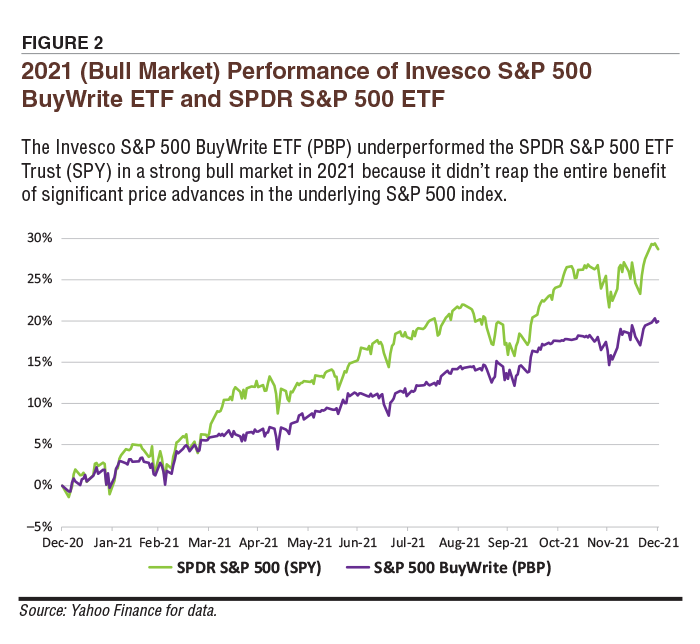
Figure 2 shows the performance of the BuyWrite ETF in 2021, a year characterized by a strong bull market. The S&P 500 [represented by the SPDR S&P 500 ETF Trust (SPY)] returned more than 28%, while the ETF returned 20%. This is not surprising, since a covered call strategy won’t reap the entire benefit of significant price advances, but the fund performance was still impressive.
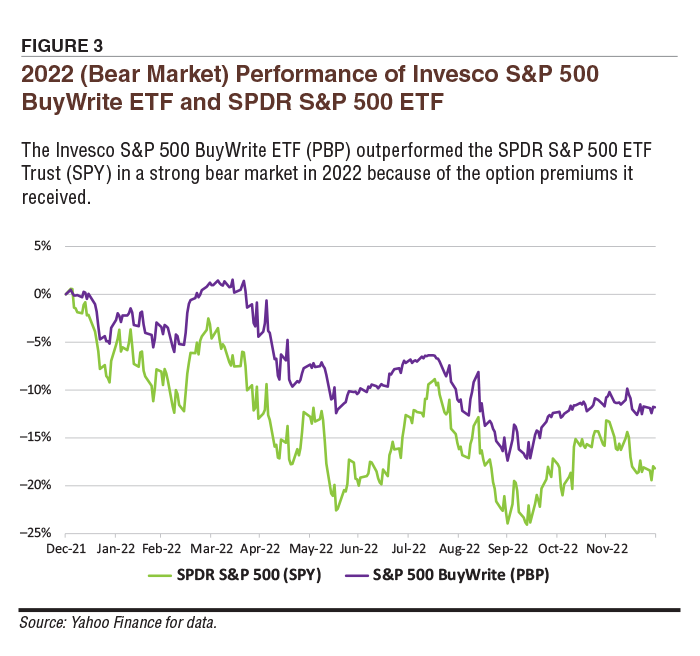
In contrast to 2021, the market experienced a severe bear market in 2022, with the S&P 500 losing 18.2%. Figure 3 shows how the BuyWrite ETF’s performance benefited from the option premiums received, losing just 11.8%.
The BuyWrite ETF’s performance in strong bull and bear markets illustrates perfectly how a covered call strategy offers some downside protection in down markets, at the expense of some upside in bull markets.
A covered call strategy offers investors the chance to collect dividends, generate premium income, benefit from some price appreciation in bull markets and mitigate losses in a bear market. It can be employed using shares on individual companies and with specialized ETFs.
A criticism that might be made about the strategy is that the risk profile is asymmetrical. In other words, if the stock price falls, the investor continues to hold the stock, thereby suffering a loss, but if the stock price rises above the strike price then the stock must be surrendered, preventing the investor from benefiting from price appreciation above the strike. However, proponents of the strategy would disagree, arguing that the premium received mitigates the loss if the stock price drops. They would also point out that if the strike price is sufficiently high (perhaps 10% to 15% above the current price, for most stocks), the option is likely to expire “out of the money,” meaning the stock price is lower than the strike price. Even if the stock is called, an investor employing the covered call strategy benefits from both premium income and appreciation from the current price to the strike price. By replicating the strategy several times a year, attractive returns could accrue even in stagnant markets.
Investors employing the strategy in a taxable account should be aware of the capital gains and dividend taxes. If a stock is called prior to the respective one-year and 61-day holding periods being met, the capital gains realized and dividend income received may not be eligible for the more favorable long-term capital gains and qualified dividend tax rates.
AAII Community

Trading Strategies

Trading Strategies

ROBERT A from NC posted over 3 years ago:
JOHN L from NJ posted over 3 years ago:
DAVE G from TX posted over 3 years ago:
ROBERT A from NC posted over 3 years ago:
JON S from TX posted over 3 years ago:
Michael S from CA posted over 3 years ago:
RICHARD F from MT posted over 3 years ago:
RAVI S from NC posted over 3 years ago:
WILLIAM J from SC posted over 3 years ago:
ANTHONY D from PA posted over 3 years ago:
BARRY J from TX posted over 2 years ago:
BOB M from MO posted about 1 year ago:
You need to log in as a registered AAII user before commenting.
Log InCreate an account