


Being a “buy and hold investor” doesn’t mean you should “set it and forget it.” Having a set of possible replacements in your back pocket can be helpful for many situations.
While stocks will go through natural ups and downs in the long run, there may come a time when a stock no longer meets the core characteristics that led us to buy it in the first place. This may mean that, for value-oriented investors, a stock has become too expensive. Likewise, for growth or momentum investors, a company’s growth may have begun to slow, or the price momentum has started to fizzle out.
Mutual fund and exchange-traded fund (ETF) investors may consider a change in a current holding should certain events occur:
- Manager change
- Portfolio change (style drift)
- Unexpected performance
- Fee increases
However, the number of investments at our fingertips is enormous. The stock universe at AAII.com contains more than 7,000 exchange-listed companies. Additionally, the mutual fund universe numbers nearly 24,000, and there are more than 3,200 ETFs. Doing some preliminary narrowing down of this list makes your life easier if and when it comes time to buy.
This is where a portfolio tracker watchlist is helpful. A watchlist is a list of securities that are being monitored for potential trading or investing opportunities.
An investor (or trader) may create a watchlist of several, dozens or even hundreds of securities—stocks, mutual funds, ETFs, etc.—to make more informed and suitable investment decisions. A watchlist can help you track companies and stay abreast of financial or other news that could impact these securities.
Alternatively, an investor may be interested in purchasing stocks in a particular sector. But if that sector is overvalued, it may offer few stocks that are attractively priced. In this case, you could create a stock tracker of all the names in that sector that would allow you to compare them on various valuation measures. Those measures include multiples like trailing price-earnings (P/E), price-to-sales (P/S) and price-to-book-value (P/B) ratios, among others. When a company on the list meets your specified valuation criterion, you would know that this stock is a possible candidate for investment.
Using a Portfolio Tracker to Follow Your Current and Potential Investments Video
We think you’d like this related webinar! Making Smarter Investment Decisions Using AAII’s My Portfolio Tool
Setting Up Tracking Portfolios
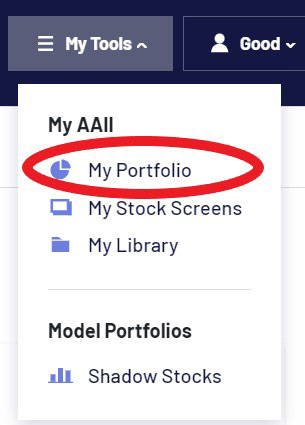 Portfolio tracking watchlists are easy to create and monitor with AAII’s with My Portfolio, a benefit for all members located under My Tools at the top right of most webpages.
To build a portfolio tracker for your current investments, click on Create, enter a name for the portfolio and copy/paste a comma-separated list of ticker symbols in the Tickers field. If your tickers are in a spreadsheet, you can use a simple third-party tool at https://convert.town/column-to-comma-separated-list to convert the tickers to a comma-separated list. My Portfolio supports stock, mutual fund and ETF tickers (bonds and closed-end funds are not currently supported).
To build watchlists of prospective ideas to track, you can enter ticker symbols for securities that come to your attention. AAII.com helps in this regard by including a yellow “+” sign next to tickers throughout the website, allowing you to add these securities to a new or existing watchlist or portfolio with a few clicks. The Stocks, Funds and ETFs pages on AAII.com present continually updated ideas, such as top performers and securities held in our model portfolios. Ideas can also be plucked from any of our 60 stock screens and the Model Shadow Stock Portfolio. If you are investigating an individual stock or fund through its Evaluator page, you will see a Follow This Stock/Fund button next to the security name to add it to a portfolio.
What Is Tracked on Your Watchlists
Once you have created a watchlist of securities, you can go to My Portfolio, load that portfolio tracker and view a variety of data on those tickers.
For regular members, the Portfolio tab shows price performance over various periods along with key fundamentals. The News tab corrals all the latest items of interest for your watchlist securities. News can be filtered by security or news source. To see more details, click on the security’s name or ticker from your watchlist to open its Evaluator page.
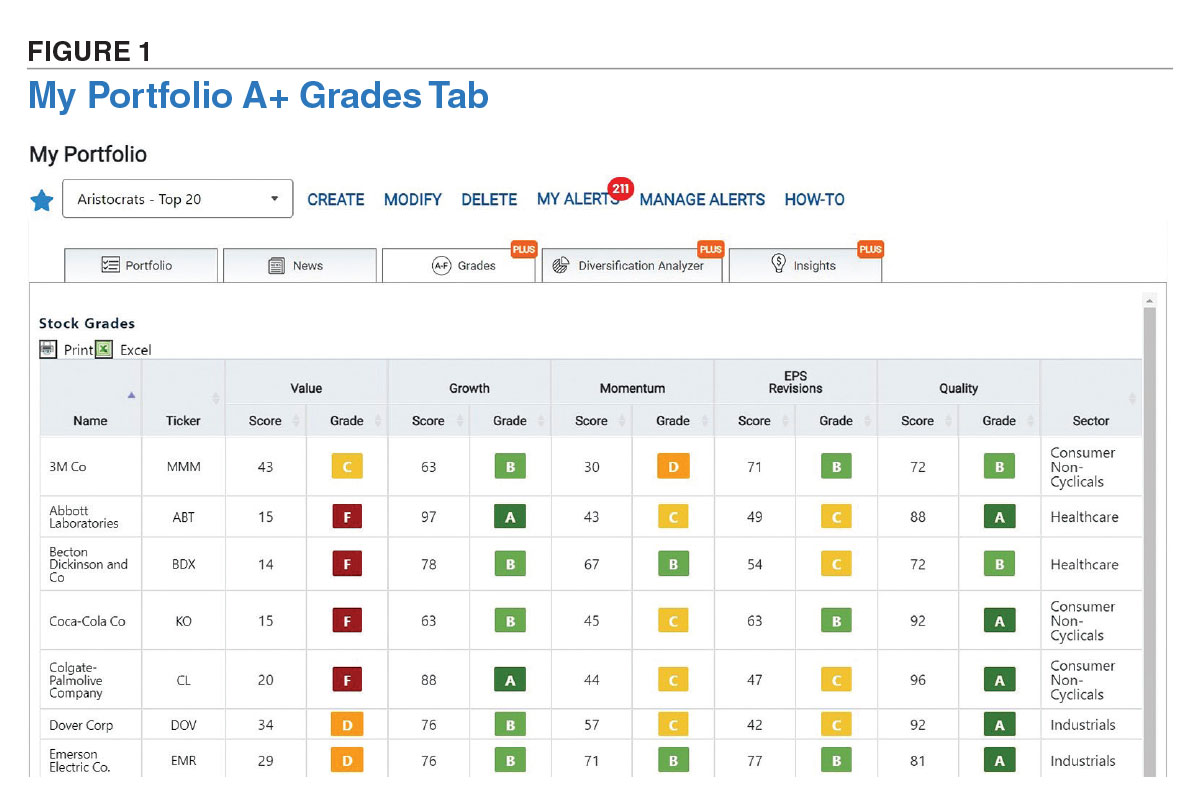
A+ Investor and Platinum subscribers have access to additional tabs that show AAII’s A+ Grades for each security, a Diversification Analyzer to see how the securities fit together as a portfolio given your risk tolerance and Insights to gain further understanding on how your securities are performing compared to their peers (Figure 1).
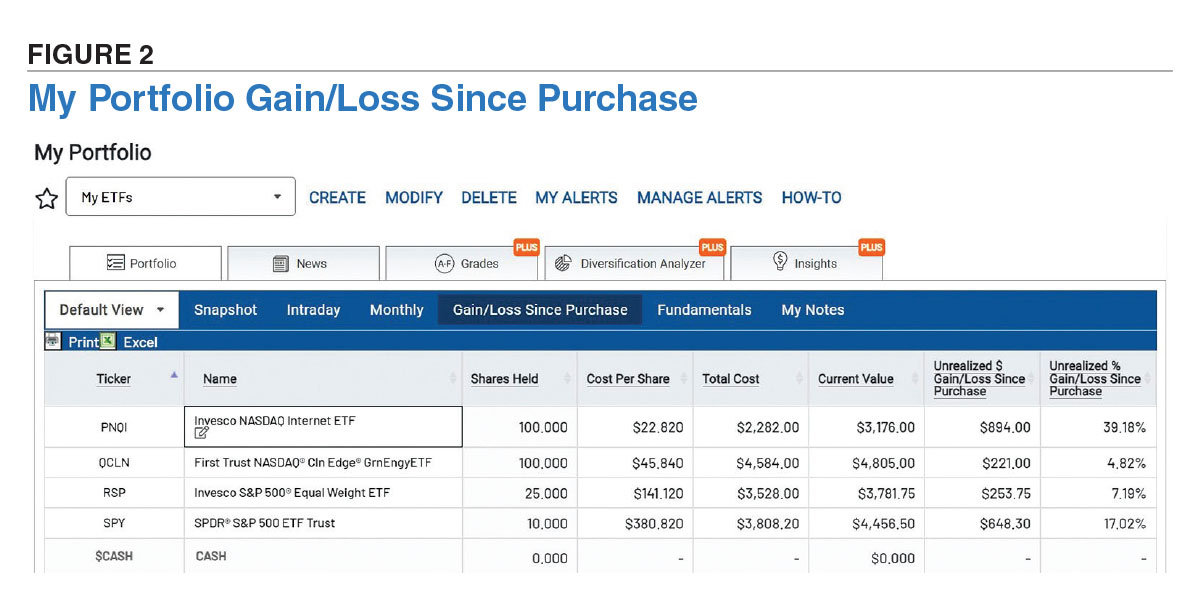
To make the most of portfolio trackers composed of stocks or funds you own, all members are encouraged to enter the number of shares held, purchase price and commission fee paid, if any. My Portfolio can then calculate the value of your individual holdings and the entire portfolio. It also shows your unrealized gain/loss since purchase for each security (Figure 2). Entering purchase information is also necessary for A+ Investors who wish to use the diversification analysis tools.
Receiving Alerts
A crucial part of monitoring your holdings or prospects is to be notified when a change takes place in the security so that you can investigate it and decide if the change warrants a reevaluation of your interest.
Price alerts in My Portfolio allow all AAII members to track daily price changes for stocks, mutual funds and ETFs that are being followed. When securities meet certain price change criteria that you select, you will receive a daily price alert. Alerts are compiled and sent to you in a dedicated email. They can also be viewed at the My Portfolio webpage. You can elect to receive price notifications on the stocks and funds in any or all of your portfolios.
A+ Investor and Platinum subscribers also have the option to receive alerts on A+ Grade changes for stocks they are tracking. A+ Grades for stocks cover the investment factors of value, growth, momentum, earnings estimate revisions and quality. Grade alerts are issued when stocks meet user-defined grade change movements up or down for one of the factors. You can also choose to be notified in the event of a newly initiated grade or a dropped grade for stocks you follow. As with price alerts, stock grade alerts are sent via a consolidated email and also viewable at the My Portfolio webpage. You can elect to receive grade notifications on the stocks in any or all of your portfolios.
Complete instructions for setting up and using AAII’s My Portfolio tool are available at www.aaii.com/myportfolio/userguide.

Related

From the Archives
Keeping Track of Your Portfolio: What to Monitor and When
Discussion
FREE REPORT

Get your free copy of our special
report analyzing the tech stocks
most likely to outperform the
market.
JOHN L from NJ posted over 3 years ago:
PHILLIP L from MI posted over 3 years ago:
You need to log in as a registered AAII user before commenting.
Log InCreate an account