


Related

Investor Professor
Some investors feel that examining a stock’s enterprise value relative to its earnings before interest, taxes, depreciation and amortization (EBITDA) is a superior method of measuring company value.

One of the key financial metrics that investors often encounter is EBITDA. This acronym stands for earnings before interest, taxes, depreciation and amortization. EBITDA is a valuable tool for assessing a company’s financial health and profitability.
EBITDA is most often used as somewhat of a proxy for operating cash flow, providing insight on the profitability of a company’s operating decisions by looking at its core operations. It is pronounced by most as EE-bit-duh, but regardless of how you say it, EBITDA is independent of capital structure. It excludes financing decisions made by management, tax rates and noncash items, which do not directly impact operations.
EBITDA ignores depreciation and amortization because they are noncash expenses. Depreciation reflects the gradual loss in value experienced by fixed assets—such as buildings and equipment—through age and wear and tear. Amortization expense is used to account for the deterioration in value over time of intangible assets, such as intellectual property and goodwill.
Taxes and interest are ignored because some argue that these elements are not related to the company’s main business operations. Not only do tax rates vary by the location of the company, but tax expenses are also influenced by the decisions a company makes regarding possible deductions, credits, carryforwards and the timing at which certain transactions are recognized.
Why would a firm discuss earnings using this measure? Companies like to report or emphasize EBITDA instead of earnings based on generally accepted accounting principles (GAAP) when they have a large amount of debt and high depreciation costs. A good EBITDA can signal that funds are available to support and pay off debt.
Industries that require high amounts of capital, as well as companies with a high level of intangible assets may prefer to use EBITDA, especially if they have low or negative GAAP earnings. Low or negative earnings make it harder to compare some industries on an earnings valuation basis.
Companies utilize depreciation to expense the cost of property, plant and equipment (PPE) or capital investments. For example, telecommunication companies have high depreciation rates on their capital investments coupled with high interest payments on debt used to finance their investments. Companies such as these can have negative GAAP earnings, whereas EBITDA figures report the earnings available for debt payments and place earnings high enough on the income statement to create positive figures necessary for valuation models.
EBITDA simply takes net income and adds back expenses that were previously deducted. An easy way to remember what EBITDA represents is that net income includes these expenses, while EBITDA excludes them.
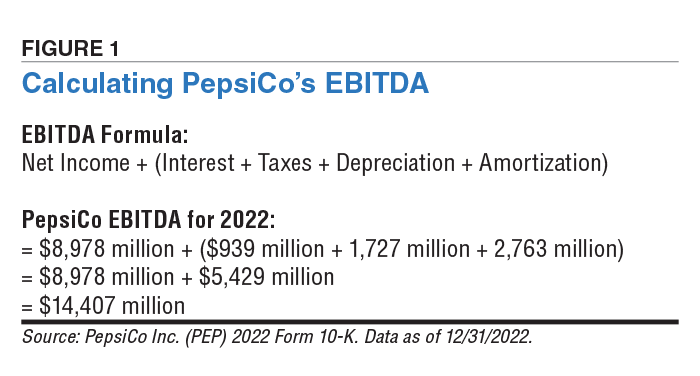
EBITDA equals net income plus the expenses of interest, taxes, depreciation and amortization. Add up all the income statement line items that are expenses—or subtract any line items that are income—and add the total to the net income or net loss figure.
You can easily calculate EBITDA using a company’s annual Form 10-K or quarterly Form 10-Q reports. Figure 1 shows an example using data from PepsiCo Inc.’s  (PEP) income statement. EBITDA may also be reported in company press releases, which all members can access through the News tab of AAII’s My Portfolio tool.
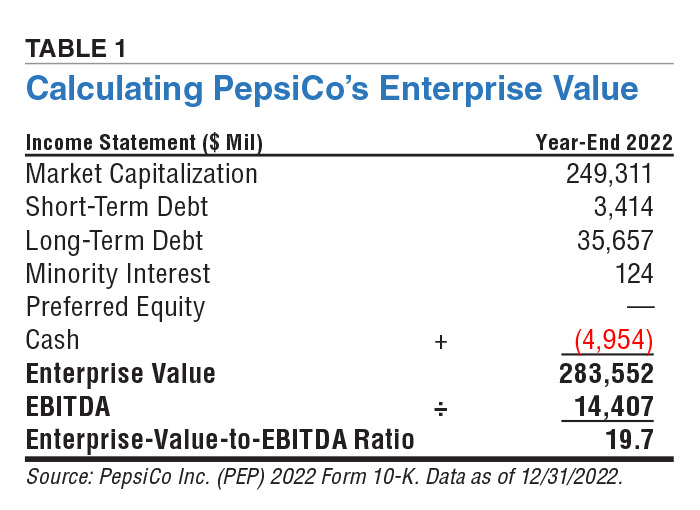
The enterprise-value-to-EBITDA ratio—also called the enterprise multiple—is one metric that can be used to determine the value of a company. The enterprise multiple is enterprise value divided by EBITDA, and it looks at a company the way a potential acquirer would by considering the company’s debt.
Enterprise value is a stock’s theoretical takeover price: If a company were to be acquired, the buyer would have both the company’s equity and its debt while being able to pocket the company’s cash. It differs from market capitalization, which only considers equity. Therefore, many believe that enterprise value gives a truer value of an entire business since price-based multiples look only at the equity of a stock.
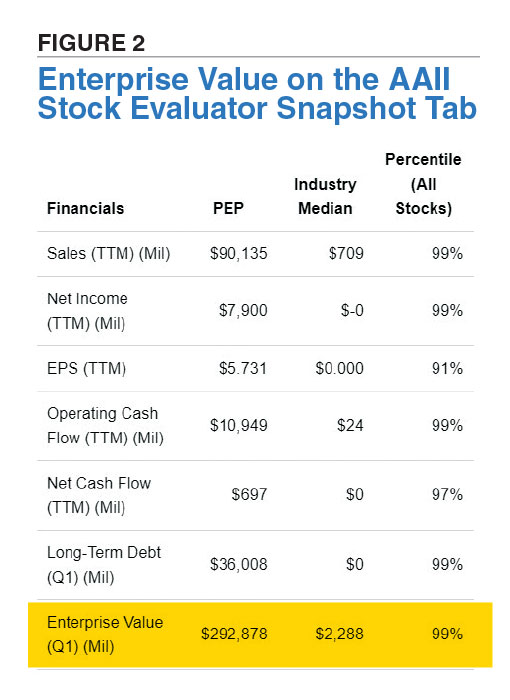
Table 1 shows the calculation of enterprise value and the enterprise multiple using PepsiCo’s year-end 2022 financials. Members can quickly see any firm’s enterprise value by typing the name or ticker into the search box at AAII.com. At the Stock Evaluator, the Snapshot tab shows the company’s enterprise value for the recent quarter; for comparison, the industry median enterprise value is given, along with the company’s rank among all stocks (Figure 2). A+ Investor and Platinum subscribers have access to current and historical enterprise value figures at the Financials tab of the Stock Evaluator.
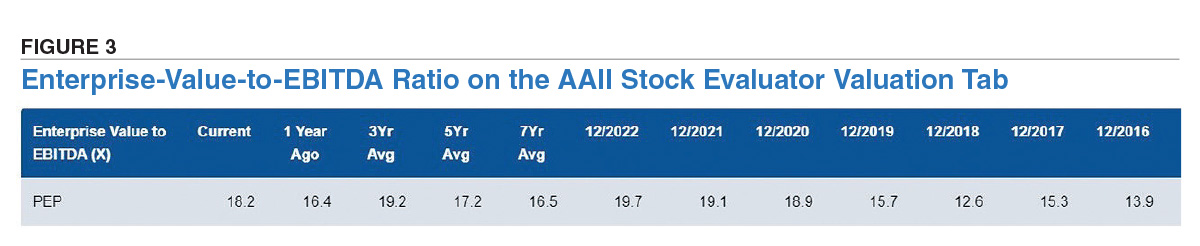
Investors mainly use a company’s enterprise-value-to-EBITDA ratio to determine whether a company is undervalued or overvalued. A low ratio relative to peers or historical averages indicates that a company might be undervalued, and a high ratio indicates that the company might be overvalued. AAII’s Magic Formula screen, available to all members in the Stocks area, uses a modified enterprise multiple for one of its criterion. A+ Investor and Platinum subscribers can check a firm’s enterprise multiple over various time periods and individual years at the Valuation tab of the Stock Evaluator (Figure 3).
Enterprise multiples can vary depending on the industry. It is reasonable to expect higher enterprise multiples in high-growth industries (e.g., biotechnology) and lower multiples in industries with slow growth (e.g., utilities).
While EBITDA is among the most widely used metrics in corporate finance, there is disagreement as to its true value. Some investors feel that examining a stock’s enterprise value relative to its EBITDA is a superior method of measuring company value, since the enterprise multiple is indifferent to the company’s capital structure and capital expenditures (capex), which can be altered as needed by management.
Warren Buffett is one of the most prominent voices against using EBITDA for valuation, believing that the impacts of capex and changes in working capital should not be neglected when understanding a company’s financial standing.
EBITDA can be used to analyze and compare profitability among companies and industries, as it eliminates the effects of financing and accounting decisions. However, EBITDA is not the same as other metrics, such as net income. Interest, taxes and noncash expenses have real financial implications that cannot be totally dismissed when analyzing a stock.
It is also important to note that EBITDA is not a GAAP measure, and therefore it is unregulated. The figure can be manipulated to make a company look more profitable. If the calculation method remains consistent from year to year, however, EBITDA can be a useful metric for comparing historical performance.
Investor Professor

Value Investing


JOHN L from NJ posted over 2 years ago:
BILL B from PA posted over 2 years ago:
BARRY J from TX posted almost 2 years ago:
MARK E from IA posted almost 2 years ago:
You need to log in as a registered AAII user before commenting.
Log InCreate an account