

Related

Financial Planning
Identifying a good adviser requires conducting a background check and then asking them five important questions.

Article Highlights:
An elderly woman in Gatlinburg, Tennessee, while regularly attending church services befriended a man whom others described as trustworthy and professional.
Little did she know that her new “friend,” a stockbroker, would defraud her of her life savings. The man, Dennis Boize, pleaded guilty to perpetrating fraud for more than six years, devastating more than 100 victims and misappropriating millions of dollars. Boize’s victims included personal friends and several fellow church members. His victims never knew that Boize had a prior conviction for bank fraud and two convictions for theft.
“That could never happen to me. I know the person who helps me with my finances. We’re good friends.” I’ve heard this hundreds of times over my career. And the fact of the matter is that the overwhelming majority of financial advisers are doing a really terrific job for their clients. And indeed, they do become their clients’ friends.
The securities business is highly regulated. But whenever billions of dollars are being transferred on a daily basis, the temptation to be unscrupulous is high. Bernie Madoff once famously proclaimed, “The nature of any human being, certainly anyone on Wall Street, is the better deal you give the customer the worse it is for you.” Madoff, who stole $65 billion dollars, is behind bars for the rest of his life.
A study conducted by the Certified Financial Planner Board of Standards in 2012 entitled “Senior Financial Exploitation Study” revealed that:
It’s actually the last point, indicting 19% of advisers that concerns me the most. I’m going to chalk up the other (albeit alarming) findings to human behavior. Yes, financial advisers are human and might omit a fact or not follow up properly, but to outright defraud? Unacceptable.
In my 30-plus years in the financial services industry, I am convinced that people can minimize the probability of becoming a victim of fraud by taking certain precautions and conducting due diligence.
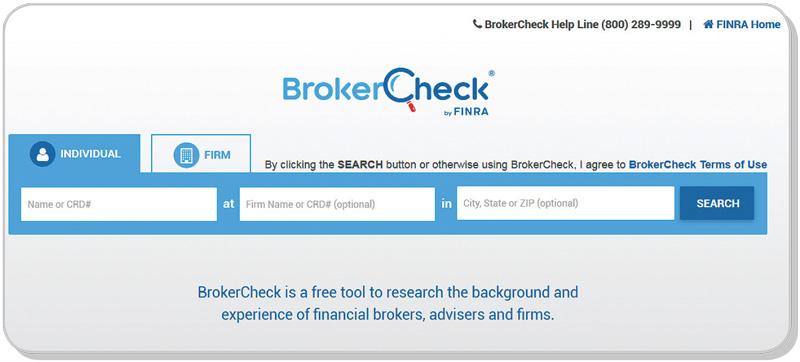
As a client advocate I strongly suggest that anyone interested in finding a new (or certifying a current) adviser, take a proactive approach. The first step is to access FINRA’s (Financial Industry Regulatory Authority) BrokerCheck website at https://brokercheck.finra.org. Simply type in the name of the adviser (and perhaps the location) and check for any disclosures. A disclosure is a registered complaint against the adviser. Before you jump to conclusions upon finding that your adviser has just such a disclosure, be advised that this is simply a written complaint lodged by anyone, typically a client, but not necessarily. It may be well-founded, but it may also be from a disgruntled person who lost market value, and something totally beyond the control of the adviser. It could also be an arbitration, regulatory action, employment termination or bankruptcy.
BrokerCheck is a free database anyone can access to conduct a background check on a registered person or firm (https://brokercheck.finra.org). It will give you a summary of a broker’s (aka registered investment adviser, or simply RIA) employment history as well as any regulatory actions taken and/or complaints filed against them and/or their firm.
Besides using BrokerCheck, it can be prudent to also do a search on the U.S. Securities and Exchange Commission’s (SEC) Investment Adviser Public Disclosure website (https://adviserinfo.sec.gov) and to conduct a background check with your state’s security regulators. Simply typing the adviser’s name into a search engine such as Google may result in additional information being found. (Be aware that scamsters may try to offset complaints by trying to maintain a good online profile. Affinity fraud, where criminals seek to take advantage of commonalities with their victims, such as belonging to the same congregation, is an ongoing problem.)
—Charles Rotblut, CFA
One of the most honest advisers I know was subject to a disclosure. His client—a real estate speculator—simply lied and told the adviser’s firm—who has the responsibility to report to FINRA—that he was put into a risky and thus unsuitable investment. He never bothered to mention that the investment was his idea and the broker advised against it.
However, if you find a disclosure, simply ask the adviser, “I notice you had a disclosure on your FINRA broker check back in 2014. Tell me about what happened.” You are due an explanation.
If there are two, three or more disclosures, I’d become concerned. It may be time to find another adviser.
Once you’ve cleared the first hurdle, I encourage clients to ask the prospective or current adviser five questions. Actually, they’re more like five conversations, as I would like the adviser to elaborate.
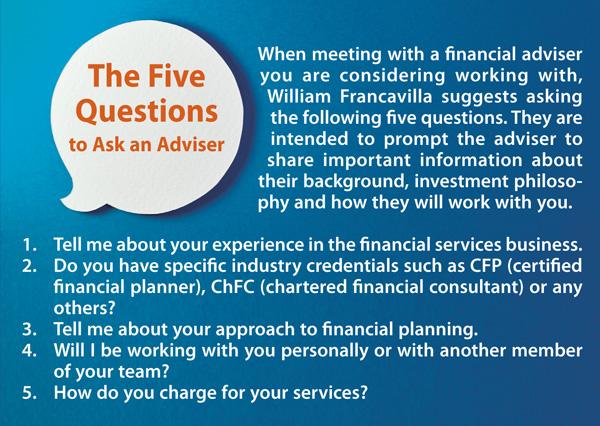
This is a deliberately “open-ended” question, and it is designed to elicit as much information from the adviser as possible. An adviser may tell you he or she has been in the business for 20 years. Press the question “Have you always been with your present firm?” This is important to know. There are very good reasons why an adviser might make a move to another company: Lack of support, the branch manager was a jerk, “I couldn’t service my clients as I felt appropriate,” etc. Each of these responses may be quite legitimate. The fact that an adviser switches firms is not a crime.
But some advisers make a habit of moving from firm to firm every five years. I know these people; they are moving because the new firm is paying them a lot of money to “move their book” (that’s you and all their other clients). Financial companies generate revenue based on assets under management (AUM) and they buy assets much like any business that intends to grow. It’s a great business model, but it may not necessarily benefit clients. It is an honest question to ask. You want to make certain your adviser is happy with their broker-dealer or registered investment advisory company and intends to remain there for many years, subject to conditions.
If your adviser moves to another firm, a literal war breaks out between the acquiring firm and the company that the adviser is leaving. As a client, you will receive numerous calls and letters, all in an effort to persuade you to either stay with your adviser and move your account to the new company or to remain with your present company and be introduced to a new adviser. The question you must ask yourself is, “How does this affect me, my family and my financial goals?”
I want an informed adviser, one who cares enough about remaining current and takes the time to complete a course of study, sometimes quite arduous. This doesn’t necessarily preclude an adviser without industry certification. I know many advisers who don’t have CFP certification and do an excellent job advising clients. But to me, an advanced designation indicates that the adviser is serious about helping others and will commit the time and expense to achieving this goal. As a certified financial planner, I know firsthand the degree of detail and dedication that is involved in successful completion.
The desired response from the adviser should sound something like this: “My investment approach is to meet the financial needs of each individual client. I want my clients to feel comfortable and confident with our plan design.”
All advisers are not equal. Some have superlative education and credentials but lack the willingness (or ability) to make their clients feel the comfort that is so necessary. Other advisers are terrific at being personal, but really don’t have a clue about how best to help you achieve your goals. And a (very) few are simply out to enrich themselves at your expense.
I prefer to have an adviser provide me with a written investment policy statement. This would include:
If we ask a dozen advisers to describe their respective approaches to advising clients, we may well hear a dozen different approaches. Ask yourself, “Which one matches my needs? Do I need a stockbroker or a comprehensive wealth manager? Would I prefer an experienced senior adviser or someone younger who might be interested in getting to know my children and grandchildren?”
Please remind yourself that this is your money and your needs are tantamount to finding the right adviser.
The industry has matured considerably due to bull markets that have dominated the economy since 1982 (with the exception of the financial crisis, of course). As a result, many advisers have leveraged their efforts by teaming with others or by hiring a team to assist their efforts. But if the lead adviser, perhaps the person you have just met, has 1,000 client relationships, it’s improbable that they will be able to devote a whole lot of attention to you and your account. There are certain clients that a senior adviser may choose or insist that they work with personally. Perhaps it’s a family member, a good friend or a high-net-worth individual with sophisticated needs.
Don’t get your feelings hurt if you are not going to be working specifically with the lead adviser, but make certain you are abundantly comfortable working with another competent member of their staff. There were many clients who would call my office and ask for one of my assistants. The client knew that I might be otherwise engaged and also that one of my team members would be quite capable of, and maybe even better at, answering a question. If the associate has an excellent understanding of you and your needs, you’ve got a great ally on the team. This is where the wisdom of an investment policy statement comes into play. It leaves little doubt as to what you should expect.
After you’ve determined that the adviser you’ve been interviewing seems like a fit, ask the fee question. I recommend that one never lead with this question because the decision to work with a particular adviser should never be predicated on cost alone. In fact, cost should only come into question in the absence of value.
Of course, it’s important to consider expense. According to Personal Capital, (an online advisory firm), an average $500,000 investment account held for 30 years would pay roughly $500,000 to $1 million in fees, depending on the institution. The range was between just over 1% to almost 2% charged by various firms. The study assumed a 7% rate of return, resulting in the client’s $500,000 initial investment growing to $3.8 million in 30 years, not adjusting for inflation. If there were no fees charged, the savings would be in the client’s account. It’s impossible to avoid all fees, but it is important to point out the impact of fees over time.
Essentially there are three ways to pay for financial services: Fee only, fee based and commissions. The level of sophistication and confidence an investor has determines what might work best.
For instance, a more confident individual investor might simply need a comprehensive financial plan that can be purchased with a one-time charge or fee-only type of account. In this scenario, a planner reviews all pertinent financial information, including risk aversion and time horizon, and reports or suggests strategies for the client to follow to maximize the probability of success. The investor then would follow the instructions and open a no-load investment or retirement account, consult with an estate planning attorney and perhaps visit an insurance agent to buy further coverage based on need. Long term, this just might be the least expensive option, even though the client’s financial plan could cost $2,500 to $10,000 depending on the level of sophistication.
The second method of payment is fee based. This is when there is an annual percentage attached to the assets under management. If one has $500,000 under management and the adviser charges 1%, the cost would be $5,000 per year. And if the account grows, so would the dollar amount one would pay. In Personal Capital’s example, you can see how an account that grows consistently over 30 years would obviously be pricey, but the account would also have grown precipitously. For someone in a fee-based arrangement, they should expect comprehensive and regular service. It should be all-encompassing and include risk management, estate planning services, tax minimization strategies, retirement analysis and all matters pertinent to financial success. If an investor is not receiving these services and is paying a percentage fee, they should find another adviser. This is not, in my opinion, merely an investment management fee.
One further note is important to consider. If the assets under management include cash and bonds, it doesn’t make sense to be charged a 1% fee—especially if the fixed-income securities are delivering only 2% to 4% yield (and are taxable). Those fees eat into your income very quickly.
A commission-based account sounds self-serving but, it can be the fairest option to consider. If one’s account is relatively stable, and the securities being held are highest quality and perhaps dividend based, there may be little need to trade stocks. Of course, there will always be reasons to buy and sell but if you can trade for a few dollars per transaction, a commission-based approach makes perfect sense—especially versus a fee-based account. Mind you, you’re only paying to trade the securities and maybe some advice from a broker. You shouldn’t expect the comprehensive services that a fee-based relationship would entail.
“Couldn’t I just ask my friend, neighbor or brother-in-law who they work with and go with them?” NO! You are abdicating your responsibility to make an informed decision. Your friend might be working with a terrific adviser. Great, interview that person and ask the five questions. Depending on the adviser’s responses and a clean BrokerCheck record, you just might have the right person—one who will put your needs first.
We asked William Francavilla for suggestions on how to go about finding advisers to interview. Here are his suggestions:

Francavilla added two additional points to keep in mind:
But please remember Bernie Madoff. He built his entire business on referrals. It was considered a privilege to have Madoff managing your money. Had people taken the time to ask him these questions, they just may have walked away and saved their fortunes. Madoff never divulged his methodology, suggesting that it was “proprietary and too complicated to explain.” This would have been a red flag and a reason to go elsewhere.
Having reviewed and discussed the adviser interview process as well as the cost structures, I’ve often been asked about advisers one might avoid altogether. In other words, who can I eliminate from consideration immediately?
There will always be exceptions, but I believe one can start by avoiding three “types” of advisers: the novice, the strongly opinionated and the salesy.
I recall my first year in the business. I had just returned from an excellent training program in Baltimore but was ill-prepared to help people with complex needs. This comes with experience and more training and, quite frankly, being involved with both good and bad markets. I started in early 1986. A year and a half later, I experienced the biggest one-day market drop in history. I learned valuable lessons that year, and as a result I know I helped many investors throughout my career. As of this writing, we are nine years into a bull market and bear markets typically follow an eight-year bull. Overdue? Perhaps. I just might want an adviser who has worked through a tough market. However, there are important exceptions to this rule. Perhaps the novice is on a team and their mentor provides strong assistance to the newer adviser. Then I’m willing to listen.
The strongly opinionated adviser is convinced that the markets will continue to rise to, say, 40,000 for the Dow. Conversely, this type of adviser is convinced that the end is near and investors need to sell all of their stock holdings. One of these opinions just might be right, but as an investor, I want my needs, not greeds, to be met. “Don’t dazzle me with your purported facts, just help me retire comfortably.”
We can spot the salesy person a mile away. They have their agenda to consider, not yours. This is the person who believes that one single investment will cure all of your financial woes. It might be an insurance-related product like an annuity or a real estate investment trust that promises an 8% yield or a stock strategy that is “guaranteed” never to drop in value, etc. We typically find these people at free lunches or dinners. If you do attend, leave your checkbook at home. One should only approach these events to learn and never to buy. If the seminar is information based, great. But if it’s an attempt to prove how their investment is superior to all others, I get suspicious pretty quickly.
When considering the questions to ask an adviser and the advisers to avoid, please remind yourself that it’s all about you! Is this person helping you solve a problem and charging you a fair fee, or is it all about the adviser and you’re only a number? I truly believe that having a professional relationship with the right adviser will help most people accumulate more wealth and receive more comfort.
The enemy of any investor will always be emotion. According to research firm Dalbar, the S&P 500 index returned 7.2% annually over the 20-year period ending in 2017, while individual investors achieved a return of only 5.3% annually. The bottom line, and essential problem, is that investors tend to sell their investments when markets go down and buy the same investments back when markets go up.
It might serve the reader well to consider the words of Benjamin Graham, father of value investing. Graham, perhaps in response to the adviser question said, “Individuals who cannot master their emotions are ill-suited to profit from the investment process.” We all claim to be able to master our emotions, but few of us actually are.
Financial Planning

Financial Planning

Financial Planning
Financial Planning
Financial Planning


L Northrop from CA posted over 7 years ago:
R Garfield from VA posted over 7 years ago:
Brian from PA posted over 7 years ago:
Barry Estell from California, for one year. Before that MO& KS posted over 6 years ago:
Andrew B from WA posted over 6 years ago:
Barry C Johnson from TX posted over 6 years ago:
Barry C Johnson from TX posted over 6 years ago:
Jim M from NJ posted over 6 years ago:
Michael E Ellis from Illinois posted over 6 years ago:
You need to log in as a registered AAII user before commenting.
Log InCreate an account