


Related
Small Cap Value Investing
Article Highlights
• The Level3 Passive Portfolio is based on James Cloonan’s book “Investing at Level3” and can serve as a complete equity portfolio.
• The weightings of the portfolio’s three ETFs are being changed to help obtain maximum diversification.
• The real estate ETF’s weighting is being reduced because real estate is included in other indexes and many investors have other exposures to it.
This is the first of a new column covering the Level3 Passive Portfolio, based on one of the new investing strategies outlined in my book “Investing at Level3.”
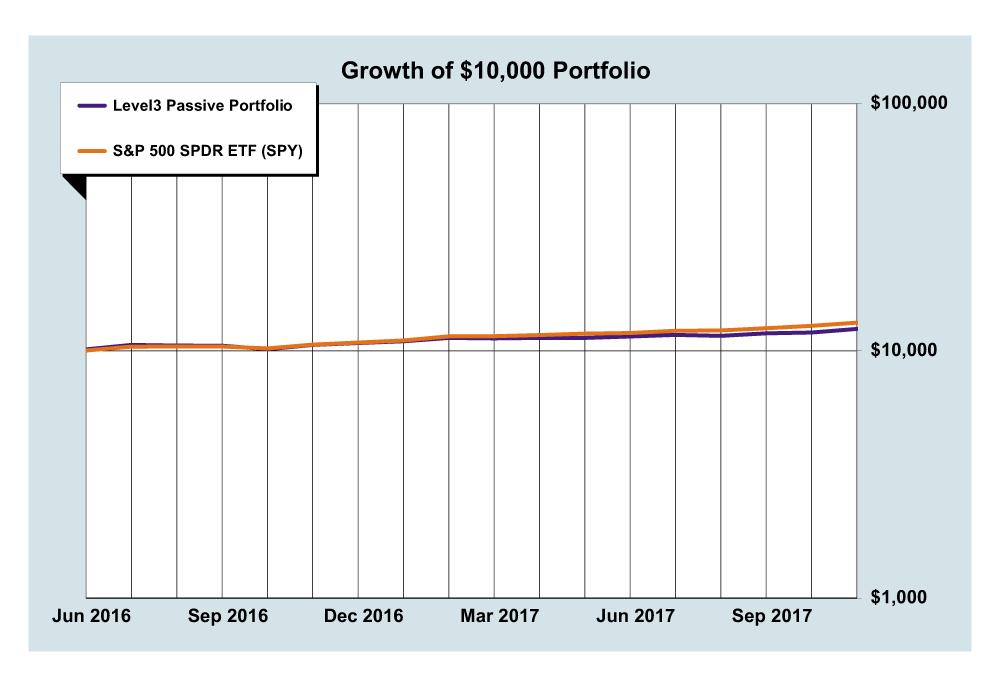
Previously, coverage of the Level3 Passive Portfolio was included with reviews of the Model Fund Portfolio, which has been discontinued. Please see the November 2017 Model Portfolios column for an explanation of this change. Tracking of the Level3 Passive Portfolio was begun May 31, 2016, as shown in Figure 1.
The Level3 Passive Portfolio is intended to be either the complete equity portfolio for those investors who wish to manage their own portfolio but do not choose to be involved in individual stock selection, or one portion of a whole portfolio for those who may wish to select individual equities and actively managed funds on a limited basis but keep the majority of their portfolio in index funds.
The Level3 Passive Portfolio consists of index ETFs that should have, based on their approach, returns above that of the S&P 500 index. As a portfolio, it is more diversified than the S&P 500, which should reduce portfolio downturns that are based on the impact of a few sectors.
Portfolio changes should be relatively rare and will occur only when a new or different ETF is felt to be more effective at accomplishing a similar objective than one of the current holdings. There are some new index ETFs with promising approaches, but there will be a period of observation before they can be considered.
Four ETFs make up the Level3 Passive Portfolio. The weights of the holdings in the portfolio may change over time based on experience. In fact, we are announcing the first changes to the original weights in this article below.
The weightings in the first three ETFs are being evened out simply as a recognition of their validity and the desire to obtain the maximum diversification effect from them.
The allocation to real estate is being reduced because it is finding its way into the other indexes and because so many investors have separate real estate holdings.
There is no rush to adjust your portfolio, so be careful of any long-term/short-term capital gain consequences. The weightings in the Level3 Passive Portfolio that we are tracking were adjusted during December 2017.
A more thorough discussion of the ETFs in the Level3 Passive Portfolio and other new funds that might qualify when they have sufficient volume and history are discussed in my book “Investing at Level3” (www.level3investing.com).
Guggenheim S&P 500 Equal Weight ETF  (RSP)
(RSP)
This exchange-traded fund has outperformed the cap-weighted S&P 500 index over the 14 years of its existence. Other indexes also indicate that equal weighting provides higher returns. Equal weighting gives more weight to value stocks and smaller-cap stocks in an index, which leads to superior performance over the long run.
This fund, because of its size and history, was originally given a portfolio weight of 40%. This weighting is now being decreased to 30%.
PowerShares Russell 1000 Equal Weight ETF (EQAL)
This ETF includes the top 1,000 stocks by capitalization size and gives some exposure to mid-cap stocks. Mid-cap stocks historically have had higher returns than large caps. It is a new fund, however, and uses an innovative approach that needs some observation before comparing it to Guggenheim S&P 500 Equal Weight ETF.
It was originally weighted at 20% of the portfolio. This weighting is now being increased to 30%.
Vanguard Mid-Cap Value ETF (VOE)
Mid-cap value has had higher returns than large stocks or mid-cap growth stocks.
It was originally weighted at 20% of the portfolio. This weighting is now being increased to 30%.
Vanguard REIT Index ETF (VNQ)
The returns of real estate investment trusts (REITs) have exceeded the returns of the S&P 500 over the long run and provide diversification as well.
This ETF was originally weighted at 20%. This weighting is now being decreased to 10%.
The Level3 Passive Portfolio requires little effort or time to maintain. The current weightings are as described above and as shown in Table 1. The approach to rebalancing is to keep it to a minimum.
Table 1. Level3 Passive Portfolio
| Fund (Ticker) | Weight* | YTD Return % | 1-Yr Return % | Return (%) Since 5/31/2016 |
|---|---|---|---|---|
|
Guggenheim S&P 500 Equal Weight (RSP) |
30% | 17.2 | 18.4 | 26.8 |
|
PowerShares Russell 1000 Equal Weight (EQAL) |
30% | 15.7 | 17.1 | 24.9 |
|
Vanguard Mid-Cap Value (VOE) |
30% | 15.0 | 16.2 | 27.2 |
|
Vanguard REIT Index (VNQ) |
10% | 5.2 | 10.1 | 7.5 |
| Weighted Avg of ETFs in Portfolio** | 14.9 | 16.5 | 24.4 | |
| Actual Level3 Passive Portfolio*** | 14.1 | 16.1 | 22.6 | |
| Comparison: | ||||
|
SPDR S&P 500 (SPY) |
20.4 | 22.7 | 30.1 | |
|
*Reflects new weightings as of December 2017. **A weighted average return of the ETFs in the current Level3 Passive Portfolio. ***Performance of actual Level3 Passive Portfolio, including reinvested dividends. Source: Morningstar, Inc. Data as of 11/30/2017. |
||||
While momentum is less of a factor with funds than it might be with stocks, and transaction costs for funds are much less than for stocks, rebalancing frequently is a distraction and can make taxes a significant consideration.
You should be able to achieve almost all the rebalancing necessary when you add and withdraw funds or when changes are made in the holdings.
Rebalancing decisions will have to be made by the individual since every investor will have added assets at a different time, so everyone’s weights will be different. But the following are some general guidelines:
For the 18 months since its inception, the Level3 Passive Portfolio is still eight percentage points behind the S&P 500, as measured by the SPDR S&P 500 ETF (SPY), primarily due to the strong period for the largest tech stocks (Table 1). It would be ahead for longer past periods, and I feel confident that it will outperform over the long term. Table 2 shows the performance for Level3 Passive Portfolio compared to the SPDR S&P 500 ETF, and Figure 1 shows the growth of $10,000 in each since inception of the portfolio, May 31, 2016.
Changes to the portfolio will be infrequent, but performance will be monitored and reported on regularly in the AAII Journal.
Table 2. Level3 Passive Portfolio Annual Performance
| Average Annual Return (%) |
Cumulative Growth of $10,000 ($) |
|||
|---|---|---|---|---|
| Level3 Passive Portfolio |
S&P 500 SPDR ETF (SPY) |
Level3 Passive Portfolio |
S&P 500 SPDR ETF (SPY) |
|
| 2016* | 7.5 | 8.0 | 10,749 | 10,805 |
| 2017** | 14.1 | 20.4 | 12,262 | 13,005 |
| Since Inception** | 14.6 | 19.1 | 12,262 | 13,005 |
|
*May 31 to December 31, 2016. **Through Nov 30, 2017. Portfolio was started on May 31, 2016. |
||||
Small Cap Value Investing

Portfolio Strategies

Ken B. from OK posted over 8 years ago:
Michael from MA posted over 8 years ago:
Connie from TN posted over 8 years ago:
Roxane from LA posted over 8 years ago:
Michael Murray from VA posted over 8 years ago:
Michael Murray from VA posted over 8 years ago:
Garry from VA posted over 8 years ago:
Ken Sovern from OH posted over 8 years ago:
Garry from VA posted over 8 years ago:
DK from VA posted over 8 years ago:
John Lambert from NJ posted over 8 years ago:
Mike Lawrence from IL posted over 8 years ago:
Ted from CA posted over 8 years ago:
Ted from CA posted over 8 years ago:
John Hallquist from TN posted over 8 years ago:
Joseph Amatuzzi from NJ posted over 8 years ago:
Charles Rotblut from IL posted over 8 years ago:
Rex from WISCONSIN posted over 8 years ago:
Garry from VA posted over 8 years ago:
Randy from OK posted over 8 years ago:
John from MI posted over 8 years ago:
Michael Fish from IL posted over 8 years ago:
Rex Peterson from WI posted over 8 years ago:
Richard Mangel from CO posted over 8 years ago:
Gary Kolb from AL posted over 8 years ago:
Richard from CO posted over 8 years ago:
Richard from CO posted over 8 years ago:
John from SC posted over 7 years ago:
You need to log in as a registered AAII user before commenting.
Log InCreate an account