


Related
Exchange-Traded Funds
Exchange-traded funds (ETFs) have been one of the most successful financial innovations in recent years.
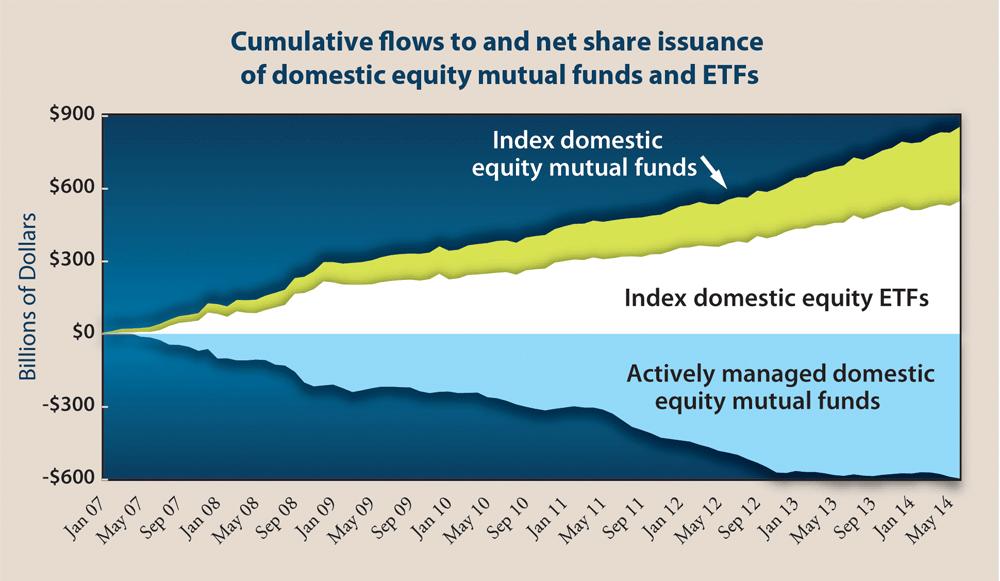
Since the introduction of ETFs in the early 1990s, demand for these funds has grown markedly in the United States, as both institutional and individual investors have increasingly found their features appealing.
In the past decade alone, total net assets of ETFs have increased nearly twelvefold, from $151 billion at year-end 2003 to $1.8 trillion as of June 2014, as shown in Figure 1.
With the increase in demand, sponsors have offered more ETFs with a greater variety of investment objectives.
Like mutual funds, ETFs are a way for investors to participate in the stock, bond and commodity markets; achieve a diversified portfolio; and gain access to a broad array of investment strategies.
Although total assets managed by stock, bond and hybrid mutual funds are significantly larger ($13.1 trillion) than those of ETFs ($1.8 trillion), ETFs’ share of their combined assets has increased considerably—from less than 3% at year-end 2003 to a little more than 12% by June 2014.
An ETF is a pooled investment vehicle with shares that can be bought or sold throughout the day on a stock exchange at a market-determined price.
In most cases, an ETF is index-based—designed to track the performance of a specified index or, in some cases, a multiple, an inverse, or a multiple inverse of its index (commonly referred to as leveraged or inverse ETFs).
Actively managed ETFs, which do not seek to track the return of a particular index, have been available to investors only since 2008. As of June 2014, there were 78 actively managed ETFs, with about $15 billion in total net assets.
Several factors have contributed to the growing popularity of ETFs. Some of these factors are related to specific features of ETFs that investors find attractive, while others are related to general trends in investing and money management that have developed more recently.
Specific features of ETFs that investors find attractive include:

General trends that have contributed to the popularity of ETFs include:
An ETF originates with a sponsor that chooses the investment objective of the fund. In the case of an index-based ETF, the sponsor chooses both an index and a method of tracking it. Index-based ETFs track their target index in various ways. Many early ETFs tracked traditional, mostly capitalization-weighted, indexes. More recently launched index-based ETFs follow benchmarks that use a variety of index-construction methodologies, with weightings based on market capitalization or other fundamental factors, such as sales or book value. Others follow factor-based metrics: These indexes first screen potential securities for a variety of attributes—including value, growth, and dividend payouts—and then either equal-weight or market-cap-weight the selected securities. Other customized index approaches include screening, selecting and weighting securities to minimize volatility, maximize diversification or achieve a high or low degree of correlation with market movements.
An index-based ETF may replicate its index (that is, it may invest 100% of its assets proportionately in all the securities in the target index), or it may sample its index by investing in a representative sample of securities in the target index. Representative sampling is a practical solution for ETFs that track indexes containing securities that are too numerous (such as broad-based or total market stock indexes), that have restrictions on ownership or transferability (certain foreign securities) or that are difficult to obtain (some fixed-income securities).
The sponsor of an actively managed ETF determines the investment objectives of the fund and may trade securities at its discretion, much like an actively managed mutual fund. For instance, the sponsor may try to achieve an investment objective such as outperforming a segment of the market or investing in a particular sector through a portfolio of stocks, bonds or other assets.
The creation/redemption mechanism in the ETF structure allows the number of shares outstanding in an ETF to expand or contract based on demand.
Mutual funds create and redeem shares on a daily basis, selling to and redeeming from investors. In contrast, the vast majority of ETF investors buy and sell existing ETF shares in the secondary market (i.e., on stock exchanges). New ETF shares are created in large blocks—25,000 to 200,000 shares—known as creation units and then sold into the secondary market.
Each day, the ETF sponsor publishes its creation basket—a specific list containing the names and quantities of the securities, cash or other assets that may be exchanged for a creation unit of shares of the ETF. The creation basket typically either mirrors the ETF’s portfolio or contains a representative sample of the ETF’s portfolio.
Only an authorized participant (AP)—typically a large institutional investor with an ETF trading desk that has entered into a legal contract with the fund—can create or redeem shares directly with the ETF. An AP assembles the assets in the ETF’s creation basket and turns over the creation basket to the ETF provider in exchange for a creation unit of ETF shares. The AP can either keep the ETF shares or sell them to its clients or to other investors on a stock exchange. The ETF may permit or require an AP to substitute cash for some or all of the assets in the creation basket, particularly when an instrument in the creation basket is difficult to obtain or transfer.
Figure 3 illustrates the creation process.
The redemption process is simply the reverse. A creation unit is redeemed when an AP acquires the number of shares specified in the ETF’s creation unit and returns the creation unit to the ETF. In return, the AP receives that day’s redemption basket of securities, cash or other assets. Typically, the composition of the redemption basket is the same as the creation basket.
Though ETFs share some basic characteristics with mutual funds, there are key operational and structural differences between the two types of investment products.
Both mutual funds and ETFs can provide the basic building blocks of investors’ portfolios. An ETF is similar to a mutual fund in that it offers investors a proportionate share in a pool of stocks, bonds and other assets. Also, like mutual funds, new shares of ETFs can be created or redeemed at any time, and ETFs are required to post the marked-to-market net asset value of their portfolio at the end of each trading day.
Like mutual funds, ETFs are most commonly structured as open-end investment companies, and they are governed by the same regulations. The vast majority of ETFs (funds accounting for 96% of assets) are regulated by the Securities and Exchange Commission (SEC) under the Investment Company Act of 1940, in essentially the same way as mutual funds.
Despite these similarities, key features differentiate ETFs from mutual funds.
One major difference between ETFs and mutual funds is that individual investors buy and sell ETF shares on a stock exchange through a broker-dealer, much as they would any other type of stock. In contrast, mutual fund shares are not listed on stock exchanges. Rather, investors buy and sell mutual fund shares through a variety of distribution channels, including through investment professionals (full-service brokers, independent financial planners, bank or savings institution representatives, or insurance agents) or directly from a fund company.
Mutual funds and ETFs are also priced differently. Mutual funds are “forward priced,” meaning that, though investors can place orders to buy or sell shares throughout the day, all orders placed during the day will receive the same price—the fund’s net asset value at the next time it is computed. Most mutual funds calculate their net asset value as of 4:00 p.m. EST because that is the time U.S. stock exchanges typically close.
In contrast, the price of an ETF share is continuously determined through trading on a stock exchange. Consequently, the price at which investors buy and sell ETF shares on an exchange may not necessarily equal the net asset value of the portfolio of securities in the ETF. Two investors selling the same ETF shares at different times on the same day may receive different prices for their shares, both of which may differ from the ETF’s net asset value.
Physical commodity ETFs and derivatives-based commodity ETFs that are not registered under the Investment Company Act of 1940 hold about 4% of ETF assets. Physical commodity ETFs typically hold precious metals or currencies, register their securities with the SEC under the Securities Act of 1933 and are subject to regulation by the stock exchanges. Derivatives-based commodity ETFs invest in commodity derivatives (typically futures, options or both) to obtain exposure to such commodities as precious metals, oil and gas, and currencies. These ETFs are regulated primarily by the Commodity Futures Trading Commission as commodity pools. They also register their securities with the SEC under the Securities Act of 1933 and are subject to regulation by the stock exchanges.
The price of an ETF share on a stock exchange is influenced by the forces of supply and demand. Though imbalances in supply and demand can cause the price of an ETF share to deviate from its underlying value (i.e., the market value of the underlying instruments, also known as the intraday indicative value, or IIV), substantial deviations tend to be short-lived for many ETFs.
Two primary features of an ETF’s structure promote trading of an ETF’s shares at a price that approximates the ETF’s underlying value: portfolio transparency and the ability for APs to create or redeem ETF shares at the net asset value at the end of each trading day.
The transparency of an ETF’s holdings enables investors to observe—and attempt to profit from—discrepancies between the ETF’s share price and its underlying value during the trading day. ETFs contract with third parties (typically market data vendors) to calculate an estimate of an ETF’s intraday indicative value, using the portfolio information that an ETF publishes daily. Intraday indicative values are disseminated at regular intervals during the trading day (typically every 15 seconds). Some market participants will use their own computer programs to estimate the underlying value of the ETF on a more real-time basis and engage in trading when an ETF’s share price is at a discount or premium to its underlying value.
The ability of APs to create or redeem ETF shares at the end of each trading day also helps an ETF trade at market prices that approximate the underlying market value of the portfolio. For example, when an ETF is trading at a discount, APs may find it profitable to buy the ETF shares and sell short the underlying securities. At the end of the day, APs return ETF shares to the fund in exchange for the ETF’s redemption basket of securities and/or cash, which they use to cover their short positions. When an ETF is trading at a premium, APs may find it profitable to sell short the ETF during the day while simultaneously buying the underlying securities. At the end of the day, the APs will deliver the creation basket of securities and/or cash to the ETF in exchange for ETF shares that they use to cover their short sales. These actions by APs, commonly described as arbitrage opportunities, help keep the market-determined price of an ETF’s shares close to its underlying value.
Different types of ETFs have different tax treatments.
ETFs registered under the Investment Company Act of 1940 are subject to the same tax rules as mutual funds. To improve their tax efficiency, ETFs commonly employ two mechanisms that also are available to mutual funds: low portfolio turnover and in-kind redemptions. The relative tax efficiency of ETFs and mutual funds depends on the extent to which they use these mechanisms.
It is important to note that though these strategies can reduce capital gains distributions to investors while they are holding ETF shares, investors ultimately pay taxes on any capital gains when they sell their ETF shares. Thus these strategies enable tax efficiency through tax deferral, but not tax avoidance.
Physical commodity ETFs are structured and taxed as grantor trusts. Investors in these ETFs are taxed as though they own the underlying assets. That is, investors are primarily taxed when they sell their investment—although there also may be tax consequences if the ETF sells commodities, such as to pay expenses.
Derivatives-based commodity ETFs are typically structured as trusts and taxed as partnerships. This carries a number of tax implications, including that investors are taxed annually on so-called mark-to-market gains (even if the assets are not sold), as reported on Internal Revenue Service Form K-1.
Professional tax advisers can help educate investors about the tax implications of investing in ETFs.
This article is based on the authors’ paper on ETFs, “Understanding Exchange-Traded Funds: How ETFs Work,” available at www.ici.org/etf. For more information on ETFs, visit www.ici.org/etf_resources. Follow ICI on Twitter at www.twitter.com/ici/.
Exchange-Traded Funds
Exchange-Traded Funds


Alvin Hawk from AL posted over 12 years ago:
J Hurton from FL posted over 12 years ago:
Greg Nolen from TX posted over 12 years ago:
Michael Hill from MD posted over 11 years ago:
Phil Caruthers from CA posted over 11 years ago:
V Bach from CA posted over 11 years ago:
Charles Rotblut from IL posted over 11 years ago:
Reedell Clark from CA posted over 11 years ago:
Charles Rotblut from IL posted over 11 years ago:
David Tjepkema from MI posted over 11 years ago:
Vaidy Bala from AB posted over 11 years ago:
J Mistry from TX posted over 11 years ago:
Cy Rochon from FL posted over 11 years ago:
John Podsedly from WI posted over 11 years ago:
Norman Nicholas from FL posted over 10 years ago:
G Muren from CT posted over 10 years ago:
Alan Simmons from CA posted over 9 years ago:
Taljit Sandhu from MI posted over 9 years ago:
Dave Faiella from CA posted over 9 years ago:
Michael Daillak from CA posted over 7 years ago:
Charles Rotblut from IL posted over 7 years ago:
Rob from NC posted over 7 years ago:
Lyn in DC from Washington DC posted over 7 years ago:
You need to log in as a registered AAII user before commenting.
Log InCreate an account