

Charles Rotblut leads a class in AAII's new Essential Investing Video Course. Go to https://www.aaii.com/ves for more information and to subscribe.
The seven discount brokers most used by AAII members offer a comparable suite of tools and services, but vary in subtle ways that can help you choose between them.
Our broker survey asks AAII members which brokers they use and what features they consider to be most important.
Based on the most recent results, we’ve compiled this comparison of the most popular online brokers (Table 1). Throughout this guide, we use the phrases online broker and discount broker interchangeably since there is no difference between the two.
The majority of AAII members who responded to our survey (62%) considered themselves to be “long-term buy and hold” investors, while 35.3% described themselves as “intermediate-term investors.” Just 2.6% of respondents considered themselves to be “high frequency/day traders.” Most respondents (46.7%) said they usually trade several times a year, while 24.5% trade between once a week and once a month.
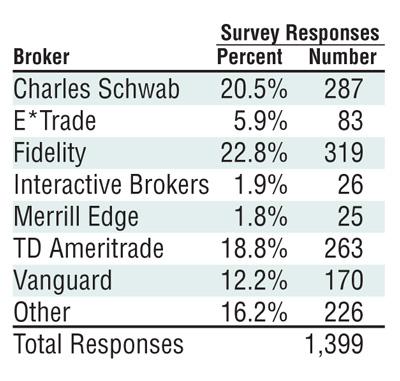
About half of all respondents (51%) only use one broker. Slightly more than a third (34%) use two, while 15% use three or more. Fidelity was the most popular, picked by 23% of respondents. Following in order of popularity were Charles Schwab (21%), TD Ameritrade (19%), Vanguard (12%), E*Trade (6%) and Interactive Brokers and Merrill Edge (2% each). Among the brokers written in (as opposed to being chosen from a predetermined dropdown list) were USAA, Edward Jones, Wells Fargo and Morgan Stanley. A few respondents listed UBS, RBC Capital Markets, Raymond James Financial, T. Rowe Price, Folio Investing, Tastyworks, Stifel Nicolaus and Robinhood. Scottrade was acquired by TD Ameritrade last year; respondents who listed Scottrade as their broker were counted as being TD Ameritrade clients.
Guidance for Choosing an Online Broker
The common question most investors have is: Which broker should I use? The answer depends on your specific needs. Any of the discount brokers listed here will work well for those simply looking for a low-cost way to buy and sell stocks, exchange-traded funds (ETFs) and mutual funds. Choosing one from among them depends largely on desired features, such as tools needed, the specific ETFs and mutual funds of interest and the location of physical offices.
Those seeking more specific guidance should ask the following questions:
-
How frequently do I expect to trade per month or year?
-
How much money do I intend to invest?
-
What investments will I invest in? Stocks? Bonds? Mutual Funds? ETFs? Options?
Some brokers are better for those seeking to only buy and hold ETFs, while others are preferable for those who intend to trade stocks on a frequent basis.
Discount brokers are geared toward do-it-yourself investors as well as those who require less management services and/or have smaller-size accounts. Full-service brokers offer a range of wealth management and financial planning services and cater to higher-net-worth individuals. The line between the two is blurry as some discount brokers do offer wealth management services. Generally, discount brokers are cheaper while full-service brokers may work better for those with complex financial and estate planning issues or otherwise require a more hands-on approach.
Accounts with both types of brokers are typically protected by the Securities Investor Protection Corporation (SIPC), though you should always check to be sure. The SIPC insures up to $500,000 per brokerage customer, including a maximum of $250,000 for cash claims. Investors with multiple accounts may be eligible for separate protection of those accounts; the key is whether those accounts meet the definition of a separate capacity. See the SIPC’s website for more information: www.sipc.org/for-investors.
In general, there is little to no minimum required to open an account at an online broker. Technically, a person could open an account with Fidelity and invest in one of its zero-expense-ratio index mutual funds with $1.00. Most investments have a higher threshold: The share price for a no-commission ETF or the minimum investment for a mutual fund. Vanguard, for instance, requires $1,000 to invest in one of its target date funds and $3,000 for most of its other mutual funds. The minimums on some mutual funds can be circumvented by setting up automatic deposits and purchases. As we explain later, some online brokers have a tiered commission structure and are a less preferable option for those with smaller account balances.
Online Broker Features
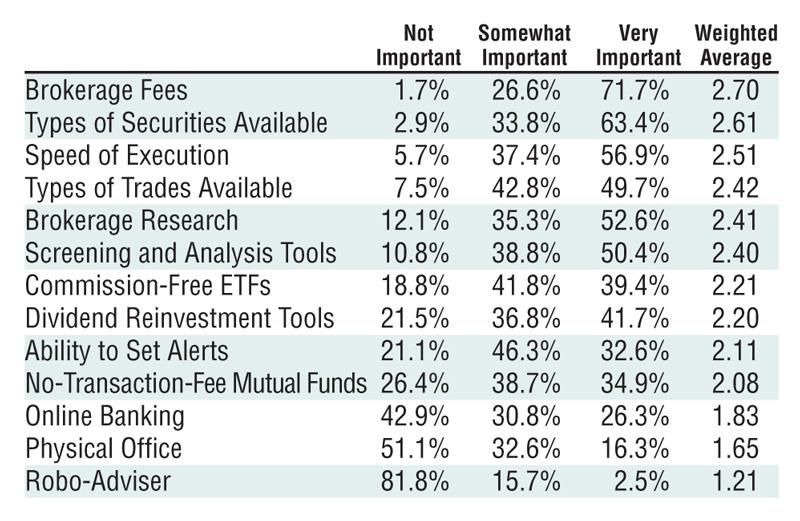
Our survey not only asked AAII members which broker they use, but also asked them to weight the importance of various broker features. Table 2 shows the results sorted by their relative “importance” to respondents as measured by the weighted average.
Fees
Brokerage fees were named the most important consideration.
The term “brokerage fees” encompasses a wide array of charges. Fees are often viewed as being synonymous with commission costs, which is the fee assessed for each trade. A quick glance at a broker’s fee schedule (discount and full service) will show there are many charges you could potentially incur. Fees may be assessed for transferring the entire balance out of an account (“transfer fee”), account maintenance (which may depend on activity or even the balance), investment management (if wealth advisory services are used), security reorganization and wire transfers, among other things.
Depending on the broker, the service you require and potentially your level of inactivity, the brokerage firm with the lowest commissions may not be the least expensive. Always read the fee schedule with consideration given to what services you will likely use.
Commissions directly reduce your return and are charged at the time a trade is executed. They should also be considered on both an absolute dollar and a percentage basis. If commissions are $6.95, one roundtrip transaction (a buy and sell) will cost $13.90. As a percentage of a $1,000 investment, this amount equates to a levy of 1.4%. As the size of the trade increases, the percentage cost drops. For a transaction worth $5,000, the same commissions represent a 0.3% cost ($13.95 ÷ $5,000 = 0.3%). As should be apparent, the less you have to invest, the more important limiting commissions becomes.
Some brokers have a tiered commission structure. For instance, Vanguard’s pricing varies on the amount invested. Commission prices drop significantly for those with $500,000 or more invested in Vanguard mutual funds and ETFs. Those with less than $50,000 invested pay a $7.00 commission fee on their first 25 trades only. See Vanguard’s website for more information (www.vanguard.com).
To provide a baseline for comparison, we’ve listed the commission for buying or selling 100 shares of a $50 stock on a dollar and percentage basis in Table 3.
Of the seven most popular discount brokers, Interactive Brokers generally offers the lowest commissions on stock and ETF trades. The firm charges $0.005 per share, with a minimum of $1.00. Like Vanguard, Interactive Brokers’ commission is tiered, but their structure is different. First, the commission charged is based on how many shares are purchased. (Interactive Brokers does offer a tiered pricing system for those investors who trade a large volume of shares; visit their website at www.interactivebrokers.com for details.) Secondly, there are also fee tiers based on activity and account size. Investors whose account balances are below $100,000 must meet a minimum of $10.00 a month in trade commissions or Interactive Brokers will charge the difference. Accounts with a balance of $2,000 or less must meet a minimum monthly trade commission of $20.00. Those who meet the requirements may find Interactive Brokers’ commission structure to be competitive, while those who don’t trade frequently may find it costly.
Runners-up in terms of the lowest commissions are Charles Schwab and Fidelity. Each charges $4.95 per trade for stocks and ETFs with no minimum trading activity requirements. E*Trade charges $6.95 per trade, though its commissions drop to $4.95 per trade for clients who trade more than 30 times per quarter.
Broker-assisted trades cost more than online trades. As the name implies, these are trades placed by calling a broker (not placing the trade online). They can be helpful for those not comfortable using a computer, lacking internet access or otherwise requiring human assistance. Broker-assisted fees are usually the same for stocks and ETFs, but are different for mutual funds. They may be waived when trading certain mutual funds and potentially some ETFs. Contact the brokers you are interested in for specifics.
The number of commission-free ETFs traded by each broker is listed in Table 3. Vanguard offers approximately 1,800 ETFs on a commission-free basis, the most of the seven online brokers. The exact number of no-commission ETFs available can vary and change over time, so be sure to check a specific fund’s status with your current broker or a prospective broker that you are considering. Expense fees levied by an ETF are in addition to commissions and are charged even on commission-free funds.

†Existing issues; new issues priced differently. *Charges inactivity fee of at least $10/month minus commissions. $3,000 minimum to trade mutual funds. **Accounts under $10,000 are charged $20/year. Accounts under $50,000 pay $20 stock commissions after 25 trades. $3,000 minimum to trade NTF funds.
Table 3 compares the fees charged by the seven most popular discount brokers, as identified by AAII members. Commissions to trade a security or fund are one of the most common brokerage fees you will incur.All of the discount brokers covered in this article offer no-transaction-fee (NTF) mutual funds—no-load funds that the broker trades without adding any trading fee. As with no-commission ETFs, the number of no-transaction-fee mutual funds offered varies by broker. E*Trade offers the largest selection of no-transaction-fee mutual funds, with Charles Schwab being a close second. A minimum holding period must be met to avoid redemption fees on these funds at most brokers, ranging from 60 days at Fidelity to 180 days at TD Ameritrade. Interactive Brokers does not list any minimum holding periods.
Transaction fees charged for mutual funds are higher than the commissions for stocks and ETFs, as is shown in Table 3. Transaction fees are in addition to any fund-specific costs such as the management fee and 12b-1 fee.
The option prices shown in Table 3 are for “basic options”; contact the brokerage firms you are interested in regarding fees for “complex options.”
Robinhood, which is not specifically covered in this guide, offers commission-free stock trading. The firm provides less financial and valuation data, charting tools and research than many of the other discount brokers. Questions have been raised about the firm’s business practices, including its disclosures.
Broker Contact Info
Charles Schwab
www.schwab.com
800-435-4000
E*Trade
www.etrade.com
855-432-6834
Fidelity Investments
www.fidelity.com
800-544-3455
Interactive Brokers
www.interactivebrokers.com
877-442-2757
Merrill Edge
www.merrilledge.com
888-637-3343
TD Ameritrade
www.tdameritrade.com
800-454-9272
Vanguard
www.vanguard.com
877-662-7447
Research and Analysis
Discount brokerage websites can be a useful resource for research and analysis. The brokers covered in this article offer stock and fund screening, charting capabilities, news feeds, research reports, earnings estimates, the ability to set alerts, watchlist tracking, fundamental stock data and other useful features.
While all the brokers offer charting and technical analysis capabilities, some offer more comprehensive tools than others. For example, Vanguard’s charting and technical analysis capabilities are basic in comparison to the other online brokers highlighted in this article.
Where Vanguard does excel is in terms of its comprehensive list of college savings calculators and tools (https://personal.vanguard.com/us/whatweoffer/college/tools). Many of the firm’s planning tools can be accessed by non-account holders.
Merrill Edge has a wide range of tools, including those for college planning, investing, personal finance and retirement (www.merrilledge.com/guidance/tools). They are also available to non-clients. The only calculators restricted to clients are the Portfolio X-ray tool (provided by Morningstar) and the bond income calculator. TD Ameritrade also offers clients access to Morningstar’s Portfolio X-ray tool.
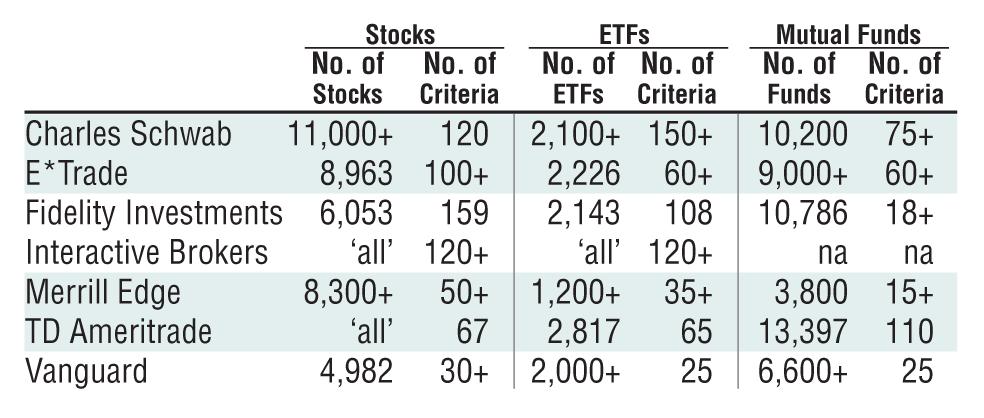
Screeners allow investors to identify specific stocks and funds with certain desired traits. All the brokers offer basic screening capabilities. Table 4 shows the number of stocks/funds the brokers offer for stock screening, mutual fund screening and ETF screening and the number of criteria you can filter on for each. More filtering fields are not necessarily better, but their presence suggests greater flexibility in terms of what characteristics can be screened for. Some of the online brokers do not display their full suite of tools unless you have an account. If you are seeking out a specific feature, contact the broker to ask them if it is available.
Types of Securities That Can Be Traded
All seven online brokers generally facilitate the trading of stocks, bonds, mutual funds, ETFs and options. Interactive Brokers doesn’t offer U.S. Treasury securities. An alternative is to buy Treasurys directly from the government, at TreasuryDirect (www.treasurydirect.gov).
Those who want to trade futures, currencies or commodities have more limited choices. For example, Fidelity and Vanguard don’t broker futures trades. At the time of publication, cryptocurrencies could not be traded at any of the covered brokers, though TD Ameritrade is working with an exchange to facilitate it.
Speed of Execution
Survey respondents ranked speed of execution as the third most important feature they desire in a broker. There isn’t a way for us to objectively measure speed of execution, and we are unaware of any independent service providing unbiased information about it.
We believe too much emphasis is being placed on execution speed. While no one wants to see a stock or ETF move away from their desired trade price, it’s more important to slow down and ensure both that the correct investment decision is being made and that the order is entered correctly. Though such a process may result in a less preferable transaction price, the avoidance of a potential mistake will have a greater positive impact your long-term returns than trying to execute a trade as quickly as possible will have. Furthermore, high-frequency trading firms will always have the edge when it comes to transaction speed.
Speed of execution is not a game that individual investors can win. Your edge, as an individual investor, comes from being able to follow a longer-term, more disciplined process.
Order Interface and Trading Platform
The trading interface varies by brokerage firm, but the basic options for placing a trade are the same. To the extent that one interface is “better” than another largely depends on personal preference.
Most of the highlighted brokers—Vanguard being the sole exception—also offer an advanced trading platform for active traders. These are investors who either have a large portfolio size or trade a minimum number of shares over a specified period. The trading platforms provide a variety of advanced analytical tools, including streaming real-time quotes, backtesting and complex charting functionality.
Other Considerations
While the aforementioned features are important, there are other considerations that could influence which broker best suits your needs.
Physical Office
Should you prefer to handle certain of aspects of your wealth management in person rather than over the phone or the internet, the location of the nearest office may factor into your decision of which discount broker to use. Charles Schwab, Fidelity and TD Ameritrade appear to have the largest number of locations nationwide, though E*Trade also has locations in many cities. Vanguard has just a handful of locations. In all cases, local branches are clustered around large metropolitan areas.
Alerts
Each of the discount brokers provide clients the ability to set alerts, but they differ in what type of alerts can be set. Alerts may be related to price, volume, news, commentary availability, upgrades and downgrades, etc.
Online Banking
All the discount brokers offer some banking services, though they vary. Interactive Brokers, for instance, provides a debit card but doesn’t allow check writing. Charles Schwab, Fidelity, Merrill Edge and TD Ameritrade offer reward credit cards. Merrill Edge is owned by Bank of America and therefore offers the most integration with traditional banking services.
Robo-Advisory Services
Robo-advisers blend traits of an advisory service and the fees offered by discount brokers. These digital services provide portfolio recommendations and automatically adjust allocations based on an algorithm. Some robo-advisory services offer the ability to consult with an adviser or planner either in person or by phone. In general, they offer less service than traditional full-service brokers and wealth advisers but also charge less. Robo-advisers can work well for investors who desire professional guidance, but have smaller amounts to invest, don’t have complex financial situations, prefer a systematic approach over one based on human judgment and/or simply prefer a low-cost solution.
All seven discount brokers offer robo-advisory services. Vanguard’s service includes the ability to speak to a financial professional. After launching Intelligent Portfolios, Schwab recognized demand for a more hands-on approach and launched Schwab Intelligent Advisory, which includes access to a certified financial planner. For more about online advisory services, see “What the Evolving Robo Advisory Industry Offers” in the October 2016 AAII Journal.
Conclusion
For many investors, any of the aforementioned discount brokers will be suitable. Personal preferences regarding website interface and desires for certain features will be your primary determinant for choosing one broker over another. If indecisive, choose the broker that offers the features you care about the most and has the lowest fees for the type of investing you plan to do. Be sure to read all details and footnotes about pricing and make sure all your questions are answered before placing your first trade.
Read More on This Topic
Stock Order Types, by AAII Staff, October 2018
How Much Is Needed to Start Investing?, by Charles Rotblut, CFA, June 2011
Bond Commissions Are Misunderstood, by AAII Staff, December 2011
A Primer on Bank Sweep Programs, by AAII Staff, July 2014

Related

Beginning Investor
The Many Ways to Place a Buy or Sell Order
Related

Beginning Investor
How Much Money Do You Need to Start Investing?
Discussion
FREE REPORT

Get your free copy of our special
report analyzing the tech stocks
most likely to outperform the
market.
Joe Stoutenburgh from MN posted over 7 years ago:
Jerry from MN posted over 6 years ago:
Joe from Florida posted over 6 years ago:
S A from OH posted over 3 years ago:
You need to log in as a registered AAII user before commenting.
Log InCreate an account