


Investors typically classify investments into either the fixed-income or equity category. But not all securities fit into only one niche. Convertible bonds have both bond-like and stock-like features.
Convertible Bonds Definition
A convertible bond is a bond that provides a stated coupon, but that also gives the holder the right to convert the bond to a specified number of shares of the issuing company’s common stock.
Depending on market conditions, an investor’s return may be more bond-like, based on the stated interest rate, or it may be more equity-like, due to its conversion features.
These hybrids have three basic attributes:
- An upside potential that normally is less than that of the underlying common stock because convertible buyers pay a premium for the conversion privilege,
- Less downside risk than the stock due to built-in price supports and
- A yield that normally is higher than that of the associated stock.
How Do Convertible Bonds Work?
A company issues bonds when it needs to raise capital. Issuing convertible bonds is a way to offer a lower coupon yield but entice investors with a value-added component. Most convertible bonds have intermediate-term maturities.
Each security has a conversion ratio that denotes the number of shares of common stock the bondholder can receive upon conversion. The ratio may be stable, or it might change over the bond’s life, but it is always adjusted for stock splits and dividends of stock. A conversion ratio of 45.5 means that for every $1,000 of par value the bondholder converts, they will get 45.5 shares of common stock.
The price at which it becomes profitable to convert the bond into shares can be determined based on the price paid for the bond per $1,000 of par value and the conversion ratio. For example, a $1,000 par value bond with a conversion ratio of 25 is sold for $900. The share price at which it would become profitable to convert the shares is $900 ÷ 25 shares, or $36.
An investor might decide to convert the bond into shares of common stock if the share price rises to a desirable level. If the share price never reaches a profitable level, the bondholder will not convert the shares, but instead will receive a return based on the bond’s stated interest rate.
Convertible bonds offer downside protection, but less appreciation than owning the actual stock. The difference is mainly due to the premium paid for the ability to convert the bond to stock.
Most convertible bonds have a call provision, meaning the company can force investors to convert the bond into common stock. This typically happens if the stock price goes to an undesirably high level. Investors who wish to convert will have to do so at that price, even if they’d prefer to wait for an even higher price. The upside is not unlimited.
On the other hand, the investor will always receive the par value of the bond at maturity, even if the share price falls dramatically. This allows for some downside protection.

Types of Convertible Bonds
In addition to a traditional convertible bond, which allows investors to convert the security into shares of the issuing company’s stock, there is an exchangeable bond that allows investors to exchange the bond for shares of stock in a company different from the issuing company.
While the “plain-vanilla” convertible bond is convertible into common stock, some are convertible into preferred stock.
You can also purchase a zero-coupon convertible bond, which usually sells at a deep discount to face value. Zero-coupon convertibles do not make periodic interest payments, but potential increases in stock price offer greater capital gains prospects.
As with any investment, conditions and rules can always be added, so be sure to fully understand all caveats of the security before investing.
Investing in Convertible Bonds
In an effort to diversify, many investors look to bonds. Convertible bonds can be a way to cash in on the gains of a rising stock price but limit the potential for loss. The interest rate will be lower than for a similar traditional bond, but the potential for gain is higher.
Many brokers allow investors to trade various types of bonds. But investing in convertible bonds requires the willingness to perform more sophisticated analysis.
Also, taxes on convertible bonds can get tricky, so be sure to read the prospectus carefully and talk with a tax professional. In general, convertible bonds receive the same tax treatment as other conventional securities concerning interest payments, gains and losses.
If a plain-vanilla convertible bond is converted to common stock, there is no recognized gain or loss, so no additional taxes are due at the time of conversion. If the bond is sold before conversion, any gain or loss on the sale is taxed. Any interest earned during the holding period is taxed as interest income.
An alternative to investing directly in convertible securities is to invest in mutual funds or exchange-traded funds (ETFs) that hold convertibles.
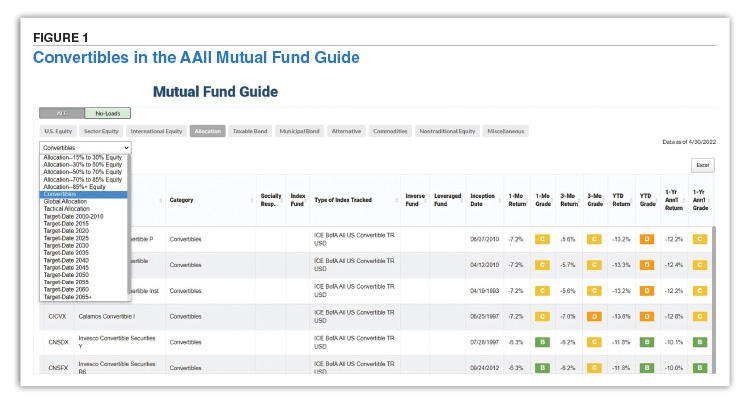
AAII members can get details and performance ratings on convertible bond mutual funds and ETFs in the Mutual Fund Guide and the ETF Guide. In either guide, choose the Allocation category and then select Convertibles from the drop-down menu of subcategories (Figure 1). Currently there are 75 convertible bond mutual funds listed in the mutual fund guide; you can toggle between all funds and only no-loads, where the list totals 39. In the convertible ETFs table, there are four listed. Data is updated monthly, and the lists are downloadable into Excel.
Subscribers to A+ Investor can use the Funds Screener and ETF Screener to filter for convertible funds and choose other desired data points. In the screeners, simply choose Convertibles from the global asset class list under Fund Type. Once your filters are set, you can save your screen for future use.

Related
Related

Beginning Investor
Choosing Between Bonds and Bond Funds
Discussion
FREE REPORT

Sneha J from IND posted over 4 years ago:
You need to log in as a registered AAII user before commenting.
Log InCreate an account