


Related

First Cut Stocks
Underperforming stocks may seem unappealing, but the price weakness can turn them into bargains with upside potential.
by Luke Wiley | October 2015

“Invert, always invert.”
– Carl Gustov Jacob Jacobi
Inversion. Such a simple concept. If there is a problem to solve, consider all the solutions that won’t work. In so doing, the correct answer reveals itself. When I first came across the above quote from 19th century German mathematician Carl Gustov Jacob Jacobi, it resonated with me. This way of thinking in reverse seemed to speak to the way I made decisions. Want to lose weight? Think of all the behaviors that will lead to obesity and do the reverse. Want to be a better father? Think of the things that would turn one’s kids away and do the opposite. Jacobi’s maxim seemed most appropriate to my career in finance, particularly as it relates to investing’s golden rule:
Buy low, sell high.
It was Jacobi’s maxim of inversion that lead me to find a better way to invest—a system for making better decisions, finding opportunities where others weren’t looking—and deliver better outcomes for myself and others who have begun to use it. It’s called “The 52-Week Low Stock Formula” and on paper, it seems simple—almost too simple. We look at companies and judge them based upon five basic questions:
Let’s start with the Jacobian Inverse, which I discuss at the beginning of Chapter 12 in my book, “The 52-Week Low Formula” (John Wiley & Sons, 2014):
I want to seek out a portfolio of 25 businesses whose trailing 12-month returns are beyond great. Even though I did not participate in any of the prior performance, I want to put my principal into such a strategy. I want to err on the side of investing that gives me a higher probability that I am buying high. Why would anyone want to buy a business that is trading for less right now than it did in its recent past?
I know the preceding paragraph sounds absurd, but this seems to be the reality of the investing public and many investment professionals. When an investor realizes how ridiculous the mindset sounds, he or she realizes that an investor should want to keep his or her mind open to stocks trading much lower or substantially lower now than they did over the past 12 months.
Put another way, consider what Howard Marks, the co-chairman of asset manager Oaktree Capital, said about taking a contrarian stance in “The Most Important Thing” (Columbia University Press, 2011):
“The thing I find most interesting about investing is how paradoxical it is: how often the things that seem most obvious—on which everyone agrees—turn out not to be true… The ultimately most profitable investment actions are by definition contrarian: you’re buying when everyone else is selling (and the price is thus low) or you’re selling when everyone else is buying (and the price is high).”
This brings us to consideration of the 52-Week Low strategy. When an investor buys into the concept, he or she will realize (or even welcome) the fact that the trailing 12-month returns of most of the companies in the new lineup are underwhelming.
In the fall of 2012, I was busy rebalancing portfolios, and thus changing some of the companies that make up the 52-Week Low strategy. After evaluating those that passed the first four filters in the strategy and making final decisions about the stocks that would make the final cut, I saw a number that sent shivers up my spine. As a younger man, those shivers would have been fear or doubt, but knowing what I know now, I recognized the unmistakable signs of real excitement.
The number was the trailing 12- month return of the collective portfolio benchmarked against the S&P 500 index. This portfolio of stocks fared 25.4% worse. The companies I was about to buy had underperformed the index by a little over 25% in the past 12 months. Collectively, they had lost 2.8% of their total value in a time when the market had shown a 22.6% gain. I could not have been more excited.
In fact, if an investor were to look at just the companies with negative 12-month trailing returns, he or she would see that they collectively lost 12.8%, while the market had shown a trailing 12-month total return of 22.6%. Six months later, those same companies returned 17.9% while the S&P 500 gained 12.5%.
Why would I have expected such outperformance? Because over the past two decades, I had learned to embrace the negative and see it for what it really was: upside and opportunity. It’s completely counterintuitive. To use a sports analogy, if a person were drafting a baseball team and, when the lineup was established, that person was told that his players had hit 25% fewer home runs than his opponents, he might get nervous. That’s conventional wisdom. That seems like a no-brainer. Fewer home runs must equate to fewer wins, right?
Wrong.
As Michael Lewis detailed in “Moneyball: The Art of Winning an Unfair Game” (W.W. Norton & Company, 2003), the Oakland A’s knew something about their roster of no-name players: They may not hit as many home runs, but they give up fewer runs, make fewer errors, and score more runs with singles and walks than anyone else in baseball, and, most importantly, they cost less money in contracts and incentives. That’s the same way I felt about those companies in my lineup. (Investment newsletter editor Jim Fink made the same type of argument on the Investing Daily website.)
The companies on my screen had passed the first four filters. They were good companies that had been left behind by the fads, just like the players on the A’s were good players who were no longer considered superstars. The players and the companies weren’t in favor, but they got the job done. And when it comes to baseball and investing, being in favor isn’t nearly as important as getting a job done well.
“The error is clear,” Marks also explained in his contrarian book. “The herd applies optimism at the top and pessimism at the bottom. Thus, to benefit, we must be skeptical of the optimism that thrives at the top and skeptical of the pessimism that prevails at the bottom.”
Popular opinion helps guide our decisions all the time. Is that new movie good? Ask a friend who has seen it before deciding whether to go. Popular opinion, in most cases, is a great tool for helping us figure out what comes next. Popular opinion dictates elections and drives fashion and food, branding and marketing.
Fifty million Elvis fans can’t be wrong, and apparently they weren’t.
As an investor, the value of popular opinion is often in its inverse. Value investors want companies to be unpopular to understand the opportunities they represent. Value investors want to avoid the most popular companies people are clamoring to get in on because demand drives prices upward. It’s simple economics.
The reasons the companies identified by my strategy had the capacity for price appreciation was twofold:
When watching a baseball game, it’s common to hear a phrase every once in a while related to a team’s best power hitter who’s in a slump. “He’s due,” the announcer says, and the sentiment is repeated on the breaths of hopeful fans everywhere. The implication is that this hitter has a proven track record of performance that, although he is in a dry spell, is reason enough to believe that on any given pitch, he’ll send one over the outfield wall and win the game.
It’s easy to mistake my theory with that sort of blind hope. It is not the same thing at all. The 52-Week Low strategy hits its fair share of home runs, but we believe it is more appropriate to try for singles, walks and balks. [Editor’s note: A balk occurs when a pitcher interrupts his delivery of a forward pitch. It usually results in the runners advancing a base.] We are managing consistency in the often unpredictable construct of the market. We are using a strategy akin to Sabermetrics (the application of statistical analysis to baseball) in the age of the home-run hitter. We don’t look at a stock that’s in a dry spell and hope that it will return to its former glory. Instead, we look at an overlooked, undervalued stock with a track record of consistent performance and a clean bill of health. If such stocks are in a slump, the opportunity is even better. And we don’t send them out there to hit a game-winning home run. We send them out there to bunt in the top of the second.
Baseball analogies aside, the point is to identify good companies first and then look for good companies whose stocks have underperformed and are now undervalued.
The underlying concept of the 52-Week Low formula is to find winners in stocks that have underperformed and underwhelmed in the year leading up to their addition to the strategy. Why is this important? Because you need to distinguish between companies that have underperformed and those that are undervalued. Undervalued stocks have usually underperformed. It’s one of the reasons they are undervalued. But not all underperforming stocks are undervalued. Some companies haven’t performed well because they are unstable or unsound.
The strategy filters attempt to weed out those companies that are bound to continue losing value from those that have lost value and are primed for recovery. The key is to maintain the discipline of distinction. It’s easy to rationalize that a company that has passed four of the five filters—or three of the five—is bound for a recovery. This is hope in the face of fear. Investors have to manage that rationalization, recognize it for what it is and walk away. If a company fails even one of the filters and is trading at historic lows, there is probably a good reason and one that goes beyond loss of popular sentiment.
The 52-Week Low strategy only works if an investor adheres to it. This means rigidly demanding that all the companies pass all five of the filters, and trusting the five filters to turn fear of negative trailing returns into realized opportunity. It also means conducting due diligence to ensure there isn’t a significant problem with a passing company not caught by the strategy’s filters. It’s hard, particularly at first, to look at the numbers in red and see anything but loss. But those using the strategy will learn, as I have, to embrace the trailing losses and even get excited by them.
As mentioned before, going against the grain and seeking opportunity in places that others have abandoned is not without pain and discomfort. These pangs of discomfort are false. They are emotions disguising themselves as rationale. Maintain the process and stick to the strategy. Data, time and results should prove the diligence worthwhile.
What Passed Wiley’s Screen?
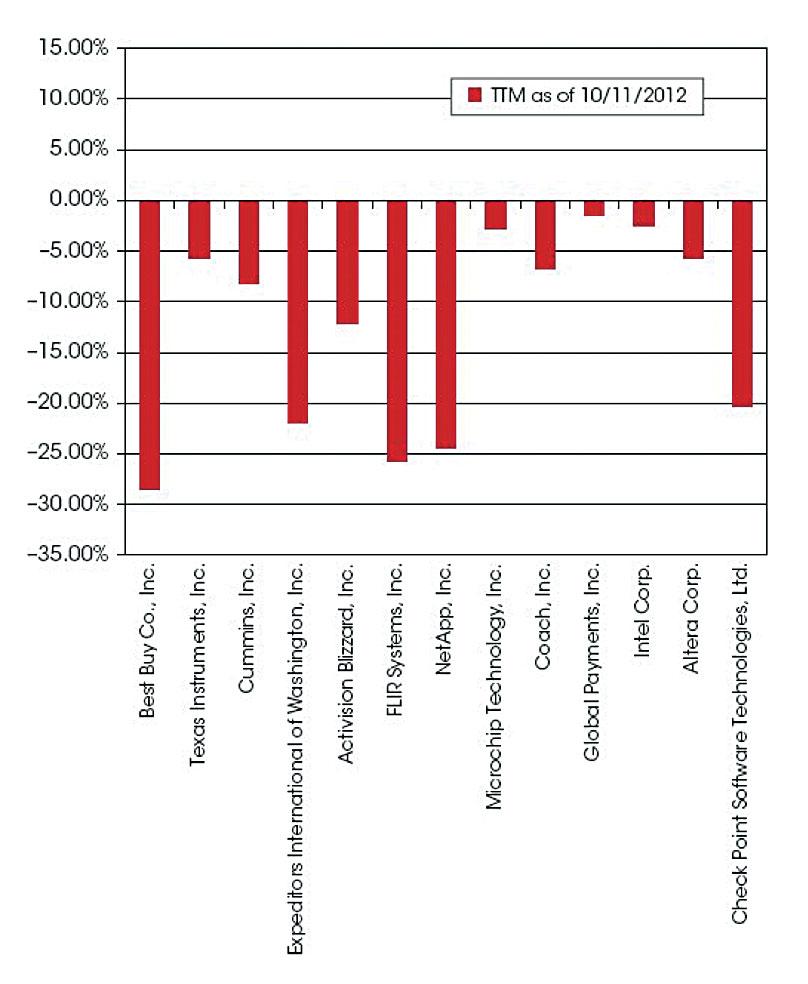
In this article, Luke Wiley discusses the negative 52-week returns that the stocks passing his filters had. Figure 1 shows some of those of stocks. All had fallen in price over the preceding 12-month periods, with declines ranging from 1.4% to 28.6%. The price declines reflected the low popular opinion the market had toward those companies at the time they passed the five filters.
The same stocks went on to rebound strongly over the following six-month period, as can be seen in Figure 2. A portfolio made up of these stocks would have realized a 19.1% return over the following six months, exceeding the 12.5% return realized by the S&P 500 index over the same period. A key reason for the outperformance was mispricing. Sentiment had swung too far against these stocks, causing them to trade at discounted valuations relative to their prospects.
A key commonality of value and contrarian strategies is to seek out stocks trading below their intrinsic value. Value investors attempt to pay less than a dollar for a dollar’s worth of intrinsic value. Strategies such as the 52-Week Low formula look to price movement as an indication that a stock’s valuation has fallen too low and then apply additional filters in an attempt to separate the stocks that are bargains from those that are cheap for a reason.
It’s important to understand that these returns may not be indicative of what an investor can expect, with future returns potentially being significantly different. This said, the long-term data shows that value strategies outperform growth strategies. Growth stocks tend to have more appealing stories, which makes them more popular. Popularity can lead to greater expectations, which in turn creates more room for disappointment. Value stocks—though still capable of experiencing large price declines—are often out of favor and thereby have lower expectations. The reduced expectations can lead to higher future returns when such companies report results that are better than investors had expected or feared.
—Charles Rotblut, AAII Journal Editor
See this issue’s First Cut for an initial stock screen based on Wiley’s formula using Stock Investor Pro.
First Cut Stocks

Louis Hemmer from NY posted over 11 years ago:
Bedford Joyner from TN posted over 11 years ago:
Russell Abbott from CA posted over 11 years ago:
Scott from CA posted over 11 years ago:
John Givens from FL posted over 10 years ago:
Shane Milburn from TN posted over 10 years ago:
You need to log in as a registered AAII user before commenting.
Log InCreate an account