


Wayne Thorp leads a class in AAII's new Essential Investing Video Course. Go to https://www.aaii.com/ves for more information and to subscribe.
Starting at $199 from AT&T, Sprint and Verizon; contract-free pricing from $649 with T-Mobile
Redesigned iPhone with larger display and new operating system.
There was a time when Apple was the leader in smartphone technology. When the iPhone first went on sale on June 29, 2007, it took the world by storm. Immediately thereafter, competitors started the large and arduous catch-up process. It took several years, but many would agree that Apple relinquished its crown as smartphone innovator a few years ago, as the likes of Samsung and others introduced phones that looked better and had bigger displays. At the same time, Apple was content with more behind-the-scenes changes, such as more powerful processors, better (albeit smaller) displays and fingerprint recognition. In recent years, the calls for a redesigned iPhone have grown louder, as some began to wonder if Apple was falling so far behind it would never be able to catch up. Apple answered those calls in September with the new iPhone 6. This time around, Apple started from scratch and, perhaps begrudgingly, bowed to the competition with a bigger display and other enhancements that the company hopes will place the iPhone back at the head of the smartphone pack.
The iPhone 6 went on sale on September 19 (along with the even bigger iPhone 6 Plus) and I picked mine up on September 22, replacing the iPhone 5 I have had for roughly two years. Now that I have used it for nearly a month, it is time to make my thoughts known. Unless otherwise noted, my basis for comparison is the iPhone 5, not the newer iPhone 5S.
Design
Having owned both the iPhone 4 and 5, I must admit that I was starting to find the iPhone design a little tired. On many occasions, I had said that if I could run iOS on a Samsung phone, I would do so. My preference for iOS over Android kept me married to the iPhone. However, it is also worth pointing out that I am not a fan of the “phablets,” such as the Galaxy Note, that have come to dominate the smartphone landscape. Because of their screen size, I find these part-smartphone and part-tablet devices to be too cumbersome. If I need a device with a larger screen, I use my iPad Air or just my laptop or desktop PC.
The first thing you notice about the iPhone 6 is its bigger screen size, 4.7 inches. This is a noticeable increase over the 4-inch display of my old iPhone 5. It is most apparent when looking at the apps on the screen. You can now view six rows of apps, with four apps per row, versus the five-by-four configuration on the iPhone 5.
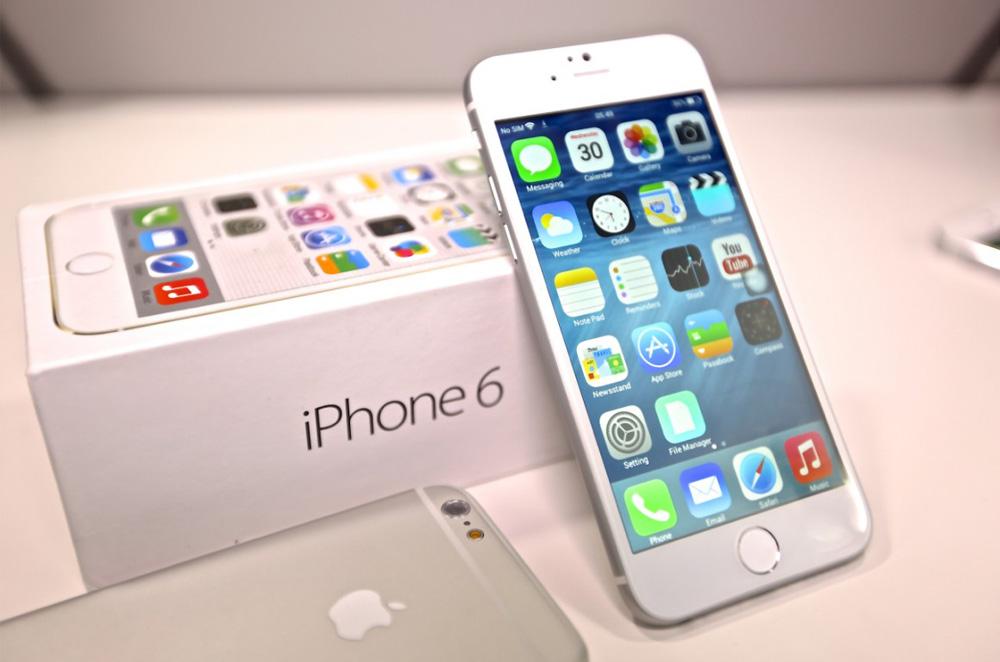
The second thing that jumps out at you is the more rounded design of the iPhone 6, reminiscent of the iPad Air. The glass front is curved around the edges of the display and the chassis is made of aluminum, with two plastic strips on the back for the antenna. Personally, I prefer the rounded edges of the iPhone 6 to the sharper lines of the iPhone 5. One design “knock” is that the bezel of the iPhone 6 is still big compared to some other smartphones. As a result, there are Android devices on the market that have similar overall dimensions as the iPhone 6 but still have bigger screens.
Apple also moved the power button to the side of the phone to accommodate the larger physical size of the iPhone 6. Even after a month, I still find myself looking for the power button on the top of the phone. Positioning the power button opposite the volume buttons also means you will probably hit the volume rocker buttons (Apple also did away with the round up-and-down volume buttons) when trying to push the power button. This is a bit annoying, since I typically hit the power button to turn off the display instead of letting it dim on its own, but this is nitpicking.
The Home button is in its usual location and it contains Touch ID technology, originally launched with the iPhone 5S. With the Touch ID technology, you can use your fingerprint to securely access your iPhone instead of having to enter in an access code.
Not quite as obvious is the thinner design of the iPhone 6 compared to my iPhone 5. The iPhone 6 is 6.9 millimeters (mm) thick, compared to 7.6 mm for the iPhone 5 (roughly 10% thinner). One design “quirk” of the iPhone 6 is the rear-facing iSight camera. Apple did not want to skimp on the camera’s sensor, so it was not scaled down when the iPhone 6 became thinner. As a result, the camera bulges out a bit. Critics were quick to point out that you now run the risk of scratching the lens if you set it down on a rough surface. However, the camera lens (as well as the Home button) is made of sapphire glass, which lowers the risk of scratches. Furthermore, I always use a case for my iPhone, so this is not an issue for me.
Overall, the dimensions of the iPhone 6 are 5.44 inches by 2.64 inches by 0.27 inches, while the iPhone 5 measures 4.87 inches by 2.31 inches by 0.3 inches. Having held the iPhone 6 Plus, I am 100% convinced I made the right choice in going with the iPhone 6. I think Apple hit the sweet spot in terms of size with the 4.7-inch screen. This is still smaller than the displays of many of the flagship models from competitors, but I use the display of my iPhone mainly for navigation purposes. Again, if I need a bigger display I will use my iPad Air or laptop/desktop.
The iPhone 6 also weighs in at 4.6 ounces (129 grams). This is roughly 15% heavier than the iPhone 5, which weighed 3.95 ounces (112 grams).
Hardware
IPhone 6 has a “Retina HD Display” with a higher resolution than my old iPhone 5: 1,334 × 750 pixels versus 1,136 × 640 pixels, respectively. However, Apple is not packing in any more pixels per inch (ppi): the iPhone 6 has the same 326 ppi as the iPhone 5. Many reviewers were quick to jump on the lack of a high-definition display with the iPhone 6. This definitely is not cutting-edge technology at this point, as several Android smartphones with similar screen sizes have been offering HD displays for well over a year. If you want a full HD display, you will need to upgrade to the iPhone 6 Plus.
According to iFixit, the iPhone 6 has a 1,810-mAh battery, whereas the iPhone 5 has a 1,440-mAh battery, an increase in capacity of more than 25% (later on, I discuss whether this translates into longer usage between charges). The iPhone 5S has a 1,560 mAh battery.
The brains of the iPhone 6 are the Apple A8 processor, which is more specifically a 64-bit dual-core 1.39 GHz Cyclone Processor (the iPhone 5S has a dual-core 1.3 GHz processor). The iPhone 6 also has an M8 motion co-processor. The iPhone 5 did not have a motion co-processor; that feature was added with the iPhone 5S. The motion co-processor allows the iPhone to capture your movements for use with a variety of health and fitness apps. The M8 is an upgrade from the M7 co-processor found in the iPhone 5S, and it now also collects data from a barometer to measure altitude changes. According to Apple, the A8 processor delivers a 25% increase in CPU performance versus the A7 processor in the iPhone 5S, as well as a 50% improvement in graphics performance over the A7 processor. The iPhone 6 also comes with 1G of RAM, the same that was found in the iPhone 5, although it is the next generation memory type.
The iPhone 6 offers better storage options: 16G, 64G or 128G (the most internal storage currently found in a smartphone). I went with the 64G model, as I typically back up photos I wish to keep to iCloud (luckily, I do not take incriminating photos!). If you plan to take a lot of videos and photos, or if you are not thrilled with the thought of putting your media files on the cloud, the 128G model may be the better choice. You now get 10G of free iCloud storage, and paid subscription storage has dropped significantly in price. I pay $0.99 a month for 20G of iCloud storage, while one terabyte of iCloud storage costs $19.99 a month.
There is expanded LTE support with the LTE network, with support for over 20 LTE carriers (seven more than the iPhone 5S). Download speeds over LTE now range up to 150Mbps, and the iPhone 6 supports voice over LTE (VoLTE). This technology is a means of routing voice traffic over the 4G LTE networks that network carriers use to transmit data. It offers better-quality voice calls and the ability to use voice and data at the same time. However, its availability differs between carriers. Verizon and T-Mobile claim to offer nationwide VoLTE service, while AT&T offers VoLTE in select markets (including Chicagoland, where I live), as does Sprint. Both Sprint and AT&T expect to have nationwide VoLTE service sometime next year.
Apple has also added 802.11ac specifications for Wi-Fi, which offers theoretical Wi-Fi download speeds of 433 mbps. This is roughly three times faster than 802.11n.
A lot of attention is being paid to the addition of near-field communications (NFC) to the iPhone 6. At least to start, this will be used solely with Apple Pay (more on this later), which Apple expects to launch later this month. NFC is a form of short-range wireless communication standard, whereby a transmitter on the iPhone communicates with a receiver at, say, a checkout counter. NFC has a very short range, which lessens the risk of third parties gaining unauthorized access to your sensitive information.
Lastly, there is the iPhone 6’s camera. Other smartphone manufacturers have been competing with each other to cram as many megapixels as possible into their onboard cameras. Apple has stayed out of the megapixel fight, instead focusing on the sensor, which ultimately has a more significant impact on your snapshot quality. The rear-facing iSight camera on the iPhone 6 still has eight megapixels (8MP), but it has a new sensor. Like the iPhone 5S, the sensor has 1.5 micron pixels and an f/2.2 aperture lens and it can shoot high-definition 1080p video at either 30 or 60 frames per second. The camera also includes phase detection autofocus, which Apple has dubbed “Focus Pixels.” Apple claims that this technology allows the camera to focus more quickly, lowering the number of out-of-focus shots you take. The front-facing camera has also received a sensor upgrade and has an f/2.2 aperture.
Software
The iPhone 6 ships preloaded with iOS 8, the latest version of the iOS platform. Besides having more screen real estate to view the apps, I have not noticed much difference in the new mobile operating system.
One interesting feature of iOS 8, which is probably more useful with the larger iPhone 6 Plus, is the “reachability” mode: double-touching the Home button slides the top half of the screen’s contents down to the bottom half of the screen, making it easier to reach with your thumb if you are using the iPhone “one-handed.” This is a somewhat inelegant solution, but my hands are big enough that I can reach the whole screen when holding it in one hand.
IOS 8 also has a vastly improved keyboard that makes texting and typing much easier.
Another new iOS8 feature that I like is the ability to track the battery usage of the apps you use. In Settings, you can now view battery usage by app so you can monitor the battery drain of specific apps. Now you can see which apps are using the most juice and, if needed, shut them down.
Apple really hyped the new Health app with iOS 8, but I have found it to be rather convoluted and confusing. Furthermore, my Withings Pulse O2 activity tracker does not talk to the Health app, so I bypass the Health app and go straight to the Withings app.
Performance
Having used my new iPhone 6 for just under a month, I am thrilled with it. It is a great phone and should go a long way toward silencing critics who have been saying that the iPhone had become dated (which it had).
First, there is the design. Having never been a fan of the “phablets”—smartphones that are pseudo-tablets—I think the screen size on the iPhone 6 is perfect, at least for me. My mom has ordered the iPhone 6 Plus, and I am very curious to see how she likes it. I think it is too big for a phone, especially if you do not have a bag to carry it in.
I am not a fan of benchmarks, as many assumptions and factors go into those results. Instead, I simply rely on real-world experience. In almost every conceivable category, the iPhone 6 is a noticeable upgrade over my old iPhone 5. It looks fresher; it feels better in my hand; apps load faster; calls are clearer; viewing Web pages, photos and videos is crisper; snapshots are better. The list goes on and on.
On-screen typing with the iPhone 6 is also much easier. As someone who texts more than I talk on the phone, I find this an important enhancement. Keys are spread out, thanks to the larger display. In addition, Apple has improved its autocorrect prediction engine, meaning it can better understand the context and make more accurate suggestions. In addition, Apple now allows you to download and use third-party keyboards with iOS 8.
One area where I have run into some problems, however, is Wi-Fi connectivity. There were many reports when iOS 8 first came out that people were having Wi-Fi issues. Apple claims to have resolved these issues, but every once in a while it seems that my iPhone 6 “loses” the local Wi-Fi network. When this happens, I turn Airplane Mode on and off and the phone reconnects to the Wi-Fi network.
Battery Life
Compared to my old iPhone 5, the iPhone 6 has a battery with roughly 25% added capacity. But does that translate into more time between charges? In my experience, the answer is a resounding “yes!” The two previous iPhones I had—the 4 and 5—were wrapped in a battery case. This was, first, because I firmly believe in protecting my investment. Second, however, I used a battery case because the iPhone is a notorious battery hog. Or I should say was. Compared to the iPhone 5, I see a pronounced improvement in battery life. It used to be that I would be lucky to get through a workday without having to charge my iPhone. Now, I can get over a day’s worth of “casual” use—email, text, occasional phone calls and Web browsing—without having to plug in. Throw in video viewing, especially HD videos, and the difference in battery consumption is tangible. The bigger battery, coupled with the increased efficiency of the processor in the iPhone 6 compared to the iPhone 5, has significantly improved the battery performance.
According to Apple, the A8 processor of the iPhone 6 draws 50% less power than the A7 processor in the iPhone 5S. However, many reviewers have reported only comparable battery life between the 5S and 6. With a supposedly more efficient processor and bigger battery, why is that? Most likely, it is because of the energy required to power the added pixels of the iPhone 6’s bigger display.
Apple Pay
Apple Pay is Apple’s new mobile payment system that will allow users to store their credit cards in Passbook for use with online payments and retail purchases over NFC (near-field communications). The e-commerce possibilities of NFC, coupled with the security features of Touch ID, make Apple Pay a potential game changer in the same way the original iPhone was.
Apple Pay is expected to be launched sometime in October, but its ultimate success—or failure—will depend on whether or not retailers embrace the concept. Apple has already struck deals with the big three credit card companies—Visa, MasterCard and American Express—along with the major credit card issuers, including Citi, Chase and Wells Fargo. However, few major retailers are on board as of yet, mainly because many of them are trying to get their own mobile payment systems off the ground. Walmart and Best Buy have already said they have no plans to support Apple Pay. Starbucks will add Apple Pay compatibility into its iOS app, but it is not looking to add NFC point-of-sale terminals at its stores anytime soon.
Only time will tell whether Apple Pay is a disruptive technology (meaning an innovation that changes the way things are done) or simply a dud.
Price
Apple products, historically, have carried a price premium over products with similar technical specs, and the iPhone 6 is no exception. However, given the level of competition in today’s marketplace, I do not think the higher price is warranted. The iPhone 6 is not the revolutionary product the original iPhone was. Instead, in my opinion, it was a desperately needed upgrade just to keep Apple part of the smartphone conversation.
You can get a contract-free, non-subsidized iPhone 6 from T-Mobile beginning at $649 for the 16G model. The 64G model costs $749 and the 128G version costs $849. In contrast, you can buy a new Samsung Galaxy Note 3 with a 5.7-inch full HD display, 13MP, 3G of RAM and 32G of internal storage for roughly $520. While it is difficult to compare Apples to Androids, I am not sure the iPhone still rates the premium pricing. I guess as long as people keep buying iPhones by the millions, myself included, Apple will keep charging the prices that it does.
Overall
The iPhone 6 has gone a long way toward quelling my Android hardware envy. Going from the iPhone 5 to the iPhone 6 is a significant leap in design and functionality, mostly due to the bigger screen size. If you have the iPhone 5S, the choice is not as clear-cut. In no way is the iPhone 6 revolutionary, although Apple Pay could become a game changer if it gains wide acceptance, which remains to be seen. The iPhone 6 has significantly closed the gap between Apple and its Android (and Windows) competitors.
After nearly a month, there is very little I would change or improve with the iPhone 6. Presumably the quirky Wi-Fi connectivity issue will be ironed out in future releases of iOS 8, and it has been the only truly frustrating part of my iPhone 6 experience.
The only true negative of the iPhone 6 is the price. I would be remiss if I did not bring this up, since I have been harping on this point when it comes to Mac products for years. Apple products are known for their quality and reliability, but I do not think they are as superior as their price premium would seem to indicate. In the case of smartphones, there are Android models that offer bigger screens with higher resolutions and better battery life at a fraction of the cost. I will admit that I think iOS is vastly superior to Android but, again, I am not sure this warrants such a price difference. If cost is a deciding factor, you will probably not be buying the iPhone 6.
While cost is not something you can blithely disregard, I do think the iPhone 6 is an amazing piece of technology, especially when compared to my old iPhone 5. This is definitely a device to consider if you are in the market for a new smartphone.
Pros
- Bigger display
- Better battery management
- Improved on-screen typing experience
Cons
- Compared to iPhone 5S, no significant battery life improvement even with larger battery
- Some Android phones have bigger screens with similar overall footprint
- Must occasionally turn Airplane Mode on and off to recapture Wi-Fi network
- Expensive relative to other smartphones
- Lacks a true HD display
Starting at $199 from AT&T, Sprint and Verizon; contract-free pricing from $649 with T-Mobile
Discussion
FREE REPORT

Charles Rotblut from IL posted over 12 years ago:
W. Richard Mcdearman from TN posted over 12 years ago:
You need to log in as a registered AAII user before commenting.
Log InCreate an account