

Related

Portfolio Strategies
Though Aesop’s fable is regarded as a lesson in thriftiness, “grasshoppers” are likelier to smooth their spending over their lifespans.
Article Highlights

Many academic studies show that retirees, particularly wealthier retirees, spend down their nest egg much slower than economic theory would predict.
In fact, a study by Browning, Guo, Cheng and Finke finds that the average household that retired in the year 2000 and was in the top 20% of wealth saw their financial assets increase over the next 12 years (“Spending in Retirement: Determining the Consumption Gap,” Journal of Financial Planning, 2016).
This excessive thrift is a mystery to many economists who don’t understand why individuals would make sacrifices during their working years in order to live better in retirement if they don’t have the intention to spend down their savings in retirement. Why not go on more vacations, buy a larger house, or drive a nicer car early in life instead of setting money aside that is never spent? This tendency is especially puzzling since the average retiree doesn’t exhibit a very strong desire to leave a bequest.
Behavioral finance may offer an explanation. Many workers become accustomed to the decision-making strategy (also known as a heuristic) of spending less than their income. This habit of thrift serves them well through their working life as they see their retirement savings grow over time.
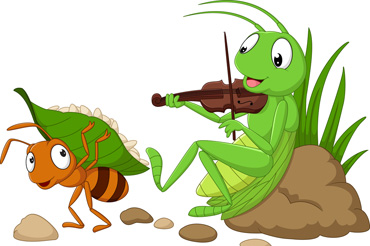
The habit of thrift is consistent with the message of the Aesop’s fable “The Ant and the Grasshopper.” The ant spends the summer gathering food for the winter, while the grasshopper chirps and dances the summer away, having a good time. When winter comes, the grasshopper begs in vain for some of the ant’s food. Of course, the purpose of the fable is to encourage children to develop a habit of thrift. Thrift is good.
But what of the grasshoppers in retirement? Many households that enter retirement have significant savings despite having more lavish spending habits. For example, a household that receives an inheritance or sells a business at retirement may find itself with significant financial assets at retirement without developing the habit of saving for the winter. It is possible that failing to develop a habit of thrift means that grasshoppers are at greater risk of overspending in retirement.
Although economists assume that households will try to smooth spending across their lifespan in order to maintain roughly the same lifestyle before and after retirement, it can be difficult to break spending habits developed over a long period of time. This so-called habit formation hypothesis suggests that we become accustomed to a lifestyle. This lifestyle is difficult to break even when our financial circumstances change. In retirement, this means that the ants have accumulated significant assets and should rationally live well in retirement. But their habit of thrift holds them back. Conversely, the grasshoppers have developed a habit of spending more and may have a difficult time responding to a drop in income, resulting in potential financial ruin.
The Health and Retirement Study (HRS) is a longitudinal survey of Americans over age 50; it is sponsored by the National Institute on Aging and the Social Security Administration. It is a sample of over 20,000 households of various age cohorts tracked prior to and after retirement. Within the HRS is a subsample of retirees who complete the Consumption and Activities Mails Survey (CAMS), which provides detailed data on household spending. The CAMS survey provides information on how spending changes before and after retirement.
We begin collecting household data in the first HRS wave to include the CAMS (2002) and continue with every survey year through 2012. We identify households in each survey that worked in the previous survey and then transitioned into retirement in the subsequent survey.
Our objective is to identify households whose income and financial assets are nearly identical before retirement, but who exhibit different spending habits. We do this by creating a regression model that predicts how much a household will spend based on income and estimate spending within five groups of retirees sorted by total wealth. We then label grasshoppers as those who spend at least one standard deviation more than the model would predict before retirement. Approximately 15% of the sample are grasshoppers. The rest of the households in the top wealth quintile are considered ants.
Grasshopper households have income and wealth levels that are at least as high as ant households, and they are more likely to have completed a college degree. The primary difference between grasshoppers and ants is the amount of money they spent in the year before retirement.
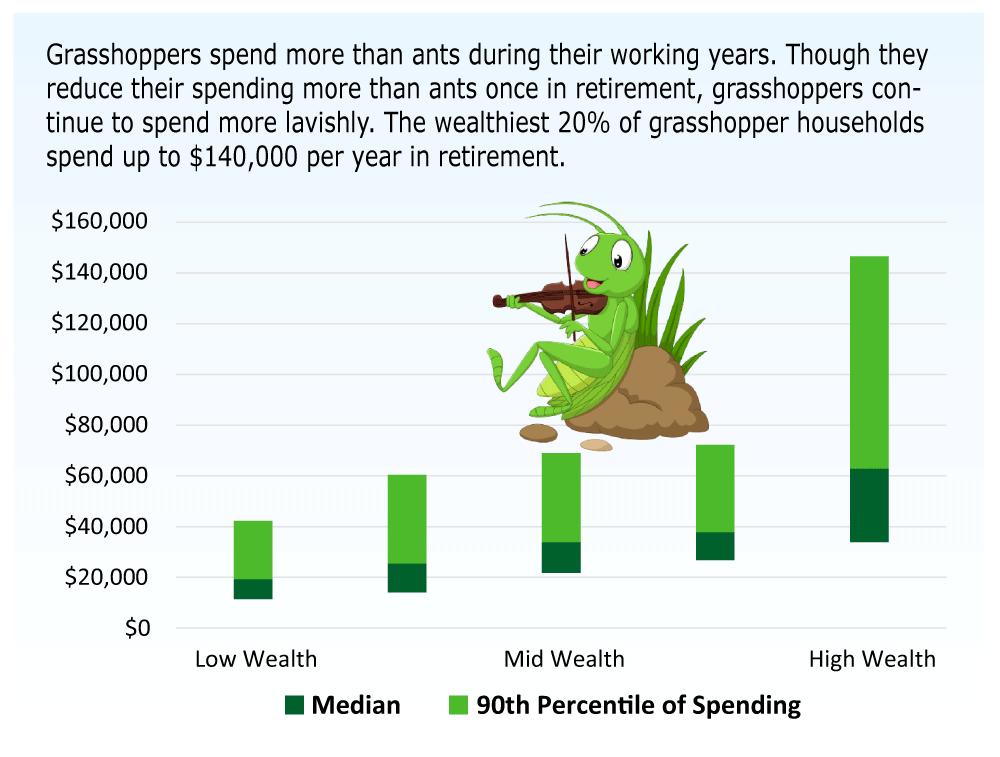
Grasshoppers who spend significantly more before retirement also spend significantly more after retirement. The amount they spend per year, however, falls faster than among the ants. The retired ants continue a slightly more modest version of the lifestyle they led during their working years. Controlling for demographic and financial characteristics, grasshoppers spend $10,225 more per year than ants.
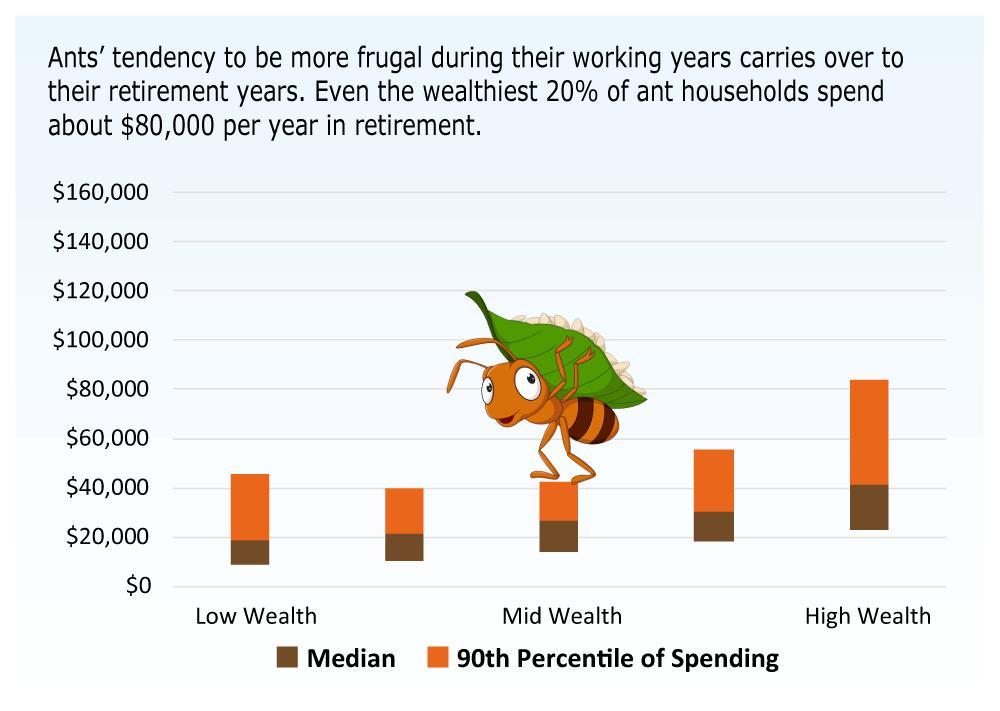
The grasshoppers spent much more lavishly than ants both when they were working and in retirement, but also see their lifestyle fall more rapidly in retirement. Among those in the top 20% of households by wealth, the 80th percentile of grasshopper households spend up to $140,000 annually compared to about $80,000 for the ant households.
What do grasshoppers spend more on in retirement? Controlling for other factors that predict spending, grasshoppers spent significantly more on non-durable spending categories and transportation. Non-durables include things like clothing, dining out, hobbies and vacations. Transportation includes mainly automobiles and auto-related expenses.
When ants receive a windfall in retirement (such as an inheritance), they spend about $5 more each year for each $1,000 they receive. When grasshoppers receive an inheritance, they spend an extra $260 per year. This means that when a grasshopper receives an inheritance, it will be completely spent within four years. We also find that most of the grasshoppers’ inheritance is spent in the non-durable and transportation categories.
Finally, we investigate whether having more annuitized income such as a pension increases spending by ants and grasshoppers. It is possible that a flow of lifetime income will allow ants to feel more comfortable spending money, which results in more similar spending patterns among ants and grasshoppers.
Grasshoppers spend an extra $417 for every $1,000 increase in annuitized income. Ants, on the other hand, only spend an additional $170 for each $1,000 increase in annuitized income. Again, grasshoppers spend most of this extra retirement income on non-durable goods.
High spenders before retirement are also high spenders after retirement—old habits are hard to break. These so-called grasshoppers will spend down an inheritance in about four years, while the more parsimonious ants will ultimately pass on an inheritance to their heirs. When a grasshopper has higher guaranteed income, he or she will spend it on non-durable goods and services and cars.
It is tempting for an ant to read these research results and feel some sense of affirmation of their conservative spending habits. However, the authors would like to remind the ants that Browning, Guo, Cheng and Finke found in their study that most retirees, especially wealthier ants, spend far less in retirement than theory would predict. Most in the top wealth quintile don’t spend down their money at all.
In fact, when we compare the spending of ant households to grasshopper households we find that grasshoppers are behaving much more like economically rational life cycle consumers than the ants. Why did the ants save up all that money if they’re not going to spend more in retirement? This is especially puzzling if ants don’t have a strong desire to pass this wealth on to their children or to charity.
It is also worth pointing out that grasshoppers seem to be doing a particularly good job of spending more on the consumption categories that provide the greatest life satisfaction according to previous scientific studies. For example, Thomas DeLeire and Ariel Kalil find that leisure spending (which falls within the non-durable category) provides significantly more happiness than spending on more longer-lasting items that may appear more prudent to an ant (“Does Consumption Buy Happiness? Evidence From the United States,” International Review of Economics, 2010).
Our findings suggest that those of us who are ants should feel some relief that we likely won’t run out of money in retirement, but we should also be aware that we’ve probably saved enough to live a little more like grasshoppers.
Portfolio Strategies

Financial Planning

M.Siddique MD from IL posted over 8 years ago:
Larry D from AE posted over 8 years ago:
Barry E from Kansas posted over 8 years ago:
Walter Curtis from IN posted over 8 years ago:
Kenneth Dodds from SC posted over 8 years ago:
Robert Bainbridge from AR posted over 8 years ago:
Larry from Oregon posted over 8 years ago:
Eric Bressler from MN posted over 8 years ago:
Eric Bressler from MN posted over 8 years ago:
S Alexander from OH posted over 7 years ago:
Jim Egbert from CO posted over 7 years ago:
You need to log in as a registered AAII user before commenting.
Log InCreate an account