
How ETF Shares Are Created, Redeemed and Traded

Unlike with mutual funds, which interact directly with investors, dollars flow from and to ETFs through intermediaries instead of investors.


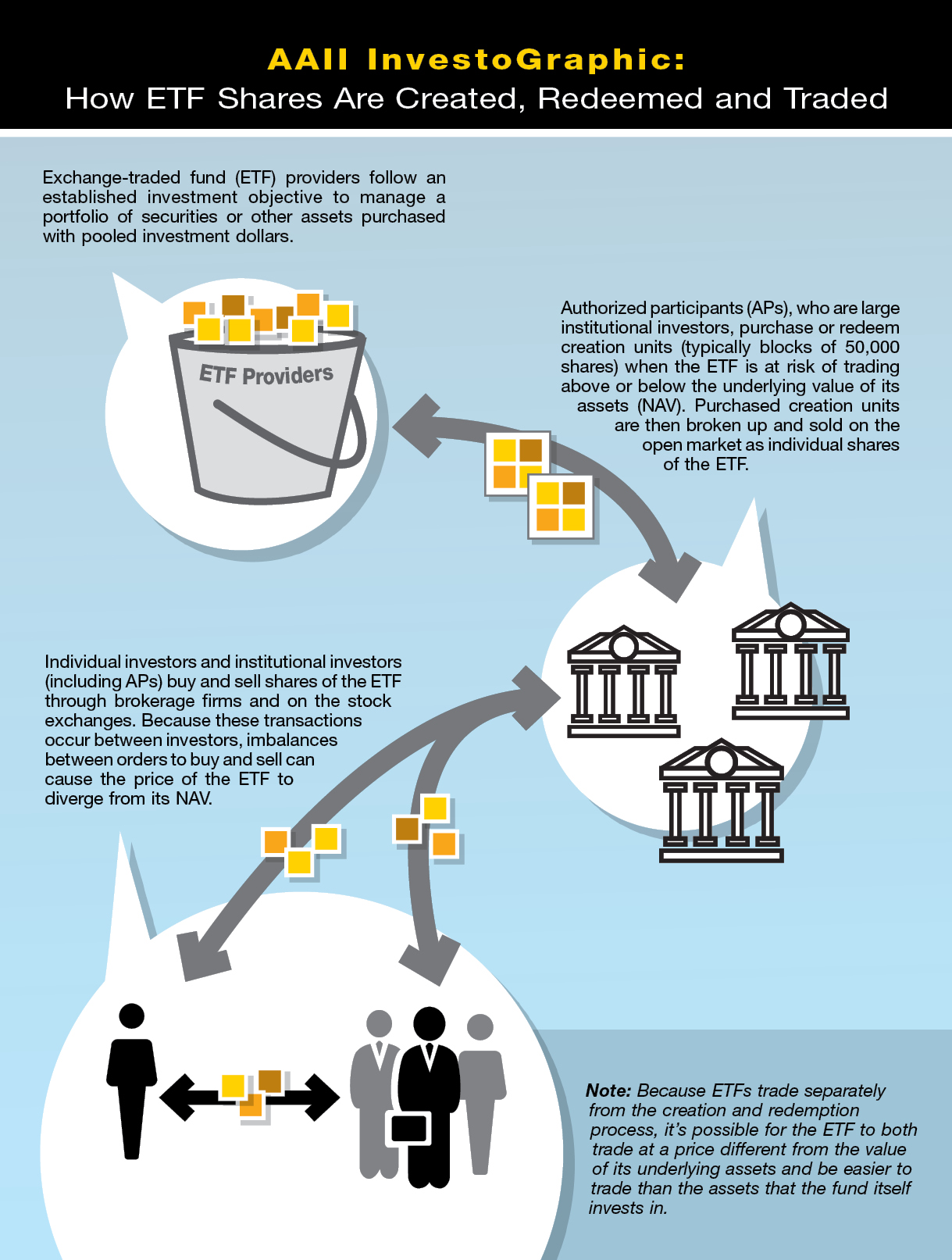
Exchange-traded fund (ETF) providers follow an established investment objective to manage a portfolio of securities or other assets purchased with pooled investment dollars.

Authorized participants (APs), who are large institutional investors, purchase or redeem creation units (typically blocks of 50,000 shares) when the ETF is at risk of trading above or below the underlying value of its assets (NAV). Purchased creation units are then broken up and sold on the open market as individual shares of the ETF.

Individual investors and institutional investors (including APs) buy and sell shares of the ETF through brokerage firms and on the stock exchanges. Because these transactions occur between investors, imbalances between orders to buy and sell can cause the price of the ETF to diverge from its NAV.

Note: Because ETFs trade separately from the creation and redemption process, it’s possible for the ETF to both trade at a price different from the value of its underlying assets and be easier trade than the assets that the fund itself invests in.


Discussion

Jim Wood from SC posted over 7 years ago:

As an investor who is looking to buy mostly index funds to be held for the long run, I am trying to understand if one is better off investing in ETFs or mutual funds and I still do not have an answer.


Charles Rotblut from IL posted over 7 years ago:

Jim, There isn't a single universal answer. ETFs are generally better for taxable accounts. Mutual funds allow you to invest the full amount because you can by partial shares, whereas with ETFs, you could be left with some odd dollar amount left uninvested. You should also consider costs. Fidelity has no-expense ratio index mutual funds (they're new and I don't much about them.) Vanguard's admiral share class has the same expense ratio is its ETFs for, say, the S&P 500 funds. Depending on where your account is, you may or may not incur commissions. I would do what you feel most comfortable with, while considering the fees and costs you may incur. With traditional index funds, the difference between ETFs and mutual funds isn't generally very big, though you should you still closely at what you're buying before doing so. Hope this helps, Charles


Christopher Michaels, ETFOptimize.com from CO posted over 7 years ago:

Jim – Other considerations when comparing index-based ETFs to index-based Mutual Funds include 1) Ample Liquidity, 2) Low Spreads (bid vs. ask price), and 3) Trading whenever the market is open. ETFs can be traded throughout the day, whenever the stock market is open, and have prices that fluctuate based on supply and demand between buyers and sellers. On the other hand, Mutual Funds are usually only priced once-a-day, and you trade with the fund manager, after the close of each market session, based on the value of the underlying shares of stock owned by the fund. ETFs have designated traders (usually institutional investors), who serve the purpose of arbitraging the price of ETFs throughout the day to keep it in line with the value of the underlying assets it owns. Because most ETFs are open-ended funds, shares can be added or eliminated at any time based on supply and demand, which offers price stability, facilitates ease of trading, and eliminates the problems of thinly traded investment assets. Mutual fund managers, on the other hand, can be forced to sell the underlying assets (usually stocks) when there are significant numbers of investors who want to sell their shares. For this reason, many mutual funds have minimum holding periods. ETFs have no minimum holding time, facilitating trades at your discretion, and because they are exchange-based, ETFs can be bought or sold anytime the market is open and generally, have low bid-ask spreads. For these reasons and more, ETFs have been the fastest growing investment product in 100 years, with investors expected to pour more than $1 trillion into ETFs this year.


John Hallquist from TN posted over 6 years ago:

Vanguard has mutual funds with an ETF share class. Their semi-annual report lists numbers of issued ETF class shares, as well as those of the various investor classes. How does a mutual fund have an ETF share class? Does that class work like an ordinary ETF? This question has puzzled me for about 18 months.


You need to log in as a registered AAII user before commenting.
Create an account

Log In

Get your free copy of our special report analyzing the tech stocks most likely to outperform the market.

Download the FREE Report Here: