


Having a retirement account is important for all individuals, irrespective of age. Do not make the common mistake of thinking that planning and saving for retirement can be put off until you are older, because the opportunity cost is too great—you’ll miss out on all the benefits you deserve.
Achieving a comfortable retirement is by no means a simple process, but with the appropriate planning, time commitment and desire, an enjoyable retirement life is attainable. Retirement management does not stop once you select a plan, and it does not stop when you are deep into your golden years. The process is ongoing and requires proper responsibility and due diligence throughout an individual’s life.
Fortunately, technology has made saving for retirement easier than ever before. A process that used to require a lot of paperwork has now become accessible with the click of a mouse. The ability to set up retirement accounts online allows individuals to easily and simply manage assets that are being accumulated for retirement. As technology advances and more people of all generations are becoming adept with computers and the internet, setting up a retirement account online is not only easier, but also more accessible.
While online brokerages have made handling your retirement accounts less time-consuming and easier to navigate, that does not mean that no research or analysis needs to be put in the process. The first steps are understanding the different types of retirement accounts, deciding which account fits you best, and then actually setting up the account. This article discusses different types of retirement accounts and then walks through the process of setting a retirement account up online.
Types of Retirement Accounts
Employer-Sponsored Plans
There are two overarching types of retirement plans: employer-sponsored plans, and personal retirement plans. The benefits of employer-sponsored retirement plans include tax breaks, savings deducted directly from your paycheck, and for some plans, matched contributions from your employer. These plans help not only employees, but employers as well. Employees gain from the low-cost nature of the plans and employers benefit through increased employee loyalty and reduced employee turnover, leading to better retention of top-performing employees.
Defined-benefit plans (pensions) were the most popular type of employer-sponsored retirement account until the 1970s. These plans have since been largely replaced by defined-contribution plans, otherwise known as a 401(k) plan or 403(b) plan. Defined-benefit pension plans do not require employees to contribute anything: A defined-benefit plan provides a specified monthly amount to an employee in retirement. The employer controls the amount added to the pension investment each year based on a complex formula including a particular employee’s years with the company, salary and expected years in retirement. Since the employer supplies all the contributions to the plan, employees have no power over investment decisions, or administration of the plan in general. Employers are subject to risk, as opposed to employees. The package also has restrictions limiting when and how much the employee can withdraw from the plan.
Today the most common employer-sponsored retirement plan is the 401(k) plan. This plan is offered mostly by for-profit businesses. Unlike defined-benefit pension plans, 401(k) plans are mainly funded by the employee. That being said, many plans include a matched contribution, which means that the employer will contribute a specific percentage of the employer’s contribution to the plan. Also different from defined-benefit pension plans, the employee has complete control of their 401(k) plan, not the employer. This means that the employee determines what investments to include in their plan. Furthermore, the employee has complete autonomy over the funds once they reach retirement. Along with this, however, the employee bears the investment risk. Another benefit of a 401(K) plan is that all employee contributions are tax deductible in the year they are made, and investment earnings accumulate on a tax-deferred basis. The distributions only become taxable as ordinary income when the employee retires and begins withdrawing funds.
A Roth 401(k) plan is another example of an employer-sponsored defined-contribution retirement plan. The main difference between this and a traditional 401(k) plan is the fact that there is no tax deduction for contributions into Roth 401(k) plans; contributions are made aftertax.
Just to reiterate, Roth 401(k) accounts are taxed prior to retirement (contributions are aftertax), and traditional 401(k) accounts are not taxed prior to retirement (contributions are pretax). Roth 401(k) account withdrawals in retirement are tax free, while traditional 401(k) account withdrawals are taxed. Typically, traditional 401(k) withdrawals are taxed (in retirement) at the tax bracket that the account holder was in right before retiring. Therefore, Roth 401(k)s are well-suited for individuals who expect to be in a higher tax bracket in retirement than they are now (people who expect their salary to grow over time). Unfortunately, not all employers offer a Roth 401(k) option.
For both the traditional 401(k) plan and the Roth 401(k) plan, annual contributions are limited to a maximum of $18,000 for 2016. Thanks to the catch-up provision, employees who are 50 years of age or older are allowed to contribute an additional $6,000 for 2016. Annual contribution limits are subject to possible increases in the future years for cost-of-living adjustments, according to the Internal Revenue Service (IRS). Limits can also vary based on an individual’s marital status. More specific details and updates regarding yearly figures can be found at the IRS website.
The 403(b) plan, also known as a tax-sheltered annuity (TSA) plan, is nearly identical to the 401(k) plan except that it is specifically for nonprofit organizations and not for-profit businesses. Examples of institutions that offer this plan are public school systems, churches, and welfare service agencies. All other details of the plan are identical to those of the 401(k) plan.
State and local government employees are eligible for the 457 plan, which is also nearly identical to the traditional 401(k) plan in terms of its taxation and distribution. Both plans limit contributions to $18,000 in 2016, but some employers offer both the 457 and 401(k) plan. If this is the case, the employee can contribute the maximum in each plan for a total of $36,000 in 2016. Essentially, employees who qualify for the 457 plan can have two retirement plans [if their employer offers the 401(k) plan too] without penalty. Be aware that these figures can change on an annual basis, so it is important to access the IRS website and check your plan’s contribution limits every year.
The Savings Incentive Match Plan for Employees (SIMPLE) plan is another example of an employer-sponsored retirement plan. This IRA plan is typically offered by smaller employers. In the SIMPLE plan, employees make tax-deductible contributions, like the traditional 401(k) plan. The employer is then required to either match the employee contributions up to 3% of the employee’s salary or make non-elective contributions. Non-elective contributions are when an employer contributes a percentage (currently 2%) of every employee’s salary to their retirement plans whether or not the employee is contributing. (Elective contributions are essentially matching contributions, which means the employer matches as much as the employee does to their account.) Smaller than the traditional 401(k) plan, $12,500 is the maximum contribution amount in 2016 for SIMPLE plans. A catch-up provision is also applicable for this plan, allowing any employee who is 50 years or older to make additional contributions of up to $3,000 in 2016. Employees are allowed to hold more than one retirement plan, but unlike the 457 plan, individuals holding a SIMPLE IRA plan are limited to a total contribution of $18,000 in 2016 for all plans combined. Again, the IRS may change contribution limits based on future cost-of-living levels.
The final employer-sponsored retirement plan of note is the Simplified Employee Pension (SEP) plan, also known as the SEP-IRA plan. This plan has similar requirements to the traditional 401(k) plan in terms of investment and distribution. However, contribution limits are much higher for SEP plans, as contributions are limited to the lesser of 25% of compensation or $53,000 for 2016. Similar to the SIMPLE plan, employees are allowed to have other retirement plans, but are not allowed to go over the maximum $53,000 contribution limit (all plans combined).
Keep in mind, you are limited to using whatever plans your employer offers. Some companies offer a choice of different account types, but many do not. But any retirement account is better than no retirement account.
Personal Retirement Plans
Personal retirement plans are the second major type retirement accounts. The two central personal retirement plans are traditional IRAs and Roth IRAs.
Traditional IRAs (individual retirement accounts) allow an individual taxpayer to place pretax income toward investments that grow tax-deferred. Individual taxpayers can contribute a specified maximum dollar amount to their traditional IRA. If an individual has both a traditional IRA and 401(k) plan, they cannot deduct IRA contributions from taxable income if annual income is over $71,000 individually or $118,000 with a spouse. These amounts may be changed annually and can be found on the IRS website. AAII’s annual Tax Guide also reports IRA contribution limits for the current and next tax years.
Roth IRAs differ from traditional IRAs in that contributions are not tax deductible, but qualified distributions (if the taxpayer is at least 59.5 years old and has had Roth IRA plan for at least five years) are tax free. Prior to retirement, contributions are tax free for traditional IRA accounts, while Roth IRA contributions are made aftertax. Once in retirement, taxes kick in for traditional IRA withdrawals, while Roth IRA withdrawals are tax free. Specifics regarding eligibility requirements can be found on the Retirement Plans section of the IRS website.
After deciding which retirement plan best fits your needs, it is then necessary to decide which online brokerage firm to use for your retirement account. Some of the top account providers are TD Ameritrade, Charles Schwab, E*Trade, Fidelity Investments, and Vanguard.
To get more information about particular brokerage’s retirement services, never hesitate to call the specific broker with any questions. Additionally, AAII polls members on their experience with discount brokers and what they feel is important when selecting a broker. For the current results of AAII’s Online Discount Broker Survey, click here.
Vanguard, widely known for its low-cost index funds and exchange-traded funds (ETFs), is a major online brokerage that offers top services. This company has a $0 account minimum, making it a friendly service for all investors. It charges a commission fee of $7 for the first 25 trades per year and $20 for subsequent trades. Its investor education and overall fund performance make Vanguard the reputable brokerage it is.
Setting up the Retirement Account
Once you have chosen a retirement account and brokerage, it is time to set up the actual retirement account.
Vanguard was kind enough to provide me with a walkthrough demo of their process. The images below are what you’d see if you created a retirement account through their online platform.
Step 1: New account versus existing account
Most people open a new account, but if you’d like to conduct a rollover (transfer retirement assets from one plan to another) or move assets held elsewhere to a different brokerage, this is where you would make that decision. For the purposes of this article, I selected “open a new account.”
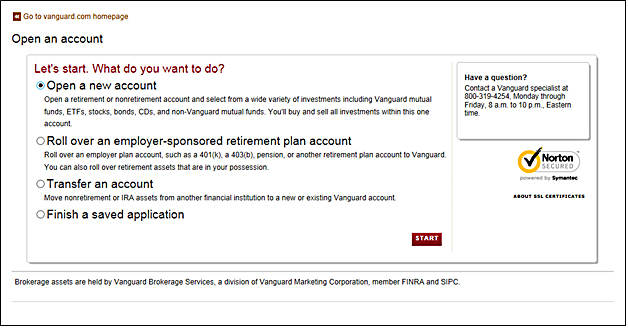
Step 2: Begin creating the account
Create a Vanguard account if you do not have one already. Sign in if you do have an account with Vanguard.

Step 3: Collect personal information
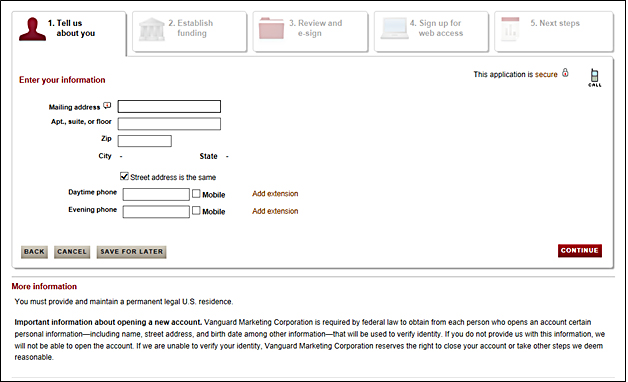
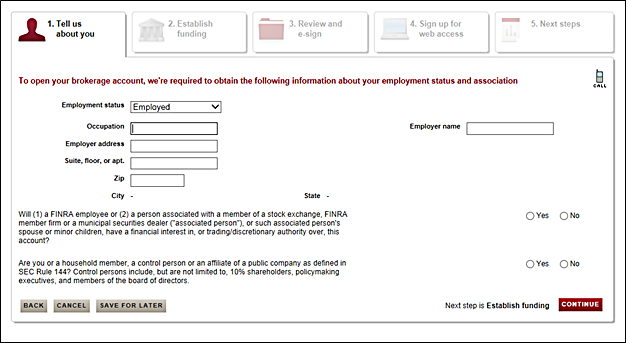
Make sure you have the personal information that they are asking for below in order to make the process smooth and quick. Be prepared to submit sensitive information such as your Social Security number, bank account information, and address.
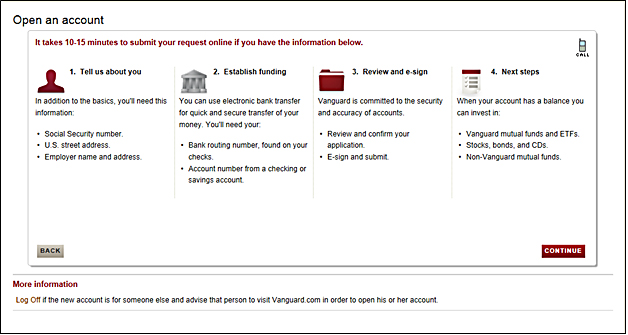
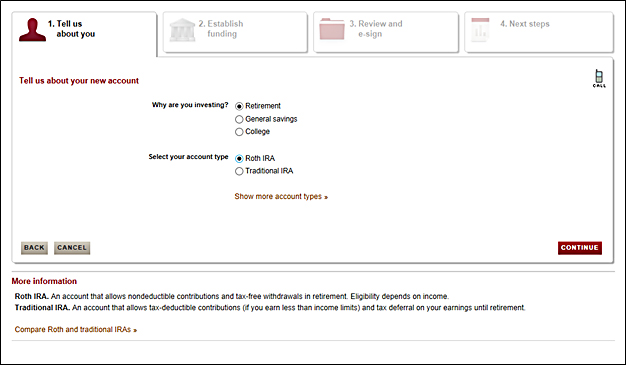
Step 4: Indicate the reason you are investing
For the purposes of this article, I selected “retirement.” You will also have to decide what account type you want. Remember, contributions to traditional IRAs are tax-deductible. Only distributions from the account are taxed as personal income. For Roth IRAs, contributions are not tax-deductible, but distributions are tax-free. I selected “Roth IRA,” but the signup process is the same no matter which account type you select.
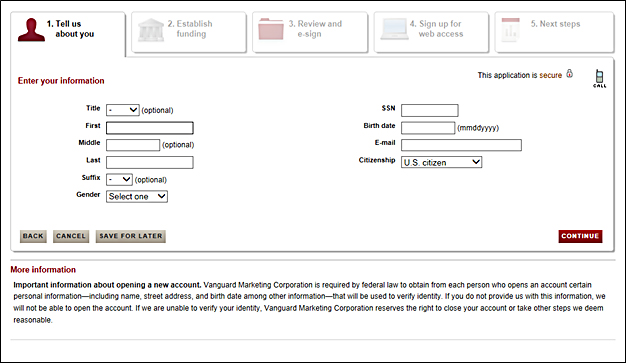
Step 5: Enter personal information
Be sure the website is secured (the URL in your browser should begin with https) and you are on a trustworthy server, since you will be submitting sensitive information such as your Social Security number, address, and date of birth. Typically, if a site is secure, you should see a lock symbol in front of the web address.
Step 6: Select your funding method
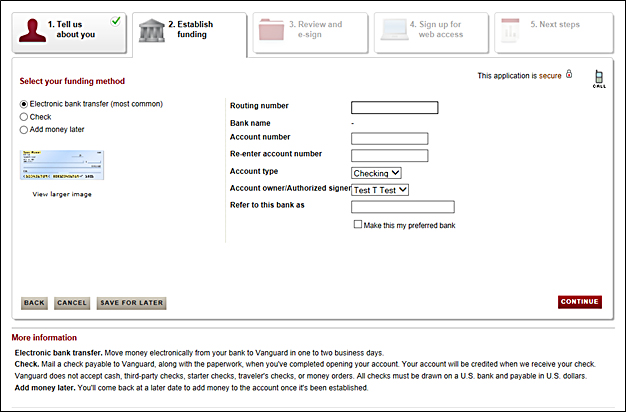
Electronic bank transfer is the most common and easiest method of payment since the processing takes roughly two business days, but you can always submit a check or add money later.
Step 7: Enter contribution amounts for your Roth/Traditional IRA account
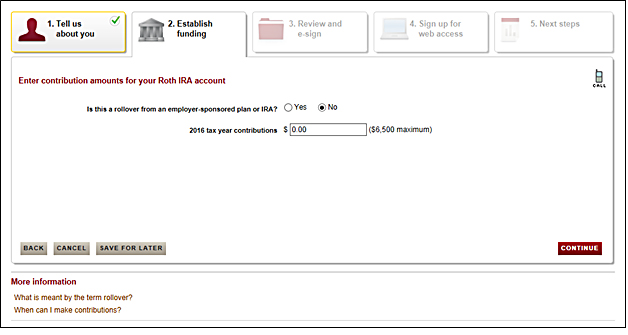
Be sure to select whether the contribution is a rollover from an employer-sponsored plan or IRA. The 2016 tax-year contributions to both traditional and Roth IRAs are limited to a maximum of $5,500 ($6,500 for those 50 and older). Contribute what you can afford, but do your best to contribute as much as possible. A general rule of thumb is 10% of pretax income.
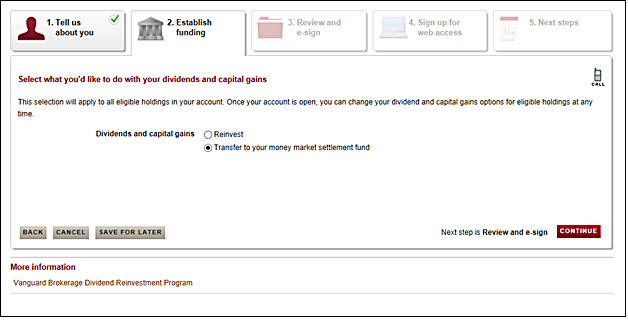
Step 8: To reinvest or not to reinvest
Decide whether you’d like to reinvest your dividends and capital gains or transfer them to a money market fund. This is an individual investment decision that is different for everybody. Typically, if you are a long-term investor, you might select “reinvest” so you can put the dividends and capital gains to work and reap the investment rewards in the long term. Reinvesting dividends and capital gains also has tax benefits in the case of a Roth IRA account. If you are a retiree or nearing retirement, you might rather select “transfer to your money market settlement fund.” This is a good choice for retirees who need income because it helps liquidate dividends and capital gains. This strategy can also help investors rebalance their portfolio back to target allocations. Or, an investor may want to just hold on to cash until they find an enticing investment opportunity. At the end of the day, it is all about your time constraints and how much risk you are willing to take. For more information on dividend reinvestment, see Tapping Into the Dividend Well: Reinvesting With DRIPs.
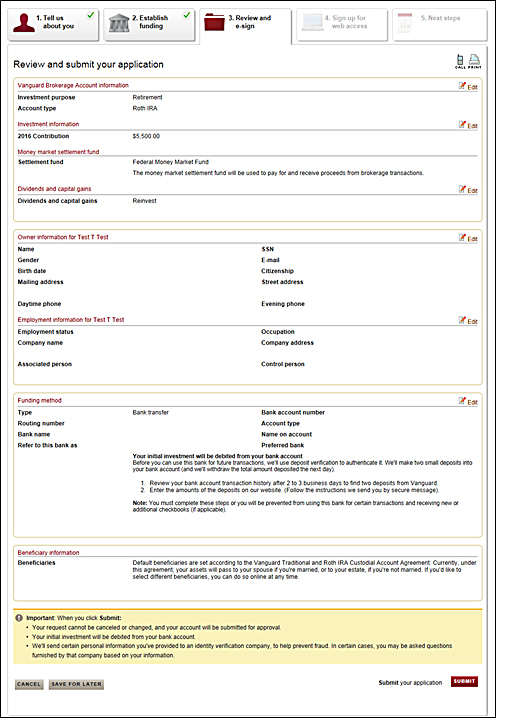
Step 9: Verify your information
Make sure all the information you submitted is correct and then submit the application to start your account. After completing this, you will be directed to complete the Vanguard-specific process of signing up for web access. The next steps to complete your retirement account are to make sure your account has a satisfactory balance and then determine what securities you want to invest in (choosing funds will be covered in an upcoming CI edition).
Conclusion
Retirement planning can be stressful and challenging without the proper knowledge and appropriate commitment. That being said, online brokerage firms have made saving for retirement easier than ever before. With the proper understanding, setting up a retirement account online is simple and takes only about 15 minutes. Even though the process has become easier, individuals still need to conduct the proper research to determine which retirement plan and online brokerage firm is best for them. It’s important because this investment can pay off substantially in the future, allowing an individual to enjoy retirement with great leisure and satisfaction.
Discussion
FREE REPORT

No comments have been added yet. Add your thoughts to the discussion!
You need to log in as a registered AAII user before commenting.
Log InCreate an account