


Related

Investor Professor
by Wade Pfau | September 2017

This article is an excerpt from Pfau’s book, “Reverse Mortgages: How to Use Reverse Mortgages to Secure Your Retirement” (Retirement Research Media, 2016).
A home equity conversion mortgage (HECM) line of credit provides a tool that can be used to mitigate the impacts of sequence of returns risk (the risk of incurring portfolio losses early in retirement).
Since 2012, a series of research articles has highlighted how the strategic use of a reverse mortgage can either preserve greater overall legacy wealth for a given spending goal or otherwise sustain a higher spending amount for longer in retirement. Maintaining higher fixed costs in retirement increases exposure to sequence risk by requiring a higher withdrawal rate from the remaining assets. (A period of down markets reduces the value of the portfolio, requiring a larger percentage of the remaining assets be withdrawn to fund the same absolute level of portfolio income.) Drawing from a reverse mortgage has the potential to mitigate this aspect of sequence risk by reducing the need for portfolio withdrawals either generally or just at inopportune times.
The conventional wisdom on how to treat housing wealth in retirement was to preserve it as a last resort option. If it did not need to be used to help fund retirement, the home may be left as part of the legacy for the next generation. However, starting in 2012, a series of articles published in the Journal of Financial Planning investigated how obtaining an HECM reverse mortgage early in retirement and then strategically spending from the available credit can help improve the sustainability of retirement income strategies.
We can think of legacy wealth at death as the combined value of any remaining financial assets plus the remaining home equity once the reverse mortgage loan balance has been repaid. The mathematical formula is:
Legacy Wealth = Remaining Financial Assets + [Home Equity – minimum(Loan Balance, 95% of Appraised Home Value)]
If we do not worry about the percentage breakdown between these two categories, research reveals the possibility of sustaining a spending goal while also leaving a larger legacy at death. Strategically using home equity can lead to a more efficient strategy than the less flexible option of viewing the home as the legacy asset that must not be touched until everything else is gone. This analysis provides a way to test whether the costs of the reverse mortgage—in terms of the upfront costs and compounding growth of the loan balance—are outweighed by the benefits of mitigating sequence risk. Strategic use of a reverse mortgage line of credit is shown to improve retirement sustainability, despite the costs, without adversely impacting legacy wealth.
Based on his personal research going as far back as 2004, tax attorney Barry Sacks got the ball rolling and received widespread recognition for ideas presented in a research article he published with his brother Stephen in the February 2012 issue of the Journal of Financial Planning (“Reversing the Conventional Wisdom: Using Home Equity to Supplement Retirement Income”). Barry Sacks is to supplementing retirement spending with a reverse mortgage line of credit as financial planner William Bengen is to the 4% rule for retirement withdrawals. [Bengen’s 4% rule holds that retirees have a high probability of not outliving their savings if they limit their initial withdrawal at retirement to 4% of their portfolio. Each year thereafter, the initial withdrawal amount is adjusted upward for inflation.] Sacks was thinking over a decade ago about how people could use housing wealth as a type of volatility buffer to help mitigate sequence of returns risk.
The aptly named article that these brothers wrote set out to present the reverse mortgage option as something more than a last resort.
The title states their objective clearly. Sacks and Sacks investigated sustainable withdrawal rates from an investment portfolio coupled with home equity to determine whether asset depletion takes place when using three different strategies for incorporating home equity into the retirement income plan:
They reversed the conventional wisdom by using Monte Carlo (multi-scenario) simulations to quantify how Strategy 2 and Strategy 3 enjoyed a higher probability for success and could be sustained longer than Strategy 1. Sacks and Sacks also found that the remaining net worth of the household (the value of their remaining financial portfolio plus any remaining home equity) after 30 years of retirement was twice as likely to be bigger with an alternative strategy than with the conventional wisdom of saving home equity to be used last.
For withdrawal rate goals between 4.5% and 7.0% of the initial portfolio balance at retirement, the residual net worth after 30 years was 67% to 75% more likely to be higher with a coordinated strategy than with a strategy using the reverse mortgage as a last resort. In other words, spending home equity did not ruin the possibility for leaving an inheritance. Instead, the opposite was true.
How is this the case? Essentially, Strategies 2 and 3 provide a cushion against the dreaded sequence of returns risk that is such a fundamental challenge to building a sustainable retirement plan. When home equity is used last, retirees are spending down their volatile investment portfolio earlier in retirement and are more exposed to locking in portfolio losses, more easily leading them on the path to depletion.
With Strategy 2, if home equity is spent first, the financial portfolio is left alone in the interim, providing a better chance to grow. By the time home equity is spent, retirees will be able to continue a given spending amount in their retirement using what will likely be a lower percentage withdrawal rate from what should be a larger portfolio. Sacks and Sacks quantify that the costs and interest paid on the reverse mortgage, while substantial, are less than the benefits the strategy provides to retirees and their beneficiaries.
Strategy 3 provides a more sophisticated technique to grapple with sequence of returns risk by only spending from the reverse mortgage line of credit when the retiree is vulnerable to locking in portfolio losses: Spend from the line of credit only after years in which the financial portfolio has declined.
Sacks and Sacks make clear that their point is not that all retirees should take a reverse mortgage. Rather, retirees who wish to remain in their homes for as long as possible should view a reverse mortgage as more than a last resort. If a retiree decides to spend at a higher level, which could lead to portfolio depletion (meaning outliving their savings) and possibly require them to also generate cash flows from their home equity, there is indeed a better way.
In a sign that the time had finally come for the idea of coordinated spending from a reverse mortgage, Harold Evensky, Shaun Pfeiffer and John Salter of Texas Tech University followed suit with two articles—beginning with the August 2012 issue of the Journal of Financial Planning—investigating the role of a standby line of credit. They developed conclusions quite similar to the Sacks brothers without knowing of their work.
Evensky said the motivation for their research came about when the home equity line of credit (HELOC) he had established as a source of liquidity for his clients kept getting cancelled during the financial crisis in 2008. The reverse mortgage line of credit was guaranteed to be there even in times of market stress. Evensky et al wrote, “Although reverse mortgages aren’t for everyone, the reluctance to consider use of reverse mortgages in the distribution phase limits the flexibility of distribution strategies.”
Their first article in 2012 investigated the use of an HECM Saver line of credit (which had lower costs, but was later merged with the HECM Standard in September 2013) as a ready source of cash to be used as a risk management tool for retirement distributions. The purpose of their research was in line with that of Sacks and Sacks: to test portfolio sustainability using Monte Carlo simulations when portfolio distributions are coordinated with a reverse mortgage.
With a similar objective in mind, Evensky et al developed a coordinated strategy to better approximate using the reverse mortgage when the portfolio was in jeopardy. Rather than drawing from the reverse mortgage standby line of credit after years of market downturns, they instead drew from the line of credit whenever the remaining portfolio balance fell below the value indicated by a separate wealth glide path calculation. [A wealth glide path is the projected change in an investor’s wealth given projected income, returns and savings contributions/withdrawals.] They determined the amount of remaining wealth required for each year of retirement to keep the spending plan on a sustainable path through the desired planning horizon. After experimenting with this critical path for remaining wealth, they determined that drawing from the reverse mortgage worked best when remaining wealth fell to less than 80% of the wealth glide path. This helped avoid overuse of the line of credit, while still providing a mechanism to avoid selling financial assets at overly depreciated prices, thereby helping mitigate sequence of returns risk.
Another difference between this research and that of the Sacks brothers is that whenever remaining wealth grew enough to be back above the 80% barrier for their critical path trajectory, Evensky et al worked to preserve a larger line of credit for future use by paying back any outstanding balance on the reverse mortgage’s line of credit throughout retirement. This contrasted with Sacks and Sacks, who made no voluntary repayment during retirement.
Evensky has heralded the value of using cash reserves to mitigate sequence risk since the 1980s. Cash provides a drag on potential portfolio returns, but its presence serves as an alternative choice to finance spending and avoid selling other assets at a loss. He suggested having two years of spending in a separate bucket and investing the remaining funds with a total return (growth and income) investment perspective. He viewed this as a compromise between the offsetting factors of the drag on returns created by holding more cash and not completely protecting the remaining portfolio if market declines lasted longer than two years.
The reverse mortgage research of the two articles written by Evensky et al follows along the same path, with the line of credit used in place of a larger cash reserve. In the 2012 article, they replaced the two-year cash reserve with a six-month cash reserve and used the line of credit to refill the reserve when necessary, as shown in Figure 1. Doing so reduces the cash drag and provides a source of funds not impacted by declining market returns. This, in turn, allows funding to last substantially longer than two years.
Their approach to choosing when to tap the HECM line of credit establishes decision rules that keep better track of cumulative outcomes, so it makes intuitive sense. Their 2012 research uses the line of credit as a source of funds only when the portfolio is below the mark set by the glide path and the cash reserve bucket has been depleted.
As with Sacks and Sacks, Evensky et al found that using the standby line of credit improved portfolio survival without creating an adverse impact on median remaining wealth (including remaining home equity). This provided independent confirmation that the reverse mortgage line of credit can help mitigate sequence of returns risk without impacting legacy goals. They also confirmed that having a larger line of credit [either through a greater home value or a higher principle limit factor (PLF)—the percentage of a home’s appraised value that can be borrowed—with lower interest rates] relative to the portfolio size heightens the likelihood of sustaining a positive portfolio balance. As a result, these strategies were shown to be more attractive in low interest rate environments. Evensky et al concluded that a standby line of credit deserves a role in mainstream retirement income planning for four reasons:
In December 2013, the same authors returned with a second study on using a standby line of credit for retirement income planning. This time, Evensky et al shifted the focus to how much the sustainable withdrawal rate could be increased with a line of credit while maintaining a 90% success rate of not outliving savings over a 30-year retirement. They confirmed that the standby line of credit helps sustain higher withdrawal rates when retirement starts in a low-interest-rate environment and/or the home is worth more than the investment portfolio.
Consistent with other withdrawal rate research using below historical average capital market expectations, Evensky et al calculated that the sustainable spending rate without a reverse mortgage is 3.25%. With a reverse mortgage, the withdrawal rate can reach 6.5%. This highest number happens when the home value matches the portfolio size and interest rates are low at the start of retirement. Since the HECM Saver no longer existed on its own, the latter article by Evensky et al article considered the new form of reverse mortgages, which still exists today. Otherwise, assumptions are the same as in their previous article. They note that these higher withdrawal rates are on par with those obtained through dynamic spending strategies that can involve substantial spending reductions over time, but that the HECM strategy can sustain the higher spending rate without such reductions.
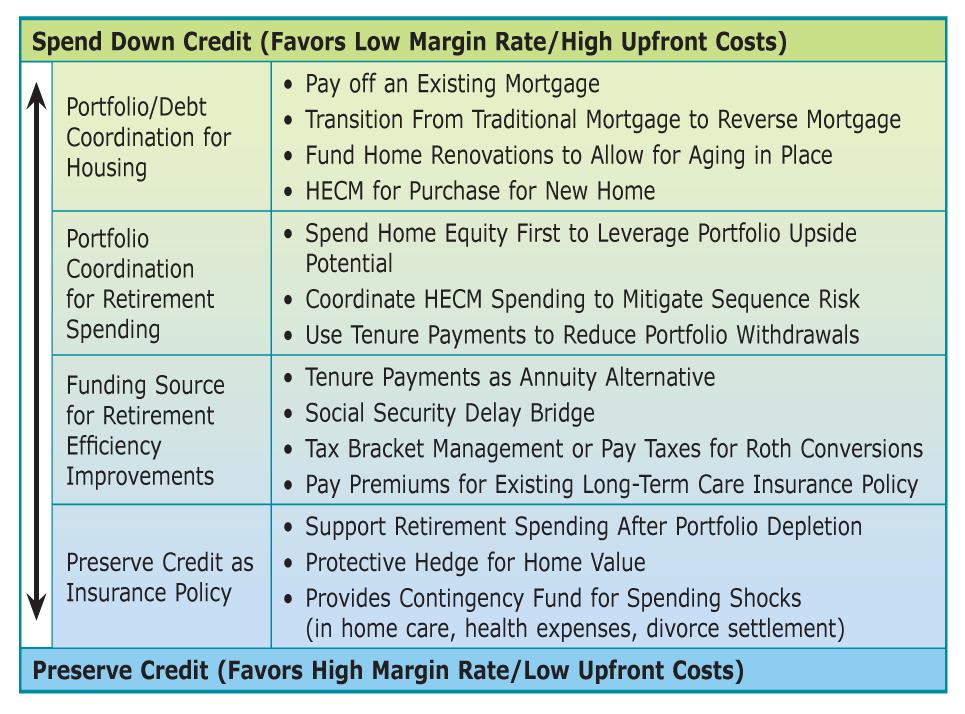
While the primary focus of reverse mortgage research has been on coordinating a reverse mortgage with the investment portfolio for retirement spending to help manage sequence of returns risk, reverse mortgages may fit into a retirement income plan in numerous ways. Table 1 categorizes the different potential uses for a reverse mortgage in addition to the portfolio coordination strategies that I have described.
Investor Professor
Portfolio Strategies
Portfolio Strategies

Charles Rotblut from IL posted over 9 years ago:
You need to log in as a registered AAII user before commenting.
Log InCreate an account