

Retirement Withdrawal Planning Worksheet
by Charles Rotblut | September 24, 2020
Charles Rotblut recently spoke at the AAII Investor Conference 360. Video replays of all sessions are available for purchase. Go to www.aaii.com/investorconference for more details.

Retirees using the 4% rule or the AAII Level3 withdrawal approach have a few considerations to take into account. They include how much to withdraw each year, what the year’s required minimum distributions (RMD) are, how the RMD compares to the planned withdrawal amount and whether to sell stocks to replenish the cash portion of retirement savings.
This worksheet will help you work through these considerations. It is split into three parts. The first part is for retirees who use the 4% rule. It includes a field to calculate the annual inflation adjustments.
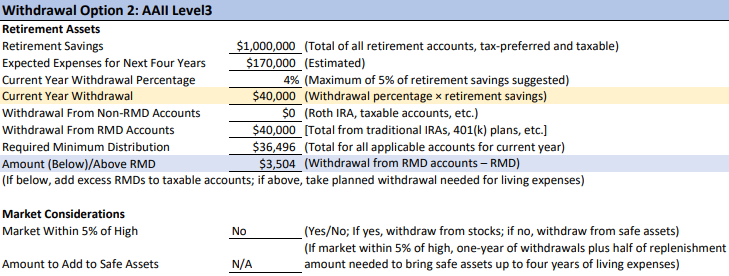
The second part will assist retirees who are following the Level3 withdrawal approach. It includes fields for estimating four years of expenses and for determining the current year’s withdrawal percentage.
The third part addresses market conditions. The creators of the two approaches—William Bengen (4% rule) and James Cloonan (Level3)—both suggest that retirees do not sell stocks when the markets are down. Cloonan further suggests replenishing safe assets (e.g., cash and cash equivalents) once the market has rebounded.

PDF worksheet available for download.

Excel worksheet available for download.
Example: Recently Retired Couple Comparing Both Withdrawal Strategies
Laura and Allison are a recently retired couple. They have $1 million in retirement savings, all of which is held in accounts subject to the RMD rules. They estimate that their annual living expenses will require a withdrawal of $40,000 during the first year of retirement after accounting for their guaranteed sources of income (Social Security, pensions, etc.). We’ve assumed they are 70½ and the pre-2020 RMD rules apply for the purposes of demonstrating the worksheet.
As part of their planning process, they choose to look at both methods to decide which option they will choose. An actual retiree or couple will want to opt for one strategy or the other. The Level3 approach is designed for those who are willing to accept greater volatility in returns in exchange for greater wealth. Bengen’s approach is a more traditional approach of taking withdrawals and one espoused by many financial planners.

Discussion
Mary Jo D from GA posted over 6 years ago:
Here's a challenge. Use an example of a single woman with $250000 savings and median SS income. No pension. $1million, indeed!
G B from WA posted over 6 years ago:
It seems that the worksheet should include a line for guaranteed income like Social Security or a pension. It looks like the worksheet assumes all income comes from investments.
ROBERT C from NY posted over 6 years ago:
A major problem, especially in a state as New York, is the consideration of taxable amounts withdrawn and the cost of withdrawing excess amounts above RMD. Each dollar withdrawn is taxable and if you need to withdraw additional taxable amounts to cover the taxes - those withdrawals are taxable - and on, and on.
John A from CT posted over 5 years ago:
I agree with all comments, worksheet is worthless
You need to log in as a registered AAII user before commenting.
Create an account