Environmental, social and governance (ESG) refers to the three central factors used in measuring the potential environmental and social impact of an investment in a company or type of business. ESG investing is rapidly evolving from a niche corner of the investment landscape into the mainstream. A+ Investor subscribers have access to predefined exchange-traded fund (ETF) and mutual fund screens that seek funds classified as following a socially responsible approach to investing.
Historically, ESG investing sought to align investors with “moral” issues, excluding certain companies or sectors from a fund or portfolio because of the perception that their business had broader negative implications for society and that businesses shouldn’t be evaluated only from a standpoint of financial return. Tobacco and oil stocks are two common examples.
The field has broadened in scope in recent years to include factors such as shareholder advocacy, community investment (deposits at banks, credit unions and other financial institutions whose mission is to serve low- and middle-income communities), as well as targeted “impact” investments in the private markets.
Funds are now actively seeking to include companies or sectors considered to have “best-in-class” ESG performance metrics relative to their industry peers. BlackRock Inc.  (BLK), the investment manager behind the iShares ETFs and one of the largest investors in the world, announced a strategic shift in 2020 in which it would make a series of moves to account for the long-term ESG risks in its investments.
Changes such as those made by BlackRock go against the longstanding perception that excluding certain sectors and companies from a portfolio can have a negative effect on investment return and diversification. An increasing amount of research has countered this notion—particularly for funds that use ESG screens to both include and exclude certain businesses, as opposed to exclusion alone.
The U.S. Securities and Exchange Commission (SEC) is also following moves in Europe to develop regulated standards for ESG-related distinction. Data and research provider Morningstar Inc. has been a leader in the U.S. in evaluating a fund portfolio’s ESG risk, helping investors better analyze funds on ESG factors. Morningstar’s socially responsible rating is featured in AAII’s Fund and ETF Screeners and marks a fund that makes investment decisions based on environmental responsibility, human rights, religious views, etc., in line with an established set of policy stances.
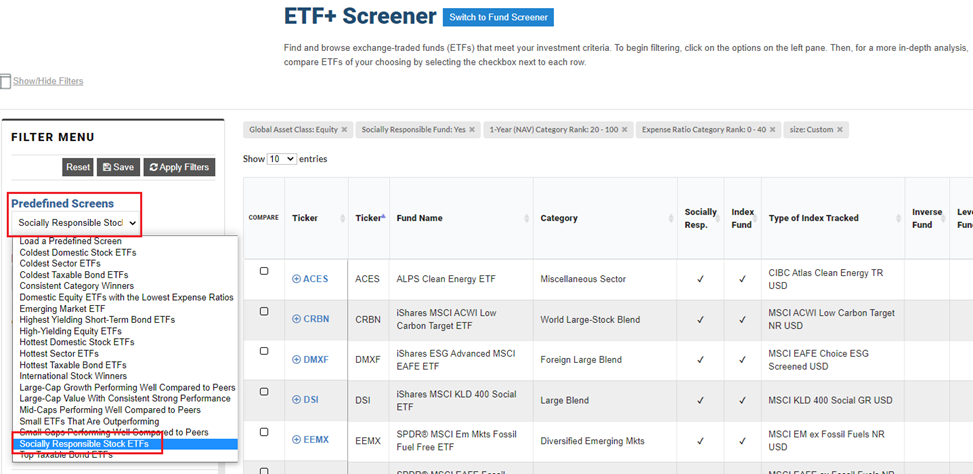
The A+ Investor predefined Socially Responsible Stock ETFs and Socially Responsible Equity Stock Funds screens seek funds classified by Morningstar as following a socially responsible approach to investing. Specifically, they seek socially responsible stock funds with below-average expense ratios. Passing mutual funds have no loads and are also open and available to individual investors.
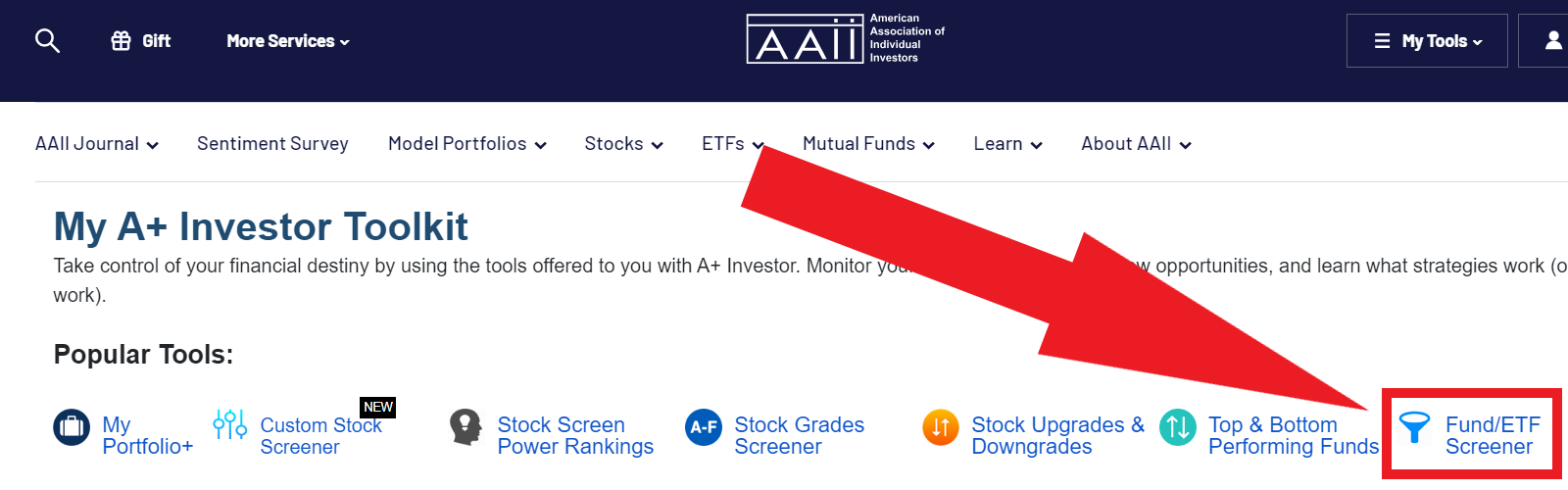
The screens are available to A+ Investor subscribers at the respective Funds+ and ETF+ screeners at the top of the A+ Investor Toolkit dashboard:
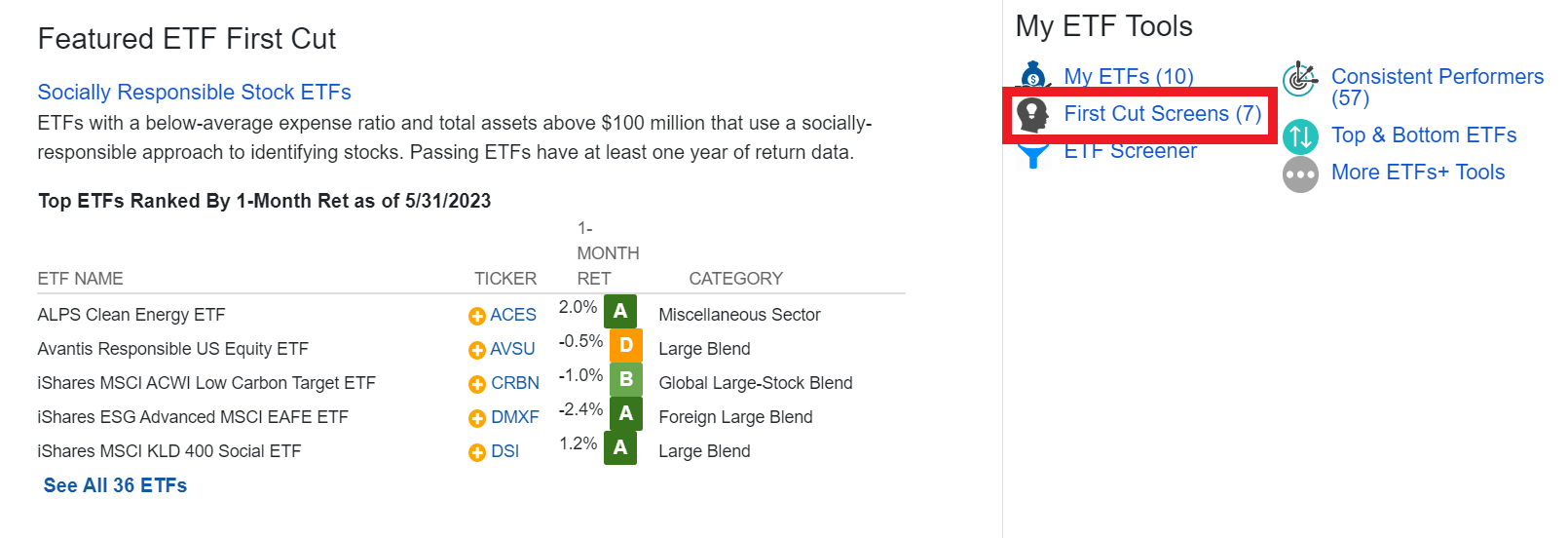
The ESG screens can also be found in the list of Mutual Fund First Cut Screens and ETF First Cut Screens linked under My Fund Tools and My ETF Tools on A+ Investor Toolkit dashboard. These screens can be modified and saved in your list of screens.