A prelude to this week’s commentary: BlackRock made financial news headlines by announcing a change in how some of its active mutual funds will be managed. Rather than rely on human stock picking, the company is shifting to a heavy reliance on quantitative strategies. Commentary about the change was quick to use the word “robots” to describe the funds’ new managers.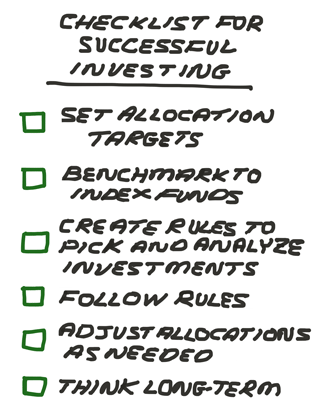
BlackRock’s decision comes as the active versus passive debate continues. Just five days after BlackRock’s announcement, The Wall Street Journal ran an article headlined, “Active Managers Stage a Comeback.” The article, citing data from Morningstar, said that 45% of all active U.S.-based managers (including stock and bond fund managers) beat their respective index alternatives.
Those of you looking at this back-and-forth between the so-called quants and traditional active strategies should realize that you don’t need to have a proverbial dog in this fight. You can choose quantitative strategies or you can choose to use a blend of quant and active. You do this by following a rules-based approach to portfolio management. The checklist displayed to the right is a simplistic, though effective, example of how quantitative and active approaches can be combined into a followable strategy.
At the very top of the list is asset allocation. There are complex mathematical models for how to do this, but ultimately, the proper asset allocation for each person requires active involvement. No mathematical formula can convey the fear you will feel when a bear market causes your net worth to plunge. For most investors, the correct allocation involves an allocation to stocks just below breakpoint where they panic and abandon their strategy during a bear market. Strategies such as keeping a buffer in cash (e.g., one to four years of living expenses for retirees) can push this breakpoint upward, allowing you to allocate more to stocks.
The second step is to fill the portfolio with passive index funds, or at least benchmark to them if an active approach is preferred. Diversified, widely followed index funds (e.g., the S&P 500, the Russell 2000, etc.) should be the default choices unless you have a strategy for realizing high returns, more portfolio income or less volatility. If you are unable to achieve one of these three goals over the long term with an active fund or strategy, go passive. Index investing, which is a form of quantitative investing, has proven to a be a tough benchmark to beat over the long term.
If you want to use active strategies, create rules for how you will select and monitor investments. Regardless of whether you intend to buy individual securities or actively managed funds, have a clearly defined process for how you will identify them, analyze them and determine when it is time to sell them. These rules will take the emotions out of your decisions and will lead to higher returns. Quantitative figures (valuation, momentum, fundamental ratios, a fund’s long-term performance relative to its peers, etc.) work very well at making these rules effective.
Once the rules are created, you must follow them. This may seem like a silly thing to write, but rules only work if they are followed. The advantage of having software make decisions over humans is that software never hems and haws about whether a rules-based action should be taken. Humans can and do look for excuses. (And yes, there are times when it makes sense to break the rules, but those occurrences should be well-defined exceptions—such as selling in response to news about a company’s CEO cooking the books—and not the norm.)
The rules should also include guidelines for how and when your portfolio’s allocation will be adjusted. Fund families using quantitative strategies can have software do this for them. Individual investors can simplify the process by periodically checking allocations against the target. For example, if an asset class (or an individual holding) becomes too excessively weighted relative to your target, pare back your portfolio’s exposure to it.
Finally, think long-term. No approach to investing—be it quantitative, active or a rules-based blend—is going to work all of the time. Investing success comes from the discipline of sticking to a well-thought-out strategy regardless of whether market conditions are favorable or unfavorable.

- The Case for Systematic Decision-Making – Wesley Gray explains that even though human expertise is needed to design models, models perform better than humans.
- Going From Stock Screen to a Real Portfolio – Guidance for how to turn a quantitative approach for finding stocks into a humanly managed portfolio.
- Factors Allow Investors to Think Differently About Diversification – The quantitative approaches used by professionals favor specific characteristics, such as those listed in this article, historically associated with higher returns.
- Model Shadow Stock Portfolio: Handling Major Financial Statement Revisions – Our Model Shadow Stock Portfolio provides a real-life example of how to use a quantitative strategy for running an actual portfolio.
Dow Jones industrial average component JPMorgan Chase (JPM) will report its first-quarter earnings on Thursday. Joining it next week will be fellow S&P 500 members Fastenal (FAST) on Wednesday and Citigroup (C), Delta Air Lines (DAL), PNC Financial Services Group (PNC) and Wells Fargo (WFC) on Thursday.
The week’s first economic reports will be the Labor Department’s February job openings and labor turnover survey (JOLTS), which will be released on Tuesday. Wednesday will feature March import and export prices. The March Producer Price Index (PPI) and the University of Michigan’s preliminary April consumer sentiment survey will be released on Thursday. Friday will feature the March Consumer Price Index (CPI), March retail sales and February business inventories.
The Treasury Department will auction $24 billion of three-year notes on Monday, $20 billion of 10-year notes on Tuesday and $12 billion of 30-year bonds on Wednesday.
- 16 Financial Ratios for Analyzing a Company’s Strengths and Weaknesses
- Factors Allow Investors to Think Differently About Diversification
- How Much Small Cap Should Be in Your Portfolio?
Pessimism among individual investors about the short-term direction of stock prices rose to nearly 40%, according to the latest AAII Sentiment Survey. At the same time, optimism fell below 30%.
Bullish sentiment, expectations that stock prices will rise over the next six months, fell 1.9 percentage points to 28.3%. This is the 11th time out of the last 12 weeks that optimism is at or below its historical average of 38.5%.
Neutral sentiment, expectations that stock prices will stay essentially unchanged over the next six months, declined 0.3 percentage points to 32.1%. The historical average is 31.0%.
Bearish sentiment, expectations that stock prices will fall over the next six months, rose 2.2 percentage points to 39.6%. The increase keeps pessimism at or above its historical average of 30.5% for the eighth consecutive week and the 11th out of the last 12 weeks.
This week’s results put optimism very close to the bottom of its typical range and pessimism very close to the top of its typical range. A bullish sentiment reading below 28.1% would be unusually low (more than one standard deviation below average.) A bearish sentiment reading above 40.0% would be unusually high (more than one standard deviation above average). Of the two, unusually low bullish sentiment readings have a much stronger record as a contrarian indicator, with the S&P 500 realizing a median gain of 6.3% over the following six-month periods.
The potential impact that President Trump could have on the domestic and global economy continues to cause uncertainty or concern among some investors, while encouraging others. At the same time, the prevailing level of valuations and the lack of downside volatility have increased concern about the potential for a forthcoming drop in stock prices.
This week’s special question asked AAII members to explain how the success or failure of the Trump administration’s proposed policies influence their outlook for stock prices. Responses were mixed. Nearly one out of four respondents (24%) think the president’s policies will have a positive impact, particularly those policies that go beyond health care (tax reform, deregulation, etc.). Conversely, nearly 22% think Washington politics could have a negative impact on the market either by allowing his proposals to move forward or by having the proposals snagged in gridlock or otherwise not passed. An additional 11% say President Trump is causing them to be more cautious, with some of these respondents describing him as being too unpredictable. About 19% say the president is not influencing or otherwise factoring into their outlook. Some of these respondents described his rhetoric as just being noise, while others say they are more focused on fundamental factors. A little under 8% say that it is still too early to tell what impact the administration’s policies will have on the market.
Here’s a sampling of the responses:
- “There should be success if taxes are lowered and regulations are reduced.”
- “I believe something ‘crazy’ could happen and lead to investors panicking.”
- “Not at this time—it’s all political hot air. Stock prices reflect relative value and earnings growth.”
- “Success—good; failure—bad.”
- “If he cannot break the legislative logjam, we are headed for a recession.”
- “The outlook for stock prices is uncertain since the details of the Trump administration’s policies and how they will be implemented are yet unknown.”

Bullish: 28.3%, down 1.9 points
Neutral: 32.1%, down 0.3 points
Bearish: 39.6%, up 2.2 points
Bullish: 38.5%
Neutral: 31.0%
Bearish: 30.5%
AAII Asset Allocation Survey
Equity allocations among individual investors rose to their highest level in nearly two years, while cash allocations fell to a two-year low. The March AAII Asset Allocation Survey also shows slightly lower fixed-income allocations.
Stock and stock fund allocations rose 2.1 percentage points, to 67.6%, after having declined during the three previous months. Equity allocations were last higher in May 2015 (67.7%). March marked the 48th consecutive month with equity allocations above their historical average of 60.5%.
Bond and bond fund allocations fell 0.3 percentage points, to 17.0%. Even with the small decline, March was the 19th out of the past 20 months that fixed-income allocations were above their historical average of 16.0%.
Cash allocations fell 1.7 percentage points, to 15.5%. Cash allocations were last lower in March 2015 (14.9%). The decline keeps cash allocations below their historical average of 23.5% for the 64th consecutive month.
To put last month’s equity allocation into perspective, stock and stock fund allocations have mostly exceeded 64% on a combined basis over the past 12 months. The high water mark for the current bull market is 68.6% (March 2015). Prior bull markets have seen equity allocations exceed 70%, however.
Last month’s rise in equity allocations occurred despite a generally cautious outlook for the stock market. Optimism, according to our weekly Sentiment Survey, was below average throughout most of March. Many individual investors find themselves choosing between high valuations for stocks and low interest rates for bonds and cash savings. At the same time, much focus remains on Washington and how the Trump administration’s policies will affect economic growth.
Last month’s special question asked AAII members to describe the impact that the Federal Reserve’s rate hikes are having on their asset allocation decisions. More than half of all respondents (57%) said that the rate hikes are either not affecting or are only having a minimal impact on their allocation decisions. Among the reasons given were the small size of the rate hikes, expectations for rates to be raised and a greater focus on the Trump administration’s policies. Slightly more than 11% said that they are allocating more to fixed income, particularly short-term bonds and bond funds. About 10% said that they are reducing their exposure to equities, while 8% are reducing their exposure to or are purposely avoiding bonds and bond funds. About 8% of respondents are increasing their cash allocations.
Here is a sampling of the responses:
- "None, as long as the hikes are minimal and spread out.”
- "Slightly reducing my stock funds (risk) and slightly increasing my bond fund allocation.”
- "If 0.25% and invoked gradually, I will maintain my current allocation rebalancing as is necessary.”
- "It makes it easier to allocate funds to bond-like assets.”
- "Very little. I’m much more concerned about upcoming events in the Trump Administration’s interaction with Congress over the next one to two years.”
- "Holding cash instead of bonds until Fed normalizes interest rates.”
- Stocks and stock funds: 67.6%, up 2.1 percentage points
- Bonds and bond funds: 17.0%, down 0.3 percentage points
- Cash: 15.5%, down 1.7 percentage points
- Stocks: 28.2%, up 1.2 percentage points
- Stock Funds: 39.4%, up 0.8 percentage points
- Bonds: 4.9%, up 1.6 percentage points
- Bond Funds: 12.1%, down 1.9 percentage points
Take the Asset Allocation Survey.
Local Chapter Meetings

March 30, 2017 The Small-Cap Premium Still Lives on the Value Side
March 23, 2017 Helpful Steps My Late Father-in-Law Took
March 16, 2017 Rate Hikes, Inflation and What You Earn
March 9, 2017 The Bull Turns 8 Years Old: Five Observations and Suggestions